According to electrek, recently, the TÜV Association, Germany’s mandatory vehicle safety inspection agency, released its 2026 annual report.The report not only ranked the Tesla Model Y as the least reliable car in its age group, but also noted that it had the highest defect rate of any vehicle tested over the past decade.
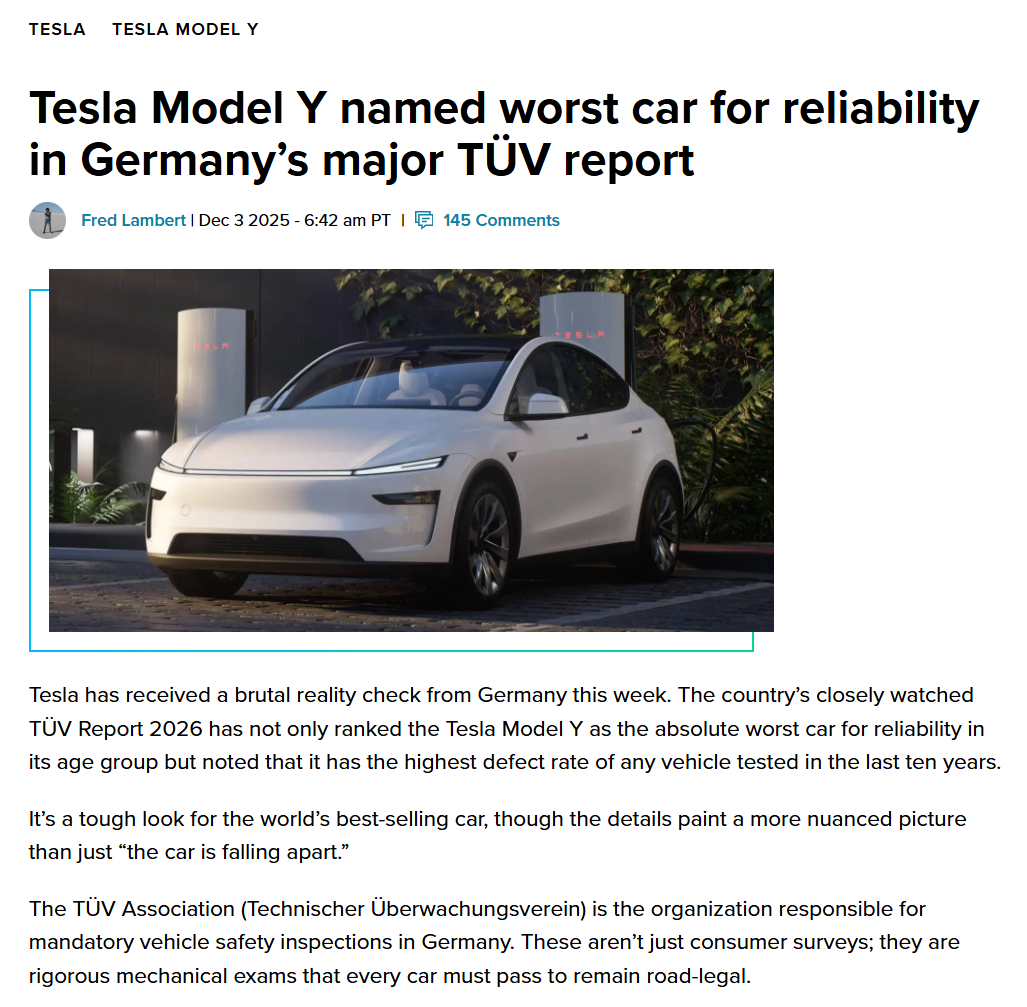
The report said they analyzed vehicle inspection data from 9.5 million vehicles and found that the Tesla Model Y ranked last among cars that were 2 to 3 years old.
According to the data, 17.3% of Model Ys failed inspection due to "serious" or "dangerous" defects. For reference, the average failure rate for this age group is about 6.5%.
In other words, Tesla Model Y not only had a high failure rate, but also achieved TÜV’s worst score in ten years with extremely poor performance.
At the same time, Tesla Model 3 also performed poorly, ranking third from the bottom with a failure rate of 13.1%.
In addition, the report also shows thatTesla's suspension components and braking systems are among the hardest-hit areas with high failure rates.
TÜV inspectors noted frequent problems with Tesla suspension components, with nearly one in five cars failing the first mandatory inspection, such as control arm bushings that have long plagued Tesla owners.
Moreover, they also found serious problems with the brake discs. Since electric vehicles mainly use kinetic energy recovery braking for deceleration, physical braking hardware is rarely used.
But in Germany's humid climate, this causes the brake discs to rust and corrode, causing them to fail safety inspections even if they still work mechanically.
In comparison, other electric vehicles performed well. The BMW Mini Cooper SE had a defect rate of 3.5% and the Audi Q4 e-tron had a defect rate of 4.0%. This also proves that the above problem is not an "electric car problem" but a specific Tesla problem.