Musk’s brain-computer interface will begin mass production this year. On the first day of the new year, Lao Ma set a high-profile flag onTaking Neuralink from the laboratory to the clinic: Neuralink will begin mass production of brain-computer interface devices in 2026 and move to a streamlined, almost fully automated surgical process.
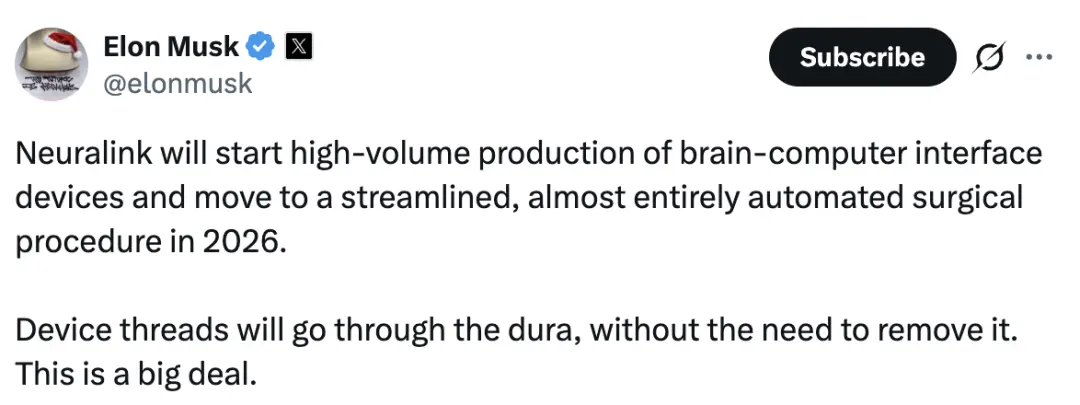
The news has just come out, and netizens have already opened their minds and imagined various ways to play:
Can you put a Grok 4 in my head?

Imagine vibe coding directly through the brain-computer interface...

I need one click to fall asleep and a permanent pleasure mode.

Who would have thought that after just ten years of development, Neuralink is actually preparing to move from the laboratory to the clinic.
An important turning point in brain-computer interface
This is not the first time that Lao Ma wants to mass-produce Neuralink.
As early as July 2024, Musk revealed that Neuralink is expected to serve more than 1,000 people by 2026.
Four months after the news was announced, Neuralink began to expand its team and focus on recruiting manufacturing technicians and micro-nano processing experts to pave the way for mass production in advance.
But as of September 2025, Neuralink has served only 12 patients.
Considering the huge market demand, this phenomenon is undoubtedly a bit abnormal. For neurological diseases, brain-computer interface is almost the most potential and even the only effective solution at present.
Why has it not been implemented yet?
Technology maturity is always an unavoidable factor. But for applications, the more realistic challenge may not be the chip, but the surgery itself.
According to the existing plan, the implantation surgery requires the surgeon to first remove part of the skull and part of the dura mater, and then use a robotic arm to implant ultra-thin electrode wires into the brain.
This process is quite complex, varies greatly from person to person, and relies heavily on the doctor's experience. So it's hard to scale.
Musk said that by 2026, Neuralink's implant surgery will be upgraded to a "highly simplified, almost completely automated process."
The core of this "simplification" lies in the way in which the electrode wires of the brain chip enter.
In this official announcement of mass production, Musk said that the brain chip electrode wires will directly pass through the dura mater without the need to remove it.
The dura mater covers the surface of the brain and is a natural barrier between the skull and brain tissue. It can isolate foreign matter from invading and prevent infection.
But this protective layer also hinders the implantation of medical devices. To insert something into the brain, this membrane usually has to be cut open. This makes the operation more difficult, and infection and bleeding can easily occur if done improperly.
The more "minimally invasive" method of the new technology allows the electrode wire to pass directly through the "door crack" without having to "open the door and enter the house." This means lower costs, smaller risks, shorter recovery cycles, and therefore a lower threshold for standardization.
As Musk said:
This is a big deal.
Founded in 2016, Neuralink is committed to allowing people to directly control computers through neural signals through coin-sized brain chips.
Given its location away from the brain, this brand-new technology showed great potential in the medical field from the first day it was born. With the help of the brain-computer interface bridge, for the first time the brain is no longer a "black box", but an engineering system that can be disassembled.
At present, Neuralink's product focus is still focused on the treatment of neurological diseases, including paralysis, muscular atrophy, Parkinson's disease, Alzheimer's disease and visual impairment.
In January 2024, former chess player Noland Arbaugh, who was paralyzed due to a diving accident, became Neuralink's first volunteer.
After the operation, the patient, who was completely unconscious from the shoulders down, was able to post on X and even play "Mario Kart" using only a chip implanted in his brain.
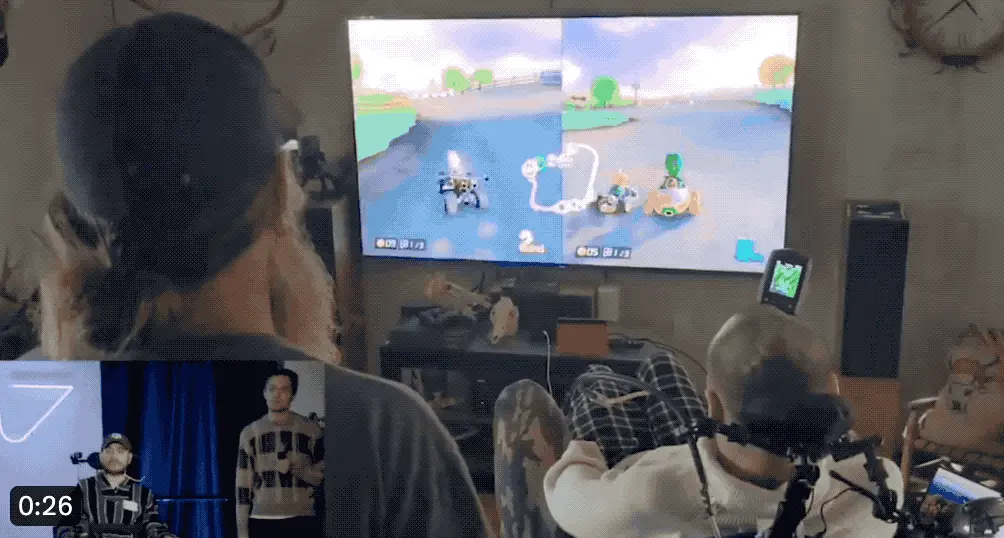
Noland said,Neuralink gives him a new life.
If Neuralink can really lower the threshold and price of this surgery through large-scale production, it will undoubtedly be a fate-changing event for thousands of "Nolands".
But for Musk, Neuralink’s territory also includes a new continent that is as vast, mysterious and unexplored as medical science – cyborg.
In Musk's view, Neuralink is not just a medical device, but an important self-defense weapon for humans to deal with potential "evil AI".
He believes that on the day when ASI will inevitably appear, humans will not become "captive pets" unless they have high-bandwidth interfaces comparable to silicon-based intelligence.
in short:If you can't beat it, join.
And once everyone can directly connect to the Internet through a brain-computer interface, the speed of human progress will no longer be limited by genes and time. RatherLike software, you can update your skill reserves through OTA at any time.
By then, human civilization will usher in a major explosion.
Perhaps in the future, your grandchildren will have a hard time understanding that there was a time when the human brain was unable to download skills.

But back to reality, judging from existing technological progress and public industry research,Automated brain-computer interface implant surgery remains experimental.
After all, the target of surgery is the brain. Once a mistake occurs, the risks and consequences are far beyond those of ordinary surgery.
At least for now, autonomous neurosurgery involving brain implants such as Neuralink remains unproven outside of a controlled experimental setting.
Running Neuralink
Neuralink, which set the flag of "large-scale production", was established in 2016.
In the ten years of rushing towards clinical trials, Neuralink has also passed all the tests -
In 2019, animal experiments were demonstrated for the first time.
In 2020, a piglet equipped with a brain-computer interface device will be displayed.
In 2021, monkeys were successfully allowed to play table tennis with their thoughts.
In 2022, the experiment caused controversy, progress was slower than expected, and FDA approval was blocked.
In 2023, we will reach an inflection point and receive FDA approval to conduct human clinical trials.
In 2024, the first patient, Noland Arbaugh, received an implant and posted and played games through brain signals.
In 2025, the popularity will begin to accelerate.
In September, it was announced that 12 subjects had been implanted; in December, this number had become 20.
At the beginning of 2026, it was announced that large-scale mass production would be achieved within one year.
In two years, it went from the first human trial to 20 participants to the preview of mass production. Along the way, Neuralink has actually been promoting the standardization of surgical procedures and preparing for the application stage.
In the 1980s, Steve Jobs once compared personal computers to "bicycles for the mind."
Ten years later, people built the "highway" of the Internet.
But even so, most white-collar jobs are still highly dependent on human labor. We need to "pedal" hundreds of kilometers ourselves to reach our destination.
Now, Musk plans toUse brain-computer interface to build this highway directly into the human brain.