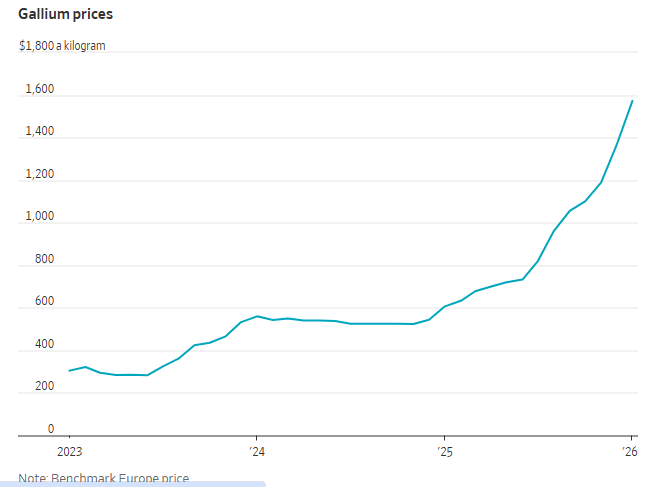
Gallium is a strange, silvery-white metal with a melting point so low it can melt in the palm of your hand. In the past two years, the rise in gallium prices in the international market has almost easily "burned" to the boiling point.Market data shows that the price of low-purity gallium in Rotterdam, the international benchmark, has increased nearly three times in the past two years. According to data from Argus Media, the average price hit a record high of about $1,572 per kilogram in January this year.
At present, gallium is undoubtedly widely used in global science and technology and military fields.Gallium can be made into high-performance semiconductor substrates after being treated with nitrogen and arsenic; in the field of chips, gallium can withstand high currents and is more resistant to high temperatures and moisture than silicon. In addition to cell phones and laptops, satellites also use gallium to protect components from space radiation.
China has an almost absolute dominant position in gallium production, accounting for more than 90% of global primary production. As the global gallium supply and demand situation becomes increasingly tight, the U.S. government is now showing an unprecedented sense of urgency.
In the past few months, the U.S. government has invested hundreds of millions of dollars in factories in the United States and overseas, seeking to establish its own gallium supply chain to reduce dependence on imports. It is also trying to completely reshape the global gallium supply chain through a three-pronged "gallium mining" strategy of "overseas layout, cross-border cooperation, and domestic recycling."
The moves to boost gallium production are part of the Trump administration's efforts to secure rare earths and critical minerals for the defense, automotive and technology industries. The efforts also include providing billions of dollars in financing and helping the U.S. build strategic reserves of products such as lithium, cobalt and nickel.
Overseas layout
One of the projects supported by the Trump administration is located in Wagerup, Western Australia (Australia's largest state). Since the 1980s, Alcoa has operated a refinery here that produces alumina by processing bauxite. Since bauxite contains trace amounts of gallium, the company plans to build a new plant to extract it.
The U.S. government plans to join forces with Australia and Japan to provide financial support for the project. Alcoa said that in return, the three governments would receive part of the gallium metal produced by the plant.
Alcoa predicts that the plant will eventually produce about 100 metric tons of gallium per year., meeting 10% of global gallium demand. For comparison, global gallium production in 2024 will be 760 metric tons.
“We have known for many years that gallium can be extracted from the production process,” Alcoa CEO William Oplinger said in a recent interview. “If global demand for gallium increases significantly and it is economically feasible, we can do the same at other refineries.”
transnational cooperation
The United States is also actively increasing its gallium supply through domestic investment.
At the end of last year, the U.S. Department of Defense invested $1.9 billion with private investors to take a stake in a joint venture with South Korea Zinc, helping the Seoul-based company acquire U.S. zinc mines and smelters.
South Korea Zinc plans to extract gallium and about a dozen key metals from zinc ore refining residues at a plant in Tennessee, USA. Another $4.7 billion in private and government loans will help South Korea's zinc industry build smelters and carry out complex metal separation processes.
It is reported that the Tennessee project is expected toIt could produce up to 54 tons of gallium per year from 2030.
Domestic recycling
Another gallium recycling program is underway in Louisiana, which has the nation's only alumina refinery.Atlantic Alumina, located between New Orleans and Baton Rouge, is planning to expand its production of alumina, a key raw material for aluminum smelting, and add gallium processing equipment.
For years, Atlantic Alumina has been stockpiling so-called "red mud," the waste material left after converting bauxite into alumina. But the company has not previously had the ability to further extract substances like gallium from red mud.
The U.S. Department of Defense got involved. The US government will invest US$150 million in Atlantic Alumina to support its planned US$450 million expansion and gallium project.The company expects to produce about 50 tons of gallium per year.
Costs and Risks
Global gallium demand will grow by about 24% by 2030, according to forecasts by Finnish critical minerals consultancy Rovjok.
However, Rovjok's estimate also shows that the cost of manufacturing gallium in the United States will be more than 20% higher than in China.
Ian Lange, professor of economics at the Colorado School of Mines, warned:Moves by the U.S. and other countries to increase gallium production could lead to an oversupply of the metal."The market is so small, it will collapse," he noted.