Recently, Unity announced that it will expand its official support for the Steam platform to cover native Linux, Steam Deck, and the upcoming Steam Machine. According to Unity’s James Stone, developers have already released games through Steam, but previous Steam support was not officially provided by Unity, but was integrated by developers themselves through Steamworks.
Stone said that Unity plans to not only provide build targets for Steam, but also directly support the Steam Deck and the upcoming Steam Machine. He added that Unity will make targeted optimizations for its Linux runtime to improve the performance of native applications and reduce dependence on running Windows versions through Proton.
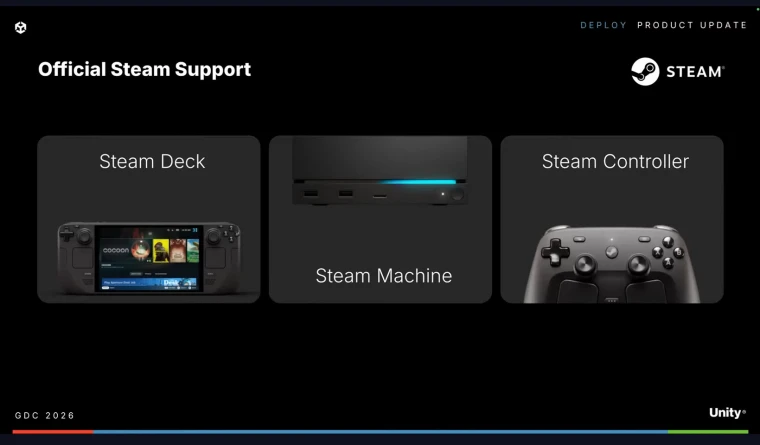
Unity also revealed that some native Linux player improvements for Steam Deck hardware are available starting today. Stone said that these changes may lead to higher performance than Proton in some cases, but Unity did not release relevant benchmark data with the announcement.
This update is based on the existing Steamworks Platform Toolkit. Unity's Steamworks Platform Toolkit 1.0.1 documentation already contains standalone Steamworks packages, bindings for Steam build target platforms, and support instructions tested with Steamworks SDK 1.62. This means that the official announcement at GDC is not the starting point for Unity tools to support Steam, but a further expansion of support for native Linux and SteamOS platforms.
For developers, this could mean less extra work deploying Steam and Linux versions. For Steam Deck users and future Steam Machine users, the more critical question is whether the studio will choose to release a native version, or continue to rely on Proton, the current mainstream way to run Windows games on SteamOS.