Amid growing concerns that a "jobs apocalypse" could engulf the broader economy, Andrej Karpathy used artificial intelligence to assess which U.S. occupations are most vulnerable to the technology's impact. Over the weekend, the OpenAI co-founder and former Tesla AI director released a chart using data from the U.S. Bureau of Labor Statistics to show the extent to which various industries are affected by AI and automation.
The scores for different occupations range from 0 to 10, with 10 representing the highest risk of impact.
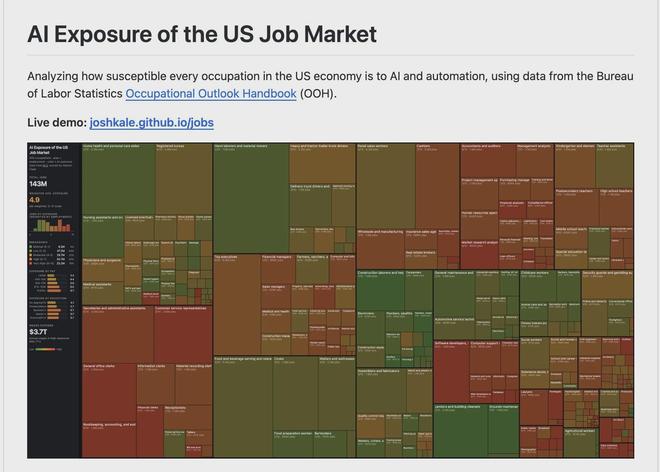
The data shows that while the overall weighted risk score is 4.9, occupations with an annual salary of more than $100,000 have the highest average score (6.7 points), while occupations with an annual salary of less than $35,000 have the lowest risk score (3.4 points).
His chart quickly gained traction online, with many predicting the end of white-collar workers. But Capas quickly deleted the data.
“This is a little project I spent two hours on a Saturday morning using ‘vibecoded’ inspired by a book I was reading,” he explained on X on Sunday morning. “I thought the code and data would help others visually explore the Bureau of Labor Statistics data set, or color it in different ways, or swap out prompt words. (Prompts), and even added their own visualizations. It turned out that this set of data was seriously misinterpreted (even though I wrote the documentation, I should have expected this), so I took it down.”
He did not respond to questions about how the data had been misinterpreted and what the correct interpretation should be.
Still, the archived version of the chart is perhaps not surprising, as it echoes previous views on how AI will reshape the U.S. labor market.
For example, software developers, computer programmers, database administrators, data scientists, mathematicians, financial analysts, legal assistants, writers, editors, graphic designers, and market researchers all received a score of 9.
This is because cutting-edge AI tools are increasingly being used to crunch data and generate content. Tasks that once took knowledge workers hours, days or even weeks to complete, AI can now complete in just minutes.
While AI is seen as a productivity booster for senior workers, there is growing evidence that businesses need less junior workers. More companies are blaming AI as they announce layoffs, although skeptics say it's just a scapegoat to correct over-hiring during the pandemic.
Meanwhile, Capas' chart shows construction workers, roofers, painters, cleaners, ironworkers and groundskeepers scoring just one point. Likewise, home health aides, nursing assistants, massage therapists, dental hygienists, veterinary assistants, manicurists, barbers and bartenders received only 2 points.
Earlier this month, Anthropic released a report titled "Labor marketimpacts of AI: A new measure and early evidence." Research has found that current practical applications of AI represent only a tiny fraction of its theoretical potential.
Similar to Karpas' data, the Anthropic paper states that AI could theoretically cover most tasks in business, finance, management, computer science, mathematics, law and administrative offices. While adoption of AI still lags, Anthropic said the groups most at risk are older, highly educated and well-paid workers.
Earlier this year, a widely circulated Citrini Research article painted a catastrophic picture of AI destroying the economy, triggering a stock market selloff.
But Citadel Securitie quickly dismissed such doomsday talk in a scathing report. The report pointed out that data from the Indeed recruitment platform shows that since 2026, the demand for software engineers has actually increased by 11% year-on-year.
Citadel also pointed out that the daily use of generative AI in the workplace has remained "surprisingly stable" and that there is currently "little evidence of imminent job replacement risks." Contrary to talk of an economic collapse, the number of new startups in the United States is increasing rapidly, and the construction of large-scale AI data centers is also driving a construction hiring boom in local areas. Furthermore, if automation expands at the breakneck pace Citrini fears, demand for computing power will inevitably surge, pushing up its marginal cost.
Citade said: “If the marginal cost of computing power for certain tasks exceeds the marginal cost of human labor, substitution will not occur, which will form a natural economic boundary.”