Intel shares surged 9% in pre-market trading on Thursday after U.S. President Donald Trump announced a partnership between Intel and Apple to design and manufacture chips in the United States. Trump posted on the Truth social platform: "Presidents have ignored their own economies and allowed Taiwan and other regions to steal our semiconductor factories. Now Apple has agreed to join hands with Intel to design and produce self-developed chips in the United States."
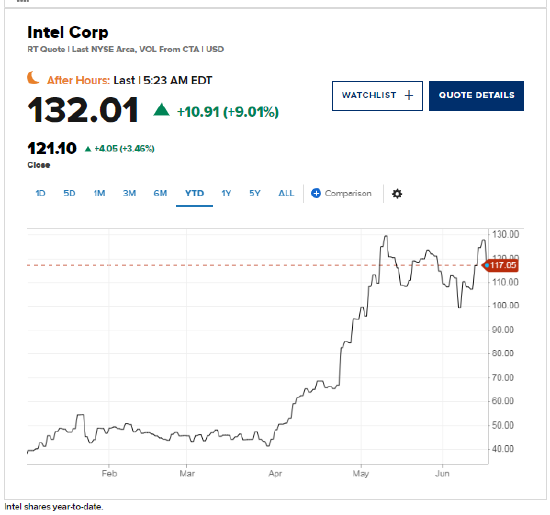
After years of sluggish development and losing its industry dominance, Intel's stock price has been rising recently. Intel's stock price has soared 464% in the past 12 months, with the company's latest market value reaching $608.7 billion.
In pre-market trading, Intel shares were last up 8.8%, while Apple shares rose 0.6%.
Consumer News and Business has reached out to Intel, Apple, the White House andTaipei Economic and Cultural Representative Office in the UKComment for verification.
Year-to-date Intel stock price trend
In the past few years, Intel has been deeply troubled by process delays, has been unable to secure major customers for its foundry business, and has been absent from the artificial intelligence chip competition for a long time.
However, since Chen Liwu became CEO early last year, Intel has successively received investments from Nvidia and the Trump administration, and the troubled chip manufacturer has regained the favor of Wall Street capital.
Trump said on the Truth social platform on Thursday: "I decided to support the development of Intel because we must complete the design and manufacturing of chips in the United States. First, we facilitated the implementation of NVIDIA, and NVIDIA has confirmed to entrust Intel to OEM its high-end chips; next, Elon Musk finalized the terawatt-level chip factory project. The world's largest chip manufacturing plant will be jointly designed and implemented with Intel's technical team."
The Terafab project is the first major external cooperation order for Intel's asset-heavy wafer foundry business. Previously, Intel's wafer production capacity was only used for its own chip production.
Although the conflict in the Middle East continues to disrupt the global supply chain and push up international oil prices, the boom in the artificial intelligence industry has provided support to the technology sector, especially the strong stock price performance of computing infrastructure-related chip companies.
The Nasdaq Philadelphia Semiconductor Index includes the 30 largest listed chip companies in the United States. The index has increased by 90% during the year.