Google announced the launch of the Android Developer Verification Program last year, aiming to improve the security of users when installing applications from third-party channels (sideloading). Earlier this year, Google said that Android users would be forced to wait 24 hours before sideloading apps from unverified developers. Now the company has further announced a detailed schedule for this series of sideloading rule adjustments.

Starting this month, Google will push a new system service to most Android devices, which will be installed automatically and used to verify developer registration identities later this year. This is the basic component for the implementation of subsequent sideloading restrictions and developer authentication mechanisms.
Starting in July, Google will launch the Android Developer ID Status API globally and open early access to the Android Developer Console API. At the same time, early trials will also be launched for "limited distribution accounts" for students, enthusiasts, and learners, which can distribute apps to up to 20 devices without submitting government-issued ID or paying fees.
In August, Google plans to officially launch "limited distribution accounts" globally and launch a new version of the Android Developer Console API. In addition, Google will also launch an "advanced process" for "advanced users" to install applications from unverified developers, retaining a certain degree of sideloading flexibility for experienced users.
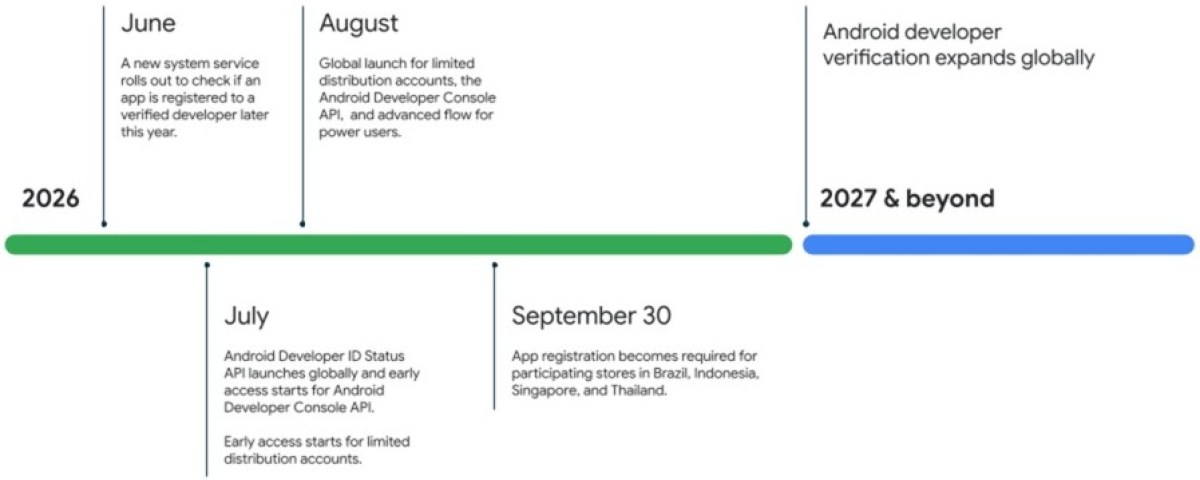
Starting from September 30, a new round of developer verification protection mechanisms will first take effect in Brazil, Indonesia, Singapore and Thailand. By then, application distribution in participating app stores (including Google Play Store, Honor App Store (Honor), Oppo App Store owned by OPlus, Samsung Galaxy Store, vivo's V-Appstore, Transsion's Palm Store, and Xiaomi App Store GetApps) will require developer registration.
Nonetheless, users can still sideload unregistered apps through Android Debug Bridge (ADB) or the "advanced process" mentioned above, and the technical path for developers and advanced users will remain. Google also gives a time window: If you distribute apps in Brazil, Indonesia, Singapore or Thailand through the above-mentioned app stores, you need to complete developer verification before September.
Google said it will expand Android developer verification requirements to the world in 2027. Before that, it will adjust and improve the rules based on feedback from partners, users and the developer community. Officials hope that by advancing in stages, they can improve security while taking into account the actual needs of different regions and different types of developers.