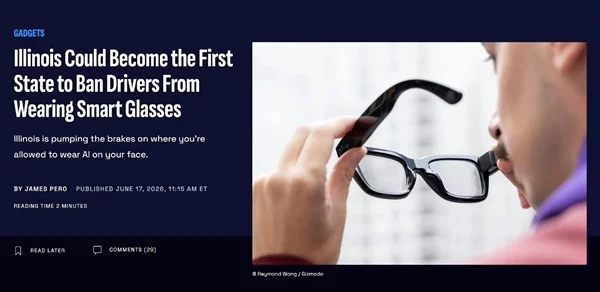
Recently, the Illinois State Assembly in the United States officially passed an amendment to traffic regulations, which for the first time explicitly included smart glasses in the category of prohibited electronic devices for driving.The bill has been submitted to the governor for signature. Once it takes effect, Illinois will become the first state in the United States to explicitly ban the wearing of smart glasses while driving..
By expanding the current definition of "electronic devices prohibited while driving", the bill specifically excludes the hands-free exemption for smart glasses, and the control standards are stricter than those for car-mounted mobile phones:
Regardless of whether the smart glasses have a display or whether they have AR functions, all categories of smart glasses are within the prohibited range;
Even if the device is in hands-free voice control mode and only uses the audio function, it is still prohibited to wear it while driving;
Even if the vehicle is parked due to traffic jams and the transmission is in neutral or park, smart glasses are not allowed to be worn - this provision also does not apply to ordinary mobile phones (hands-free mobile phones are usually exempted when parked).
The fine for the first violation is US$75 (approximately RMB 508), and the fine for second and subsequent violations doubles to US$150. If wearing smart glasses directly causes a traffic accident with serious casualties, the minimum fine is increased to US$1,000, and the driver may also be held responsible for misdemeanor or even felony criminal liability.
The core reason for supporting the legislation is to prevent distracted driving: The sponsor of the bill believes that smart glasses project display information directly into the driver's field of vision, which is more concealed and more continuous than looking down at a mobile phone.
Even if the manufacturer labels it "for navigation only", it cannot restrict users from dangerous behaviors such as viewing messages and playing videos. Therefore, banning it directly from the source can better ensure road safety.