Engineers at Duke University in the United States have created the fastest pyroelectric photodetector ever recorded. This device "senses" light signals by capturing the heat converted into light after it is absorbed. This new ultra-thin sensor can operate at room temperature, requires no external power supply, and can be integrated into a chip system to respond to light from almost the entire electromagnetic spectrum. It is expected to promote the development of a new generation of multispectral imaging technology. Relevant research results have been published in the journal Advanced Functional Materials.

Currently, most digital camera equipment relies on semiconductor light detectors to convert visible light falling on their surfaces into electrical current, which is then processed by electronic circuits to form images. The working band of this type of device is similar to that of the human eye, mainly concentrated outside the limited visible light range, and often "turn a blind eye" to electromagnetic radiation in other bands. In order to detect a wider band, researchers usually use pyroelectric detectors: when the material absorbs light, its temperature increases, producing an electrical signal.
However, traditional pyroelectric detectors have long been inferior to semiconductor solutions in terms of response performance. In order to obtain sufficient signal, the device often requires a thick absorption layer or very strong incident light, which makes the overall volume bulky and the response speed slow. Maiken Mikkelsen, professor of electrical and computer engineering at Duke University, points out that commercial pyroelectric detectors have limited responsiveness and "either require very bright light or a very thick absorber layer, which is naturally slow because heat itself doesn't travel very quickly."
The Duke team's breakthrough came from a structural design called a "metasurface." The researchers precisely arranged a large number of silver nanocubes on top of an extremely thin gold film, separated by a transparent layer about 10 nanometers thick. When light strikes these nanocubes, it excites electrons in the silver, trapping the light energy in the local structure through a plasmon effect. The specific wavelengths that are captured depend on the size and spacing of the nanocubes, allowing the frequency of absorption to be controlled through engineering of the nanostructures.
Because this nanostructure is so efficient at "capturing" light, researchers only need to place an extremely thin layer of pyroelectric material underneath it to generate a strong enough electrical signal. The team first demonstrated this idea back in 2019, although its response speed was not measured at the time. “Thermal photodetectors should theoretically be very slow, so the whole field was surprised when we found that it exhibited time scales close to those of silicon photodetectors,” recalls Mikkelsen.
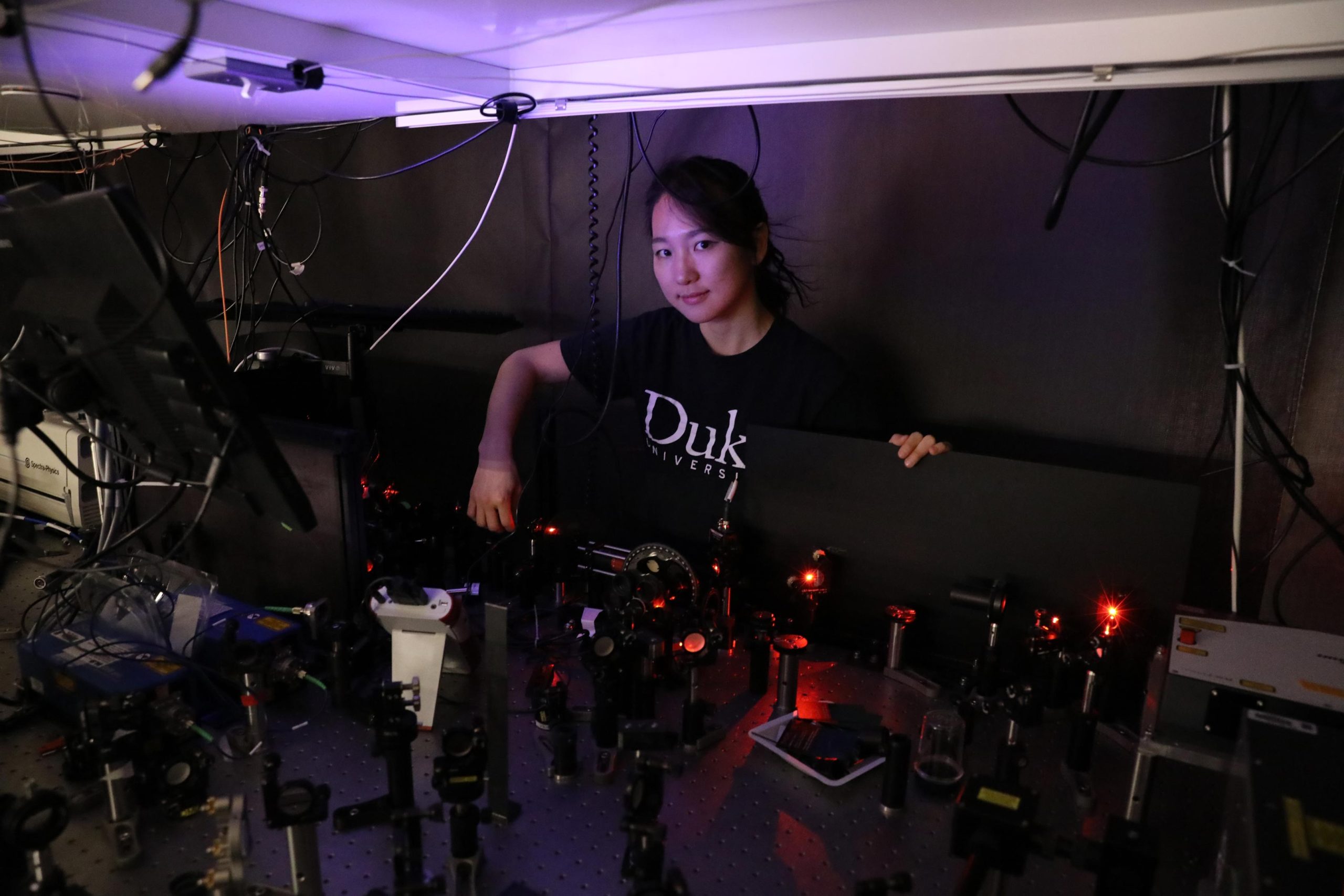
In recent years, Eunso Shin, a doctoral student in Mikkelsen's team, has further optimized the device structure and designed a lower-cost test solution to measure its ultimate speed without relying on expensive professional instruments. The upgraded design uses a circular metasurface instead of a rectangular structure, which on the one hand increases the effective capture area for incident light and on the other hand shortens the signal transmission path inside the device. The team is also working with collaborators to introduce thinner layers of pyroelectric materials and improve the design of circuits used to read and transmit signals.
During the test session, Shin built an experimental platform consisting of two distributed feedback lasers. As the laser frequency gradually approaches the working limit of the photodetector, the response of the device's output signal will change significantly, from which its true working speed can be deduced. The results show that the new photodetector can operate at frequencies up to 2.8 GHz, which means it can convert incident light into a measurable electrical signal on a time scale of about 125 picoseconds.
"Pyroelectric photodetectors usually operate in the nanosecond to microsecond range, and this time the results are hundreds or even thousands of times faster," Shin said, noting that the team is still working to further increase the speed while exploring the upper speed limit of the physical mechanism of pyroelectric photodetectors.
Looking forward to application prospects, the researchers believe that by further "packing" the pyroelectric material and readout circuit into the narrow space between the nanocube and the gold film, it is expected to continue to compress the device thickness and improve performance. In addition, they are also exploring the use of multi-layer metasurface structures so that a single device can detect multiple wavelengths and their polarization states simultaneously. As subsequent design iterations and manufacturing processes mature, this technology is expected to lead to a new generation of powerful multispectral imaging systems.
Since such detectors do not require external power supply when working, they have the potential to be deployed on drones, satellites and various spacecraft to perform long-term, highly maneuverable remote sensing missions. In precision agriculture scenarios, unmanned platforms equipped with this imaging system can identify which crops require irrigation or fertilization in real time, achieving more precise resource management. Mikkelsen believes that once devices can detect enough frequencies simultaneously, "it will open the door to applications such as skin cancer diagnosis, food safety detection, and remote sensing vehicles. These are still on the way, but that is the direction we are heading."