The price increase of memory chips, represented by memory and flash memory, is intensifying, and there is still no sign of price stabilization. Companies such as Samsung and SK Hynix have even stated that they will be out of stock before 2028 or 2030. These companies can earn more than five times their net profits this year just by rising memory prices.
Micron, the world's third largest memory giant, also recently released a financial report with explosive performance.Revenue for the Q2 fiscal quarter ended February 26 nearly tripled year-on-year to approximately US$23.9 billion.Adjusted earnings per share (EPS) on a non-GAAP basis was $12.20, both significantly higher than market expectations.
The profit is even more surprising,Non-GAAP gross profit margin rose to 74.9%, a significant increase from 56.8% in the Q1 fiscal quarter, much higher than the 37.9% in the same period of the previous fiscal year. The non-GAAP operating profit margin also increased to 69.0%, which is almost the same as NVIDIA's AI GPU.
Micron's forecast for the next fiscal quarter is also much higher than expected. The median revenue in the third fiscal quarter is US$33.5 billion, which is more than 41% higher than the average analyst estimate of approximately US$23.7 billion. The median non-GAAP EPS in the third fiscal quarter is expected to be US$19.15, which is nearly 70% higher than the US$11.29 expected by analysts.
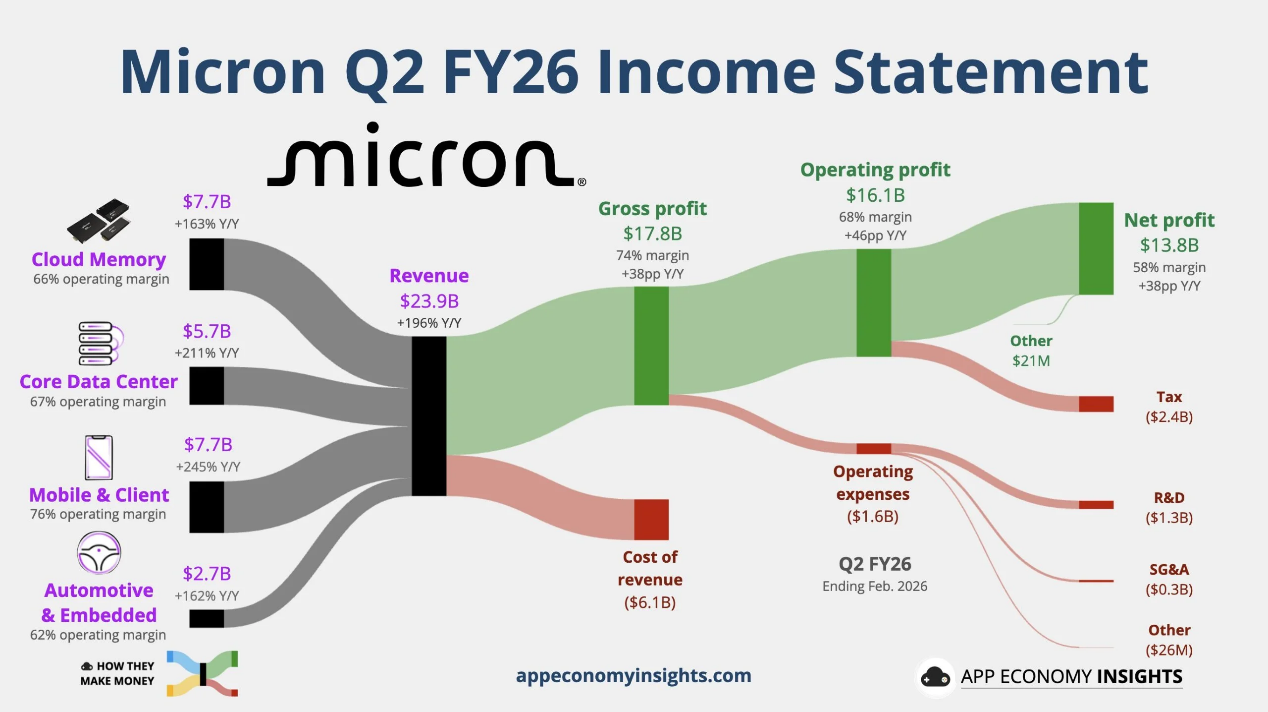
In addition to its eye-catching financial reports, Micron has also elevated the importance of memory.Memory is clearly defined as a strategic material in the AI era, and the supply shortage will remain until at least 2027.
Micron said that the memory output value (bit TAM) used in data centers will exceed 50% of the memory chip output value for the first time, which means that the market focus has shifted from the previous PCs and mobile phones to AI data centers.
With this change, when looking at the prosperity of the memory chip market in the future, shipment volume is no longer the key, but indicators such as the content of single-machine memory chips, the proportion of high-end products, and the proportion of data centers.
The current demand is not just due to insufficient HBM. DDR5, LPDDR, NAND, and SSD are also expanding due to AI database, KV Cache, and storage upgrades. AI promotes the overall upgrade of memory chips.
In previous reports, we mentioned that Samsung has begun to sign 5-year long-term agreements with customers in order to lock in long-term orders. Micron is no exception, and has signed its first 5-year long-term agreement customer. The specific customer has not been announced, but this means that the memory industry will shift from the previous short-term fluctuations in spot prices to long-term stability.