A research team from Northumbria University in the UK used the most advanced James Webb Space Telescope (JWST) to provide a key answer to a problem that has puzzled the planetary science community for decades: Why does Saturn's rotation speed appear to "change" depending on different measurement methods?
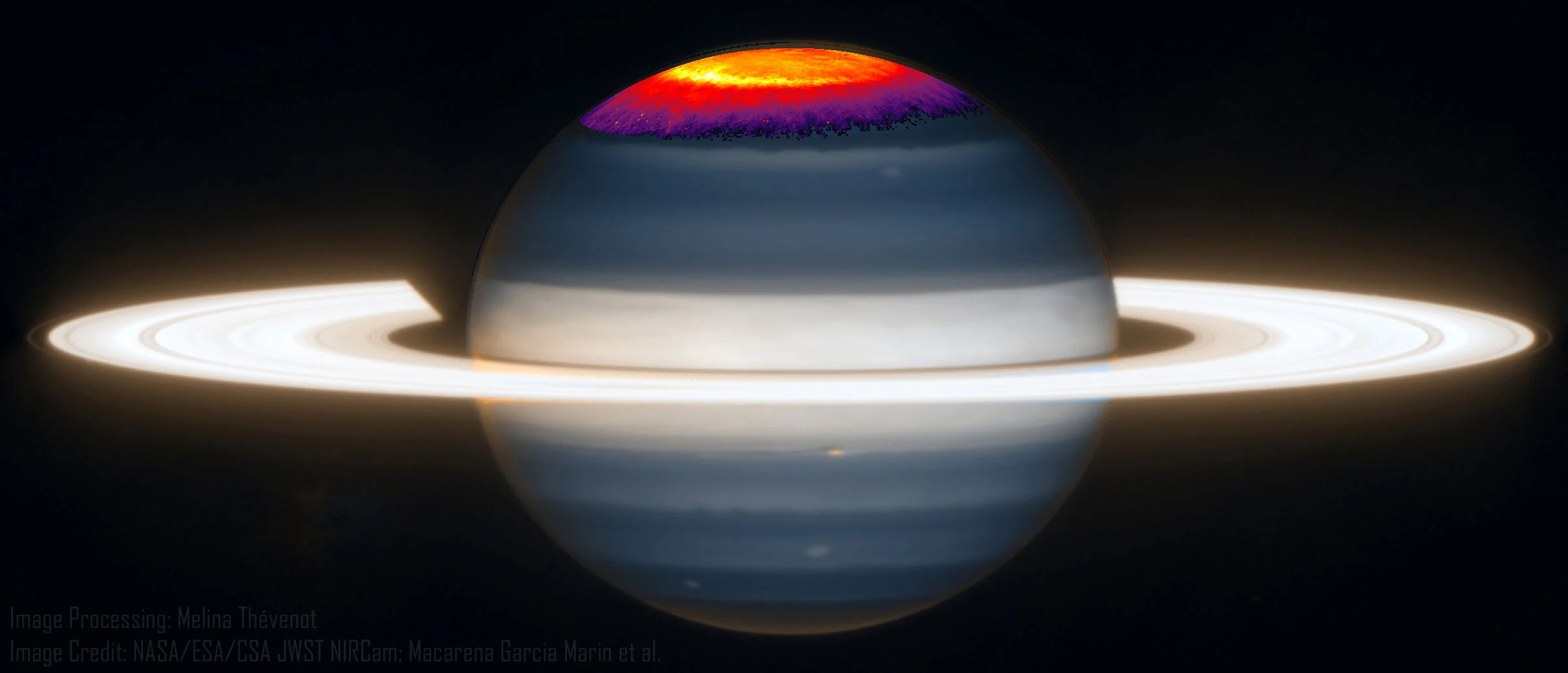
The latest research published in the "Journal of Geophysical Research: Space Physics" has mapped detailed images of the temperature and charged particle distribution in Saturn's auroras for the first time, showing that this phenomenon originates from a continuous self-sustaining feedback system driven by Saturn's auroras, thus creating the illusion of "rotation rate changes" in observational data.
Saturn's unusual behavior has puzzled astronomers for decades. Data obtained by detectors represented by the Cassini spacecraft around 2004 have shown that Saturn's rotation period seems to change over time. This result conflicts with traditional physical understanding - the planet's overall rotation should remain stable over long time scales. In 2021, a study led by Tom Stallard, professor of planetary astronomy at Northumbria University, gave an important clue: What really changes is not the rotation speed of the planet itself, but the high-speed wind field in the upper atmosphere. These winds generate currents in the upper atmosphere, which in turn affects the auroral signals, making the "rotation measurement" based on auroral electromagnetic waves seem to be changing.
However, this explanation itself raises new questions: If high-altitude winds drive the currents, how are these winds "ignited" and sustained in the first place?
The latest JWST observations provide a missing piece of the puzzle. Stallard's team teamed up with multiple institutions in the UK and the US to use JWST to continuously monitor the aurora zone at the north pole of Saturn - similar to the aurora borealis on Earth - covering a complete "Saturn day" and obtained observational data with unprecedented spatial and temporal resolution. The researchers focused on analyzing the infrared radiation of a molecule called trihydrogen cation (H₃⁺) in the upper atmosphere of Saturn. This molecule is a natural "probe" of temperature changes and can be used to invert atmospheric heating conditions and particle density distribution.

Previous ground-based and orbital observations have measured temperatures with an uncertainty of about 50 degrees Celsius, which is roughly the same as the temperature fluctuations researchers are trying to resolve, and can only be averaged across a large range of polar regions. The JWST data improves this accuracy by about an order of magnitude, allowing scientists to resolve detailed local heating and cooling structures in the auroral region for the first time.
The observations were in good agreement with a numerical model developed more than a decade ago, but only if the main heat source was accurately placed in the region where auroras sink into the atmosphere, where charged particles "smash" into the upper atmosphere along magnetic field lines. This shows that Saturn's aurora is not only a spectacular optical scene, but also a powerful local energy source: auroral particles settle and deposit energy within a specific height range, increasing local atmospheric temperatures, thus driving high-altitude wind fields. These winds will stimulate currents in the interface area between the planet's magnetosphere and the atmosphere. The currents in turn provide energy for the aurora, allowing the aurora to maintain and continue to heat the atmosphere for a long time, forming a closed cycle of "aurora-heating-wind-current-aurora".
Stallard vividly compared this process to "a planetary heat pump": the aurora heats the atmosphere, the atmosphere drives the wind, the wind generates electric current, and the electric current feeds back the aurora, and the system is self-sufficient and operates over and over again. It is this stably operating feedback system that causes the "rotation rate" calculated based on auroral electromagnetic signals to drift over time, making it look like the rotation of Saturn itself is slowly changing.

The significance of this research goes beyond explaining Saturn's "variable speed rotation" mystery. The results show that there is a tight coupling between Saturn's atmosphere and its magnetosphere: Atmospheric processes can drive current and energy outward, changing the magnetosphere environment, while energy and particles in the magnetosphere can settle again, transporting energy back to the atmosphere. This two-way energy and momentum exchange mechanism may be the key to the long-term stability of abnormal signals like Saturn. It also suggests that on other planets with strong magnetic fields and atmospheres (including gas giant planets and even exoplanets), there may also be atmosphere-space environment linkage processes that have not yet been fully understood.
Stallard said this result changes the way we understand planetary atmospheres: If the state of a planet's atmosphere can drive electric currents outward, thereby changing the surrounding space environment, then when studying the upper atmospheres and stratospheres of other planets and even exoplanets, hitherto unexpected interactions may be discovered. The relevant results were published in the "Journal of Geophysical Research: Space Physics" under the title "JWST/NIRSpec reveals the atmospheric driving mechanism of Saturn's variable magnetosphere rotation rate". The research was funded by the British Science and Technology Facilities Council and other institutions.