After Micron withdraws from the consumer memory market, it is shifting its focus almost entirely to providing high-performance storage and memory solutions for hyperscale cloud vendors and artificial intelligence-related companies. The company's recently released new 6600 ION data center-grade solid-state drive focuses on capacity, return on investment, and energy efficiency, and is regarded as an important product upgrade for its AI infrastructure needs.
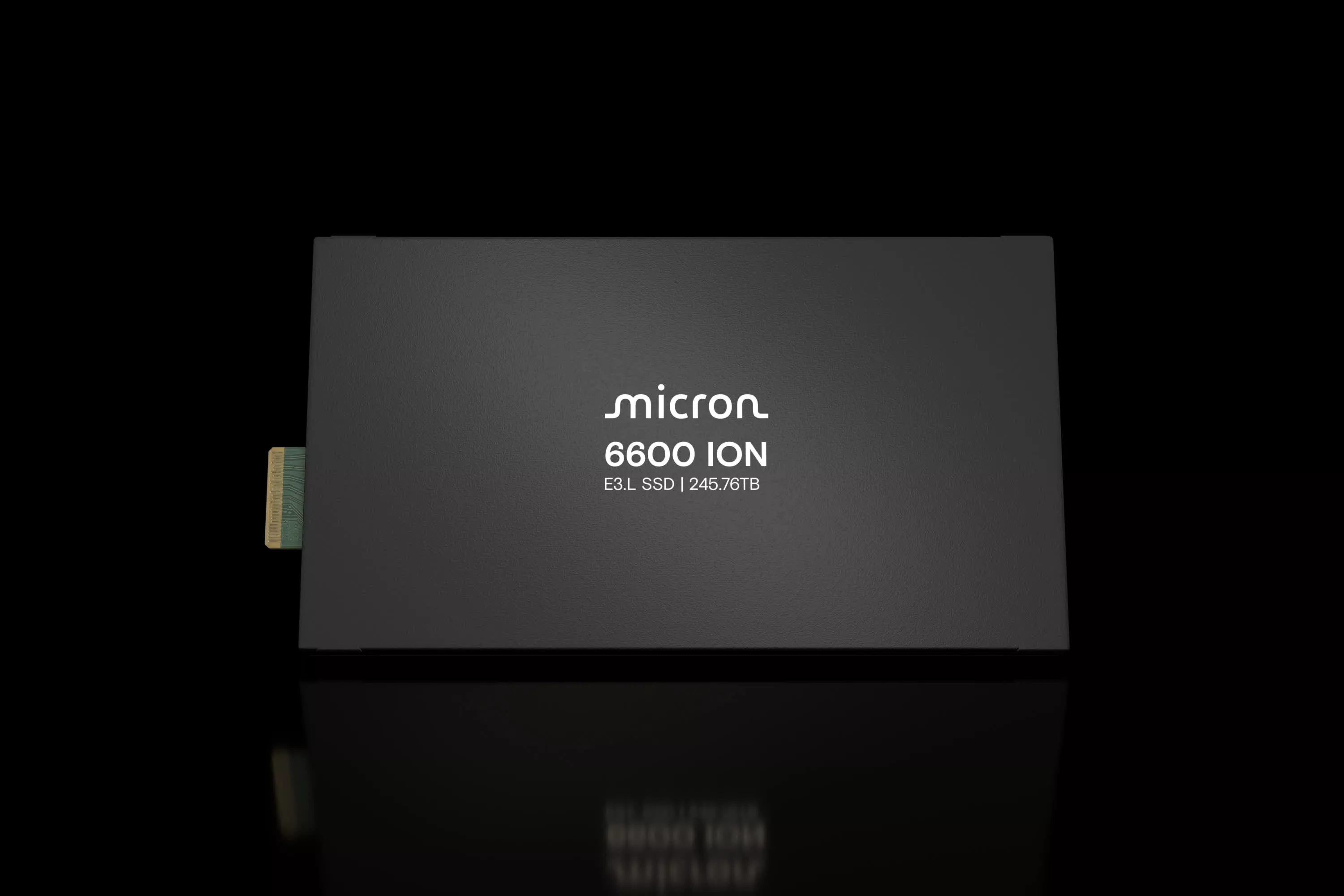
The 6600 ION SSD is available in two enterprise-class forms, U.2 and E3.L. A single hard drive can achieve a maximum capacity of 245TB. Micron calls it one of the highest-capacity SSDs currently "commercially available" in the industry. It is a continuation of the many high-capacity enterprise-class solid-state drives that have been launched in the ION product line in the past few years. As rack space in data centers becomes increasingly tight, the high density of the 6600 ION makes it a more compact alternative to traditional bulk storage solutions.
A set of comparisons provided by Micron shows that if a 245TB 6600 ION E3.L solid-state drive is used to replace a traditional mechanical hard drive array, to obtain the same original capacity, the space occupied by the entire cabinet can be reduced by approximately 82%. For cloud service providers and AI cluster operators that need to stack massive amounts of data in limited computer room space, this change not only means that more data can be "stuffed" into a smaller volume, but it can also directly optimize the overall infrastructure layout.
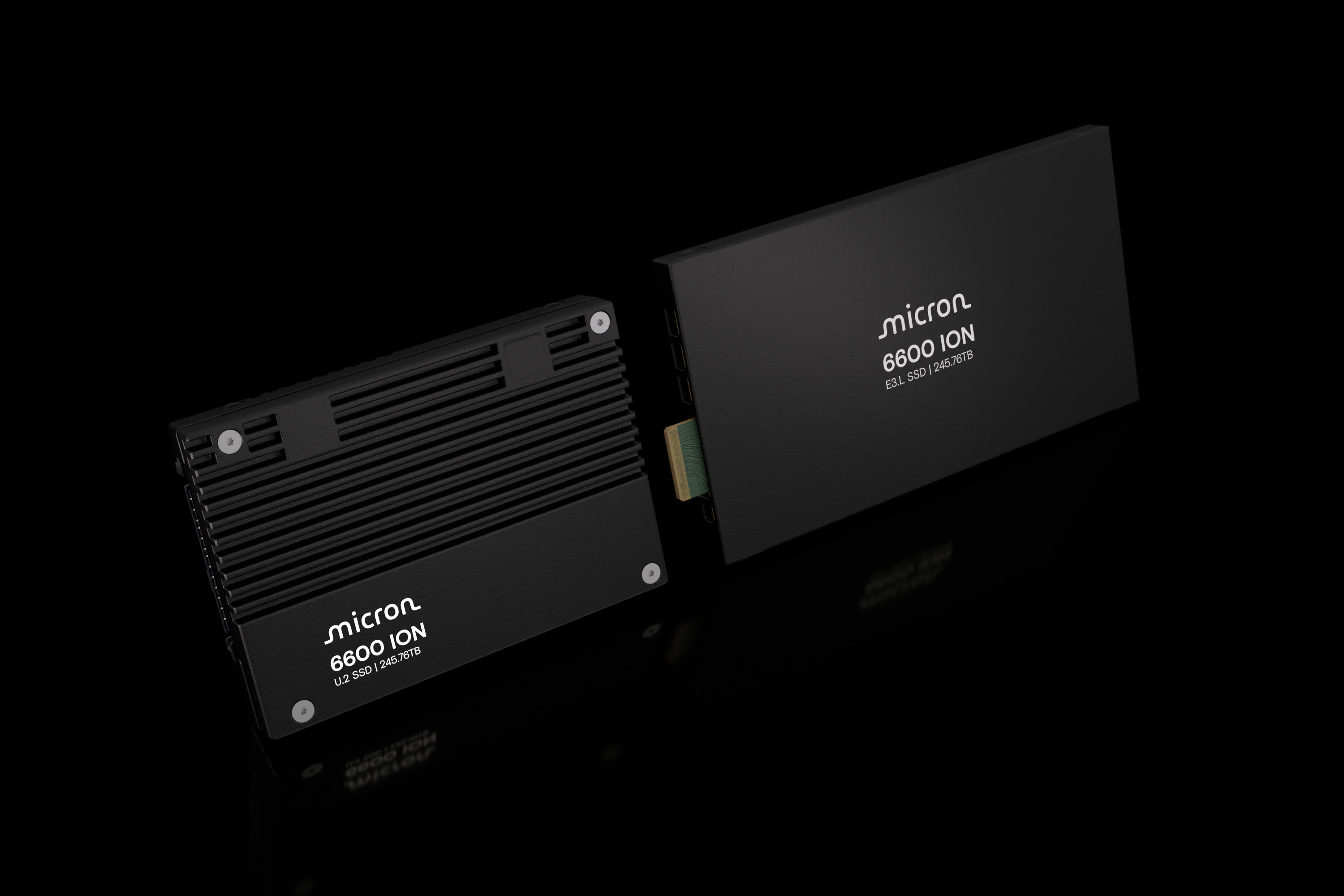
In terms of technical implementation, the 6600 ION is based on Micron’s own ninth-generation QLC NAND flash memory chip. Micron said that this generation of enterprise-class QLC is at least one generation ahead of competing products, allowing customers to process more data in less rack space while reducing overall machine power consumption and cooling requirements without significantly sacrificing performance.
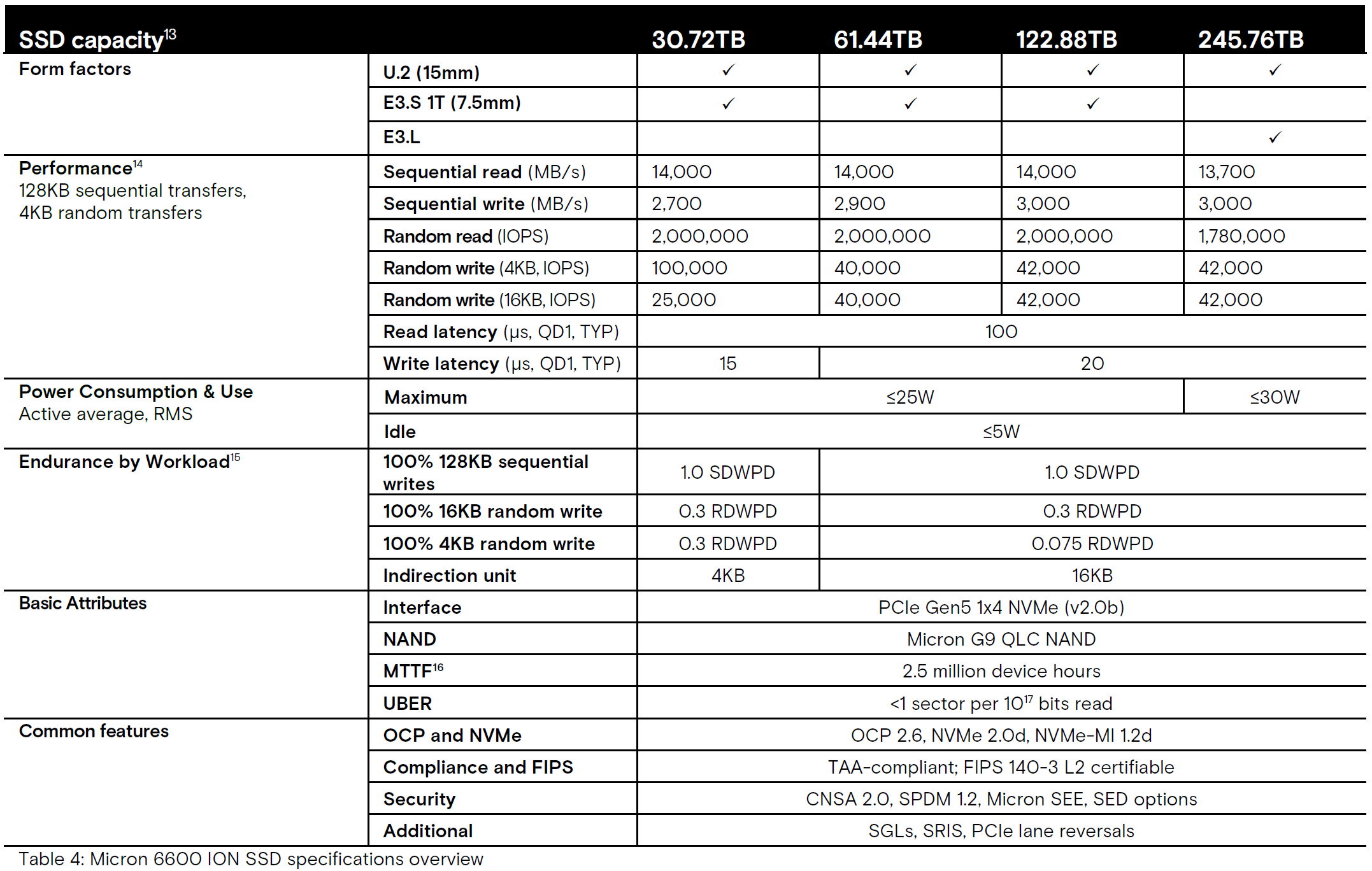
In terms of energy consumption, the peak power consumption of a 245TB 6600 ION is up to about 30 watts, which is about half of that of a mechanical hard drive of the same capacity. For data centers where electricity costs and carbon emissions are key indicators, this type of high-density, low-energy solid-state storage is expected to significantly outperform in terms of energy efficiency ratio and help achieve energy conservation and emission reduction goals.
In terms of interface and performance specifications, the 6600 ION uses the PCIe 5.0 bus and is connected through x4 NVMe channels. The overall machine life indicator is a mean time between failures (MTBF) of 2.5 million device hours. In a sequential access scenario, the 122.88TB capacity version has a read speed of up to 14,000MB/s, while the 245.76TB version has a write speed of up to 3,000MB/s. Currently, the maximum capacity of 245TB is only available in E3.L configuration.
Micron positions the 6600 ION series as a cost-effective, high-density storage solution for modern data centers, focusing on data-intensive workloads such as AI training and massive data analysis. Dell has announced that it will use this high-capacity SSD in its enterprise-class storage products. Travis Vigil, the company's senior vice president, emphasized in his introduction that this product has obvious advantages in the "mathematical account", that is, it forms a more attractive balance between capacity, space occupation and energy consumption.
As early as 2025, Micron announced the closure of its own brand Crucial desktop/consumer memory business, exited the consumer DRAM market, and shifted its main production capacity to the enterprise and data center fields of high-performance storage and memory chips. As one of the "Big Three" alongside Samsung and SK Hynix, Micron's transformation is consistent with the trend of the entire semiconductor industry: driven by generative AI, high-bandwidth memory and ultra-high-density storage for data centers are becoming the core battlefield for manufacturers to compete.