A new study from the Grainger School of Engineering at the University of Illinois at Urbana-Champaign shows that the earliest sensory cortex of the brain is not just responsible for "passively receiving" information, but plays an unexpected active role in the decision-making process. This discovery challenges the classic model of hierarchical and step-by-step processing of the brain that has long dominated the mainstream. The research team believes that this more dynamic, two-way interactive neural organization method is expected to provide new inspiration for low-energy consumption and high-efficiency artificial intelligence architecture in the future.
The traditional view is that the brain's decision-making process generally follows a one-way "bottom-up" hierarchical pathway: information enters from early sensory areas such as vision, hearing, or somatosensory, and is gradually transmitted to higher-level association cortex and frontal cortex, and finally integration and decision-making are completed in these "higher-order centers." It is based on this understanding that most artificial intelligence systems such as convolutional neural networks adopt a similar hierarchical structure, viewing intelligence as the result of information being processed layer by layer along a fixed direction and "outputting decisions" at the top level. However, as the understanding of natural intelligence deepens, more and more scholars have begun to question this oversimplified "assembly-line" model.
This research was led by Yurii Vlasov, a professor in the Department of Electrical and Computer Engineering at the University of Illinois, and the paper was published in the Proceedings of the National Academy of Sciences (PNAS). The research team chose to re-examine the brain from a system level, viewing it as a "natural intelligence" system shaped by evolution, emphasizing feedback loops and two-way information flow between different brain areas, rather than a single-directional serial processing chain. Under this framework, decision-making is viewed as the result of continuous interaction and co-emergence among multiple brain regions, rather than as an instruction "unidirectionally issued" by higher-order regions.
A distinctive feature of natural intelligence is high efficiency and energy saving: when completing complex perception, cognition and decision-making tasks, the energy consumption of the human brain is much lower than that of most artificial intelligence systems today. In order to understand the source of this efficiency, the research team is not limited to a certain functional module, but starts from the overall architecture and examines the collaboration between different areas. Vlasov said that understanding how the brain organizes decision-making calculations at the architectural level is expected to help the engineering community design next-generation artificial intelligence systems that are more effective, more energy-saving, and "smarter".
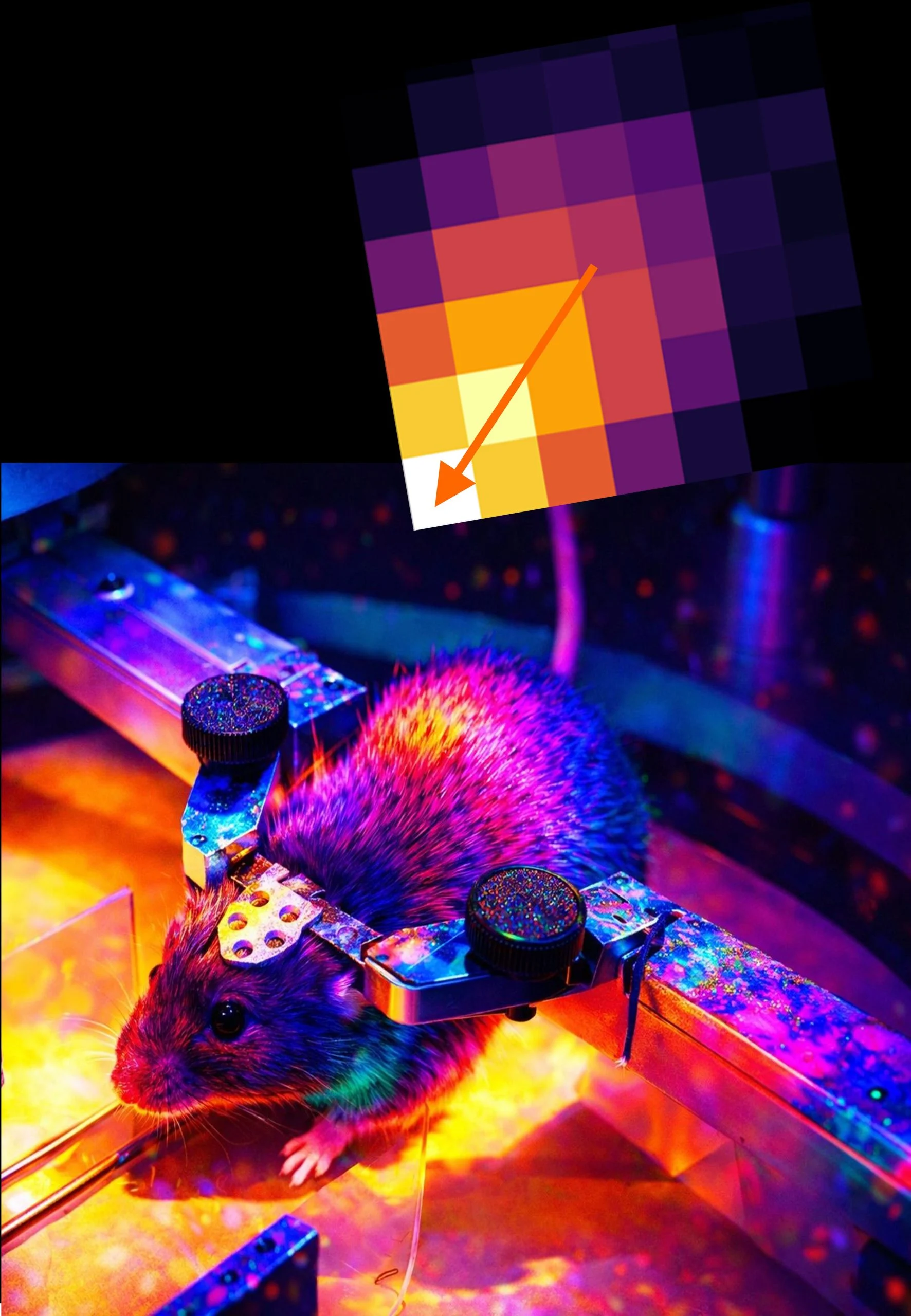
In terms of specific experimental design, the researchers focused on the earliest processing stages of the brain, that is, the areas responsible for sensation and perception. They conducted experiments on mice, allowing the animals to move in a virtual reality corridor, sensing the environment through their tentacles and making perceptual decisions about turning left or right. During this process, the researchers recorded the activity of neurons in a large area of the mouse brain, paying particular attention to the response pattern of the primary somatosensory cortex (S1).
The results were unexpected: Signals related to decision-making were clearly captured in the primary somatosensory cortex, which has traditionally been viewed as “only processing basic sensations.” This shows that the decision-making process is not initiated only at the "back end" of higher-order cortex, but that obvious decision-making representations are already apparent at the sensory processing stage at the forefront of the brain. In other words, the early sensory area does not simply package and upload "raw data", but is involved in encoding action choices at a very early point in time.
Further analysis found that the activity of the primary somatosensory cortex does not occur in isolation, but is significantly modulated by feedback from higher-order brain areas. This top-down feedback signal, together with bottom-up sensory input, shapes the pattern of neural activity in S1. It can be seen that the brain does not advance linearly along a single path "from perception to decision-making", but continuously exchanges information through feedback loops between multiple levels to complete the interpretation of external information and the choice of behavior.
Vlasov pointed out that the brain's "neural coding" is still like an undeciphered language, but understanding these feedback loops and dynamic interactions from a system level can already provide valuable inspiration for the design of artificial neural networks. Current artificial intelligence still has obvious shortcomings at the decision-making level. However, natural intelligence can complete calculations with energy consumption far lower than that of modern hardware systems under the same or even more complex tasks. The architectural experience behind this is worthy of the engineering community to "learn from nature."
Although this work is not yet enough to directly provide an engineering blueprint for building "better AI", the research team believes that it provides a perspective from which to rethink artificial intelligence. By systematically studying how the brain organizes and processes information, researchers are expected to summarize a set of transferable principles to guide the improvement of artificial intelligence in terms of architecture, energy efficiency, and decision-making mechanisms. Future AI systems may need to break away from the strict layering and one-way communication framework and instead introduce more dynamic feedback and parallel interaction structures similar to biological brains.
Next, Vlasov's team plans to continue tracking changes in brain activity in the temporal dimension, focusing on studying the rapid temporal dynamics of neural activity. They are developing new tools to measure and analyze neural signals with greater precision, trying to uncover how feedback loops are involved in decision-making from data with higher temporal resolution. In his view, only by seeing how these feedback loops are activated in time and how they are formed and reconstructed between different processing levels can we truly understand the operation of natural intelligence and transform it into the design basis for a new generation of artificial intelligence architecture.