Recently, a video showing the S9 zero-gravity seat almost pinching a child sparked heated discussion. In the face of public concerns, Hongmeng Intelligent Technology quickly responded that the vehicle has an anti-pinch function, but the protection was not activated because it did not reach the trigger threshold, and emphasized that multiple safety mechanisms have been set up. Although the technical explanation has its logic, having safety protection does not mean that it is safe. When the anti-pinch function was "silent" in a real and obvious squeeze scene, this incident deserves our in-depth inquiry.
I asked Hongmeng Zhixing: Can the so-called "multiple security protection" protect users?
Hongmeng Zhixing responded that the anti-pinch function needs to reach a certain force threshold before it is triggered, and the video scene did not meet the standard. This explanation just exposes the "closeness" between technical design and real use scenarios: the anti-pinch threshold is based on a certain weight, but when the resistance produced by the squeezed child on the seat is lower than the preset standard, does it become a cognitive blind spot of this intelligent design? When technical parameters only adapt to "standard scenarios" but ignore "non-standard scenarios" that users may encounter, the so-called "multiple security protections" cannot ensure all-round security.
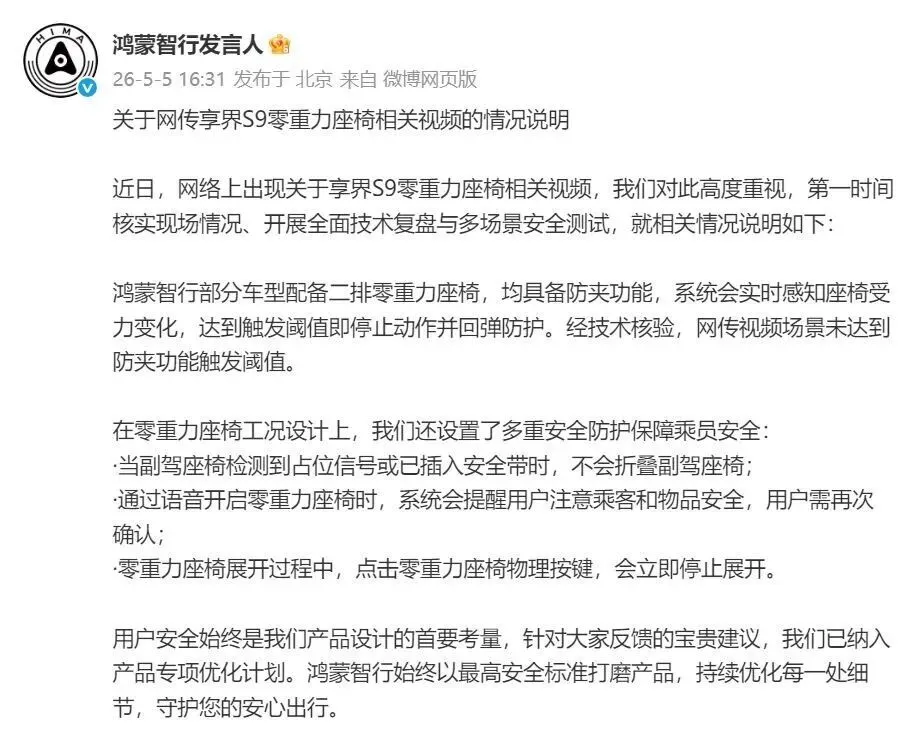
In addition, Hongmeng Zhixing also needs to clarify: Are the restrictions on the use of children clearly marked in the manual of this seat? In the extreme scene testing before the product is launched, are test cases such as children accidentally entering the blind spot and limb anti-pinch failure included? The answers to these questions will determine whether this incident is an "isolated incident" or a systemic security breach.
Second question to the industry: Can safety redundancy reflect brand warmth?
The ultimate safety in the automotive industry has never been about "just meeting the standards", but "active redundancy". When vigorously promoting assisted driving systems in the past, many car companies would take the initiative to add additional safety reminders to guide drivers to correctly understand the boundaries of capabilities, even if the technical parameters meet national standards. What the public expects more is not an explanation of "why it was not triggered," but how to ensure that "it will definitely be triggered in the future." Real smart luxury is by no means a pile of parameters and functions, but when technology and human nature are misaligned, companies and products are willing to choose a "more conservative but safer" action logic, reflecting their respect for "people-oriented".
Three questions to the adults in the video: Are potential risks ignored?
It must be clarified that regardless of whether the vehicle is running or stationary, children are the key targets of protection when using vehicles because of their small size, light weight, and weak reactions. No matter what the considerations are, placing the child on the co-pilot to experience the zero-gravity seat in the video is not appropriate in terms of safety. Fortunately, the children were not injured this time, but this is enough to sound the alarm for everyone: no matter how advanced the technology is, adults' vigilance against mechanical movements is always the most reliable first line of defense to protect children's safety. Zero-gravity seats are an innovative configuration that improves travel happiness, but this incident reminds the industry of the urgent need to establish safety testing standards for smart cockpit configurations, especially specific indicators involving child protection, to avoid consumers becoming "testers" in technical blind spots.
An anti-pinch threshold that fails to respond in time may be just a string of numbers in the world of code, but in reality, it may be related to the safety of a child and the fate of a family. I hope this incident can serve as a solemn reminder: All technologies that are running for the sake of "leading" should look back and see if security has kept up.