Fossils dating from 2.1 million to 300,000 years ago in East Asia are core materials for reconstructing the evolutionary history of Homo erectus in East Asia. However, their long age and traditional destructive sampling methods have severely restricted the molecular research on these precious samples, leaving a series of key scientific questions about human evolution unresolved for a long time.
Recently, the Institute of Vertebrate Paleontology and Paleoanthropology, Chinese Academy of Sciences, for the first time successfully obtained endogenous enamel protein data with phylogenetic information from six Middle Pleistocene Homo erectus tooth fossils dating back approximately 400,000 years from three sites in Zhoukoudian, Beijing, Hexian, Anhui, and Sunjiadong, Henan, without destroying the complete form of the fossils. This is the first time in the world that molecular information with the identification characteristics of Homo erectus has been obtained, reshaping the interaction network of ancient human groups in East Asia during the Middle Pleistocene.
In order not to destroy the complete form of the fossil, the scientific research team explored and innovatively proposed a nearly "non-destructive" assessment and sampling plan. First, the researchers used matrix-assisted laser desorption ionization time-of-flight mass spectrometry to screen the preservation of ancient proteins in ancient human tooth enamel.
On this basis, the team applied the acid etching minimally damaging sampling technology to the Middle Pleistocene Homo erectus fossils for the first time. This technology consumes only a small area of surface enamel and efficiently obtains endogenous proteins without basically affecting the fossil morphology.
It is precisely because of this key breakthrough that scientific researchers were able to study the East Asian Homo erectus fossils from Zhoukoudian, Hexian, Sunjiadong and other places from the molecular level for the first time.
The researchers successfully identified 6-11 endogenous enamel-related proteins, including 650-3457 peptide segments, and the constructed consensus sequence covered 269-903 amino acid sites.
This is the first time in the world that endogenous enamel protein data with characteristic phylogenetic information has been obtained from Homo erectus fossils, and it is also the oldest ancient human proteome in East Asia to date. The study pushed the time limit of the East Asian ancient human proteome from about 160,000 years ago to at least 400,000 years ago.
Do Homo erectus in China belong to the same evolutionary branch, or do they represent multiple different origins or relatively isolated groups? The heterogeneity in physical form of the Middle Pleistocene Homo erectus fossils in East Asia has triggered a long-term debate among scientists.
The enamel protein data provided a decisive answer. The study discovered a decisive new mutation - a single amino acid polymorphism in ameloblastin AMBN A253G. The mutation was identified in all six Homo erectus samples and has not been found in any other published archaic, modern, or other living or fossil primates.
The study constructed an endogenous protein comparison data set including six East Asian Homo erectus and one Harbin individual. The results showed that the six East Asian Homo erectus clearly clustered into one branch and were clearly separated from Denisovans, Neanderthals and modern humans.
This discovery provides direct molecular evidence for the first time to confirm that the Homo erectus from the above three sites in China belong to an independent evolutionary group, resolves the long-standing controversy regarding the internal classification of Homo erectus in East Asia, and fills the gap in the understanding of the genetic characteristics of Homo erectus.
In all six East Asian Middle Pleistocene Homo erectus samples, the research team also identified another common key mutation, AMBN M273V, and reverse-traced its corresponding coding DNA region and conducted detailed analysis, revealing that some genes from the Denisovan genome have penetrated into modern humans, and their origin can be traced back to the Middle Pleistocene-related populations of Zhoukoudian, Hexian, and Sunjiadong.
Based on the above studies, scientific researchers have outlined an unknown picture of human evolution: Homo erectus in East Asia, represented by Zhoukoudian 400,000 years ago, is not only a unique evolutionary group, but also one of the sources of ancient genes in the modern human gene pool.
This study is the first to transform Homo erectus from a morphological cognitive entity into an evolutionary entity with clear genetic contributions; at the molecular level, it has discovered deep genetic connections between East Asian Homo erectus related to Zhoukoudian, Hexian, and Sunjiadong, Denisovans, and some modern human populations today, providing important evidence for understanding the complexity of ancient human evolution and the gene exchange network within the genus Homo.
The innovative method system from sampling to data analysis used in the study has transformed paleoproteomics from a tool focused on lineage identification to a core research method that can independently deduce and verify evolutionary hypotheses. It has established a reference research paradigm for exploring older human groups, marking paleoproteomics as an important means to decipher the history of human evolution.
Relevant research results were published in Nature (Nature)superior.
Paper link
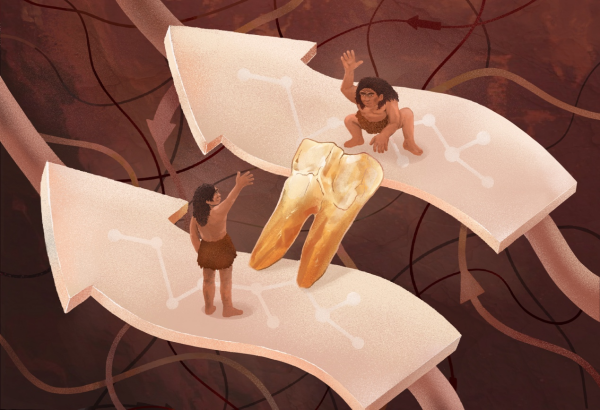
For the first time, scientists extracted genetic information about lineage characteristics from Homo erectus fossils
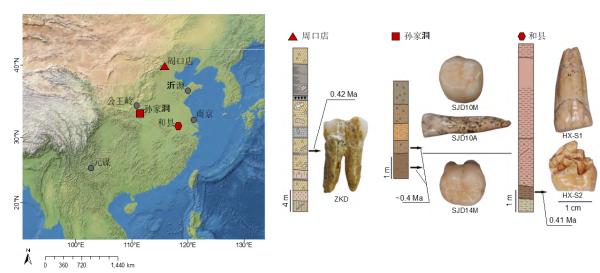
The geographical location of the Homo erectus site in the Middle Pleistocene of China and the sample information of this study