Rice is one of the most widely grown staple food crops in the world, providing about 20% of the daily caloric intake for more than half of the world's population. However, currently widely cultivated rice is an annual crop that needs to be resown every year, while its wild relatives are mostly perennial plants that can bloom year after year and continue to sprout new shoots from the base of the plant.
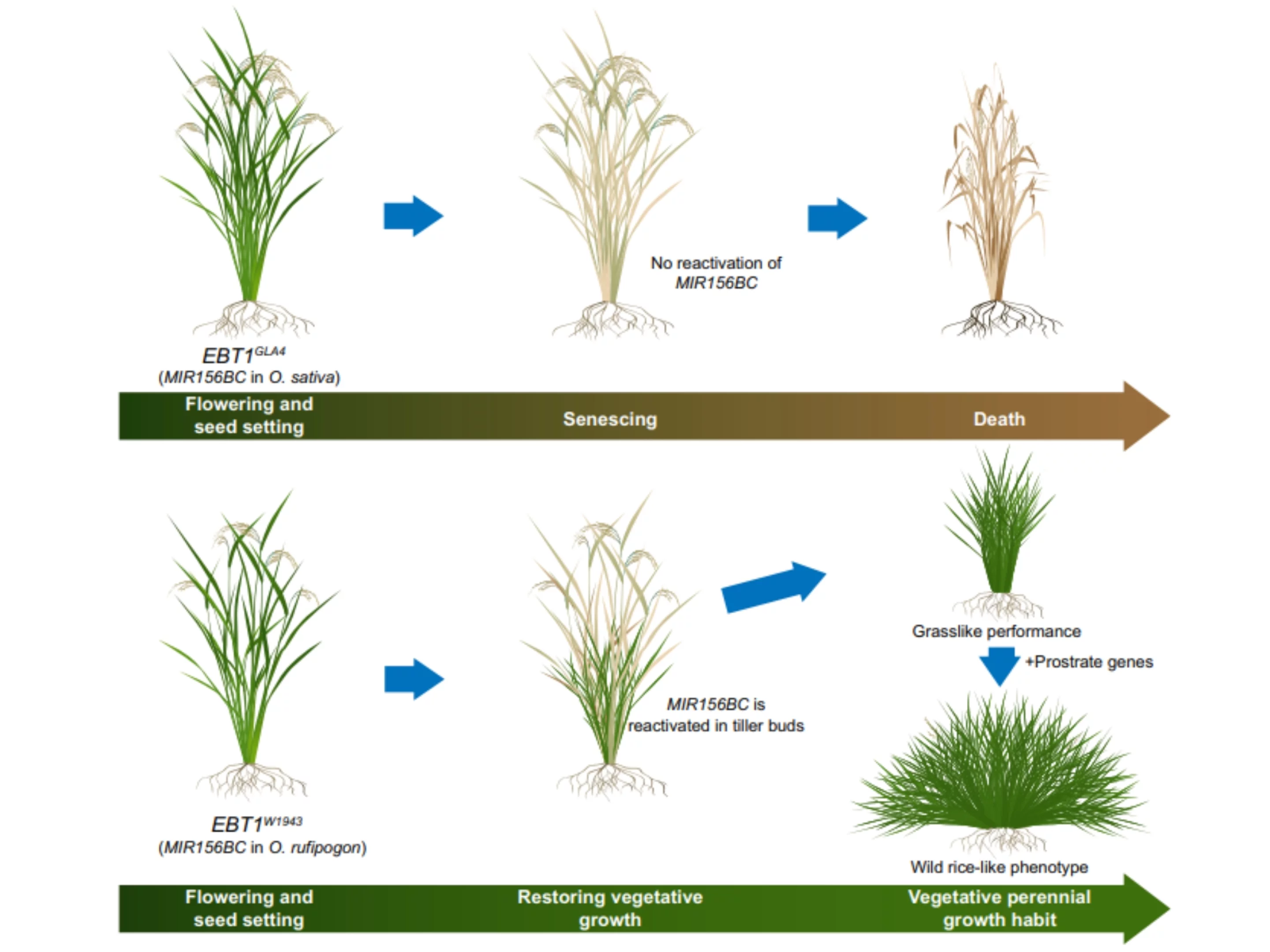
A latest study published in Science shows that scientists have found key genetic factors that determine perennial characteristics in wild rice (Oryza rufipogon), and successfully introduced relevant genes into cultivated rice (Oryza sativa) to create rice materials with perennial growth capabilities. The research team believes that today's cultivated rice is likely to be derived from perennial ancestors, but its regeneration ability was gradually lost during the long-term domestication process.
To track this perennial trait, Han Bin, a geneticist at the Chinese Academy of Sciences, and colleagues conducted a comparative analysis of 446 wild rice samples and cultivated rice materials. They identified a genomic region called "Endless Branches and Tillers 1" (EBT1) on chromosome 1 of rice, which contains two copies of the regulatory gene microRNA156, labeled B and C respectively.
Research shows that in the seedling stage, this microRNA156 B and C sequence is highly active and can maintain the plant in the vegetative growth phase, allowing it to continue to grow leaves and stems without rushing into reproductive development. As the plant matures, this activity gradually weakens. In ordinary cultivated rice, this means that the life cycle of the plant ends after flowering and fruiting. In wild rice, this gene region will be "reset" after flowering, allowing the plant to resume vegetative growth again instead of completely dying.
The research team further crossed wild rice with cultivated rice to observe the functional performance of relevant genes in living plants. Among the many hybrid progeny phenotypes, the researchers selected a material numbered G43, which showed the ability to stop reproductive development and restart vegetative growth after flowering.
During the process of restoring vegetative growth, G43 will grow a large number of side branches called "tillers" from the base of the plant. Normally, an ordinary rice plant produces approximately 10 tillers in its life cycle from jointing to heading, fruiting, and death, while G43 can produce more than 70 tillers on average, significantly demonstrating its ability to regenerate and expand multiple times.
However, this "endless tillering" currently faces obvious limitations: most of the side branches formed by these secondary growths are sterile tillers, which will only grow abnormal flowers but cannot produce seeds. The research team believes that in order to obtain perennial cultivated rice that can be truly promoted on a large scale, relevant genes need to be further introduced or regulated elsewhere in the genome to achieve a variety that can regenerate for many years and maintain sufficient fruitfulness.
Salomé Prat, a plant geneticist from the Agricultural Genome Research Institute, pointed out in an interview with Refractor that while the current EBT1 locus brings perennial characteristics, it also inhibits the normal flowering of rice, thereby reducing yield. In this allele, she explains, the gene is activated again in tiller buds after flowering, driving new tiller formation, but this also means the reproductive phase is suppressed.
Jorge Dubcovsky, a plant biologist at the University of California, Davis, warned that this kind of gene-edited rice "is unlikely to be available to the public quickly" in the short term. He pointed out that from the perspective of broad agricultural production, perennial crops tend to have lower yields than annual crops. In the context of continued global population growth, humans may not be able to afford the large-scale replacement of existing high-yielding annual staple crops with lower-yielding perennial crops, even if the former has advantages in terms of ecology and sustainability.
Despite the prospects and challenges, this research is still regarded as an important progress in the field of rice genetic improvement, providing key clues for creating cultivated rice that can be harvested for many years through molecular breeding methods. If scientists in the future can steadily introduce perennial characteristics into main varieties without significantly sacrificing yield, the rice planting system is expected to usher in far-reaching changes in terms of reducing sowing, saving labor and resources, and improving soil and ecological environment.