Humans and cattle have lived together for thousands of years. Since the domestication of the extinct bison about 10,500 years ago, cows have gradually become an important source of meat, dairy products and leather in the world. However, while we are accustomed to studying how to manage and utilize cattle, there is actually insufficient scientific evidence about how cattle view and understand humans themselves.
Previous research has shown that some domestic animals such as sheep and pigs have been proven to be able to recognize human individuals and remember human-related experiences to a certain extent, but similar abilities have lacked systematic verification in cows. A new study led by Léa Lansade, a senior researcher in the animal cognition and welfare field of the French National Institute of Agriculture, Food and the Environment (INRAE), shows that cows can not only distinguish between familiar and unfamiliar human faces, but also integrate human faces and human voices into a unified "image" for cross-sensory recognition.
The research team selected 32 Plymouth Holstein cows, ranging in age from 15 to 21 months. Since birth, four regular keepers have been responsible for the daily feeding and care of these cows, but the cows may occasionally come into contact with other people on the farm, such as students or visiting colleagues. The study emphasized that these cows had never participated in similar experimental procedures before to eliminate experience interference.
In the experimental design, the researchers first took images of 8 adult men aged 30 to 60 years old. Four of them were familiar keepers that the cows had daily contact with, and the other four were unfamiliar colleagues that the cows had never seen before. The research team then arranged two types of core tests: a visual preference test and a cross-modal (cross-sensory) test to test whether the cows could "see who is who."
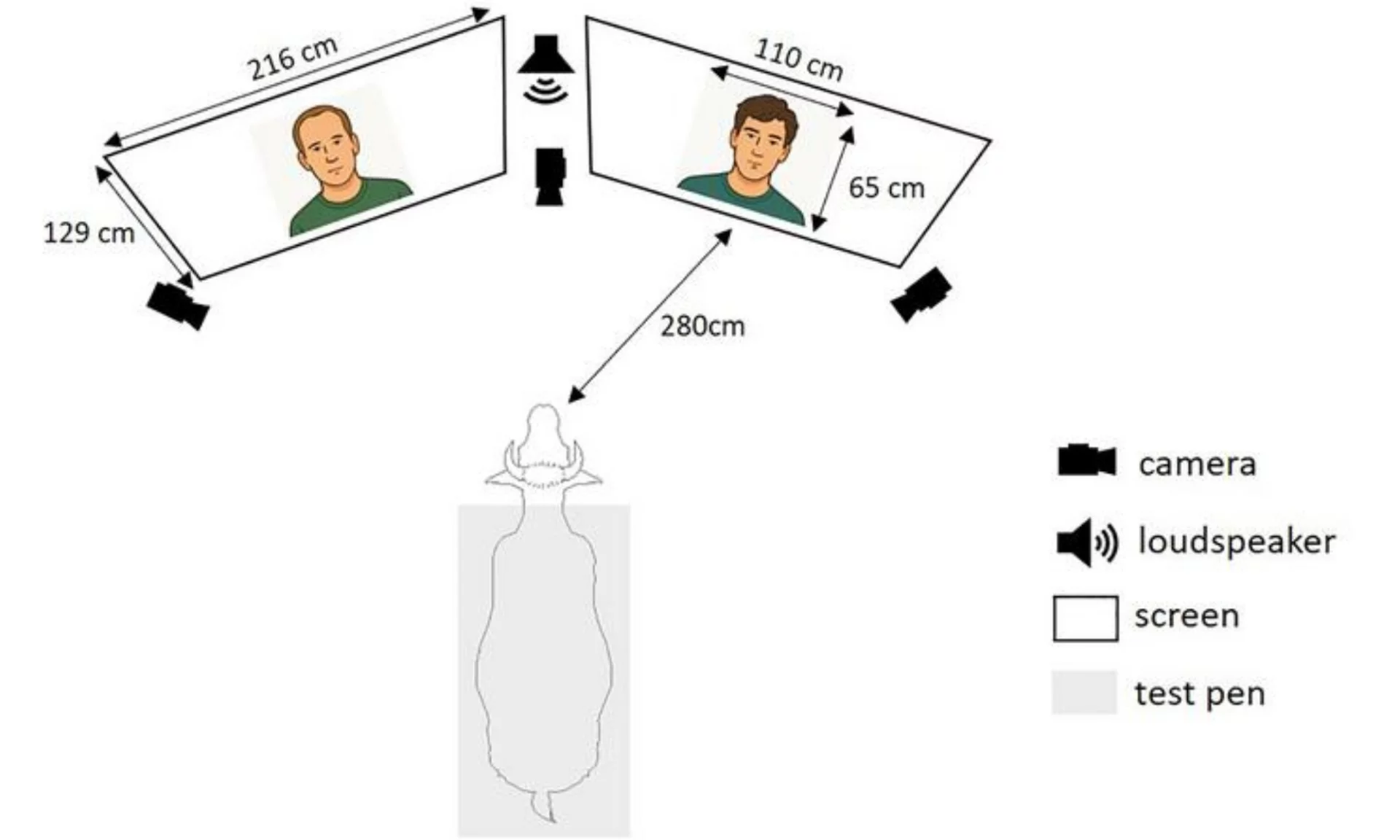
In the visual preference test, the researchers presented two silent videos to the cows at the same time, one showing the face of a familiar breeder and the other showing the face of a stranger. By accurately recording how long the cows looked at each screen, the researchers found that the cows generally stared longer at videos showing unfamiliar faces. This "staring at strangers" behavior is usually considered a "novelty preference" in animal cognition research, indicating that animals can not only distinguish between "seen" and "unseen", but also show stronger attention to new faces.
In the cross-modal test, the research team added human voices while playing the video, but deliberately designed "matching" or "mismatching" combinations: either the familiar keeper's face was paired with his voice, or the images and voices were deliberately made from different people to create an inconsistent situation. The results showed that when the picture and sound came from the same familiar person, the cows looked at the video that "matched" the sound significantly longer. This shows that cows can not only distinguish between different humans by their faces, but can also "bind" the faces and voices of familiar individuals together in their brains to form a cross-sensory integrated representation.
The research team also monitored the cows' heart rates while watching the videos to assess whether different faces and voices triggered significant fluctuations in emotion. The data shows that whether familiar or unfamiliar faces and voices have a very limited impact on physiological indicators such as heart rate of cows, it shows that their reactions are more reflected in the level of cognitive processing rather than strong emotional excitement or stress response.
In the paper, the researchers pointed out that through visual preference and cross-modal testing, they proved that cows can process human face information presented in two-dimensional videos, and can associate familiar and unfamiliar faces with corresponding sounds, thereby integrating multiple sensory cues for recognition. Compared with "single-modal" recognition that only relies on a single sensory cue, this cross-modal integration is often regarded as a more advanced cognitive performance, meaning that animals can construct a more complete "image" of a character in memory.
Ronsard said that this cross-modal recognition result shows that cows will form a more stable mental representation in the brain of familiar people and process information related to social relationships in a more complex way. In other words, in the cognitive world of cows, humans are not a vague type of "homogeneous existence", but are composed of distinguishable and memorable individuals. Based on this, researchers believe that cows have higher social cognitive abilities than were generally recognized in the past, and their perception of the environment and human interaction is far from what can be summarized by "simple animals".
From a practical perspective, this study also provides new perspectives on livestock management and animal welfare. The research team pointed out that cows can distinguish between caregivers and strangers, which means that they may develop different levels of trust or vigilance towards different people based on past interaction experiences, which will affect daily management, group behavior and even production performance. Future research can further explore on this basis how cows acquire and process information related to human behavior, how to establish selective interactions between different people, and whether this ability can be further strengthened through good feeding and positive interactions.
As Ronsard emphasized: "These discoveries have profoundly changed the way we look at farm animals, and we also know that the better we understand an animal, the more we tend to treat it better." This result has been published in the open access journal PLOS. The research team hopes that it will promote society to re-examine the relationship between humans and livestock from both emotional and scientific aspects, so that the "cognitive world" of farm animals will no longer be ignored.