The Northwestern University research team recently demonstrated a new energy storage material that is completely different from traditional batteries: it exists in the form of a yellow liquid. After being "charged" under the action of visible light, electric current, chemical fuels or X-rays, it will spontaneously assemble and transform into a black conductive hydrogel. It can store electrons for several months in the absence of oxygen, and release these electrons to oxygen when needed to provide oxidative power for subsequent chemical reactions.
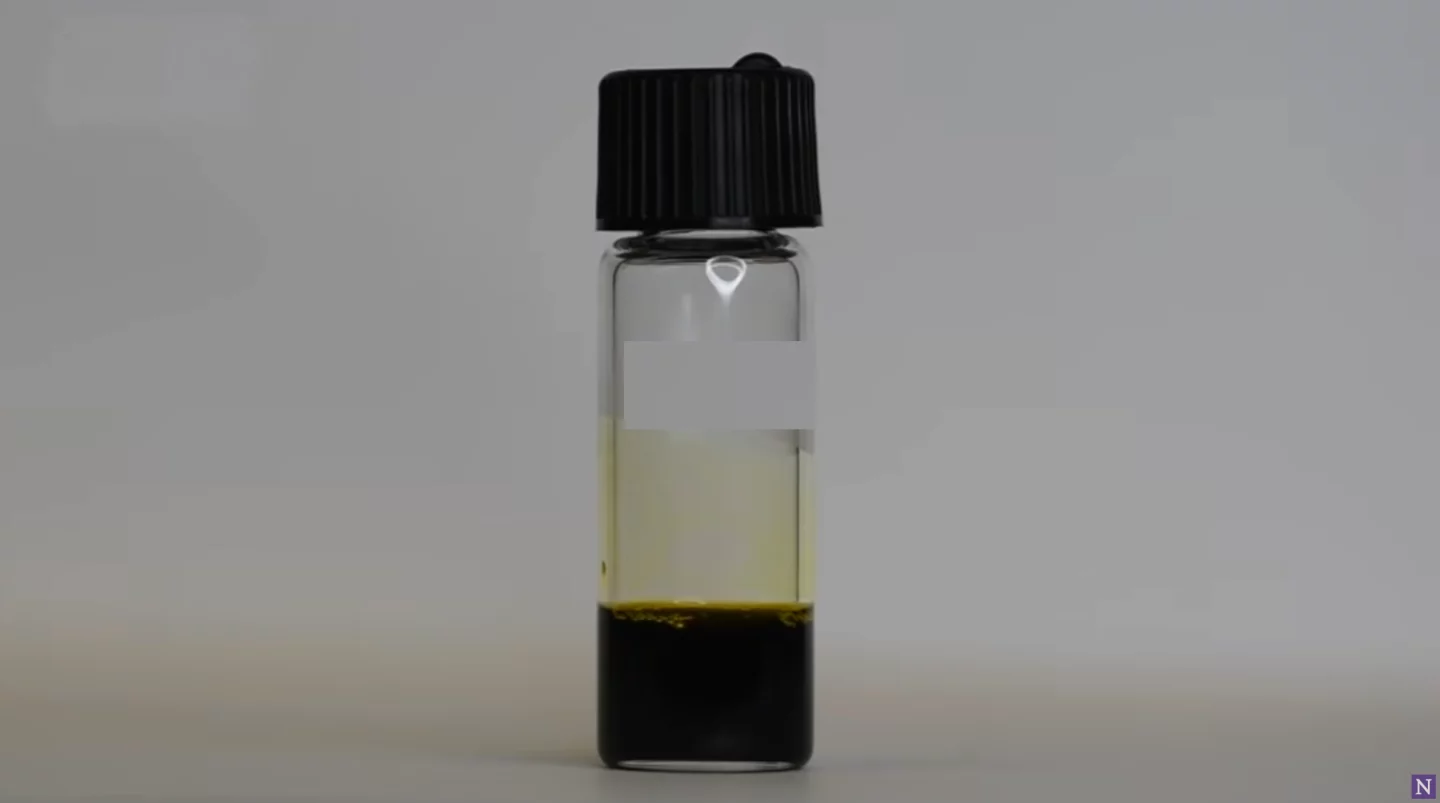
The research results, published in the journal Chem, are described by the team as a "cell-inspired" chemical system capable of integrating energy harvesting, energy storage, structural remodeling and catalytic functions on a single soft material platform. Different from the traditional concept of lithium-ion batteries used to power mobile phones and other devices, this material is not an electrochemical battery that outputs a stable current, but is more like a soft matter warehouse that can repeatedly "fill" and "release" chemical redox energy.
In an uncharged state, the material is a yellow liquid composed of small globular molecular aggregates; when it is exposed to energy sources such as visible light, electric current, chemical fuels, or X-rays, the molecules accept electrons and change their electronic structure, triggering the stacking and combination of molecules, through π-π interactions and the formation of free radical "pimers", and finally reorganized into long-chain supramolecular polymer fibers, allowing the originally loose liquid to be reconstructed into a black, conductive hydrogel. In this process, the "charged state" itself is an "assembly state". The molecules do not passively store charge like ions in traditional battery electrodes, but rearrange around extra electrons to build a new soft structure, thereby physically stabilizing these stored electrons.
In an oxygen-free environment, this black gel can seal electrons for a long time. The team claims that it can maintain energy storage state for several months without oxygen. When energy needs to be released, oxygen is introduced. Oxygen molecules accept electrons stored in the gel to generate highly reactive oxygen-containing species. These reactive oxygen species can oxidize organic substrates and promote a series of redox reactions. In other words, the material outputs chemical redox work rather than electric current. What it stores is chemical energy that exists inside the gel in the form of extra electrons. Once exposed to air, oxygen consumes these electrons and prompts the material to gradually return to its original yellow liquid state.
The research team regards this system as a model of "dark photocatalysis": In traditional photocatalysis, light must be continuously involved when the reaction occurs; in this work, the material can be "precharged" by light energy or other energy in advance, and then store electrons in a dark environment for a long time. When needed in the future, these stored electrons can be used to drive chemical reactions through oxidation. This means that certain light-driven catalytic processes are expected to continue in the absence of light in the future, providing new time and space flexibility for environmental remediation, pollutant degradation, surface sterilization, and a series of photocatalytic chemistry.
The Northwestern University team emphasized that this is the first example of a material that stores energy through "self-reconfiguration": the capture, storage and release of energy no longer rely on fixed-structure engineering devices (such as electrodes in batteries or semiconductors in solar cells), but are given to a soft matter platform that can dynamically change its own structure during the charge and discharge process. After completing the oxidation reaction, oxygen will continue to consume electrons in the gel and gradually reverse it back to a yellow liquid. This "reset" process also allows the system to be recharged and has the potential for recycling.
At present, the research is still in the conceptual and laboratory stages. The article was published by the journal "Chem". The official press release of Northwestern University positions it as a type of cell-inspired material that "captures energy and releases it on demand", providing new design ideas for future exploration in the fields of long-lasting energy storage, programmable catalysis and environmental applications.