The latest analysis from the independent energy think tank Ember shows that in April 2026, global wind and solar power generation exceeded gas power generation for the first time on a full-month scale, marking an important milestone in the transformation of the global power structure towards renewable energy. Data show that wind power and photovoltaics together contributed 22% of global electricity that month, while gas-fired power generation accounted for 20%. Calculated in terms of electricity, wind and solar power generated a total of 531 terawatt hours (TWh) in April 2026, 54 TWh more than the 477 TWh of global gas-fired power plants in the same period.
This point in time is quite symbolic. April 2026 is the first full month since the new round of global energy crisis (related to the conflict in the Middle East) broke out. The latest data shows that even in the context of continued fluctuations in the fossil fuel market, renewable energy is still rapidly reshaping the global power structure. From a historical comparison, five years ago in April 2021, global gas-fired power generation was approximately 476 terawatt hours, almost the same as the current level. However, at that time, wind power and photovoltaics combined only generated 245 terawatt hours, less than half of the level in April 2026, showing that wind and solar have achieved leapfrog growth in just five years.
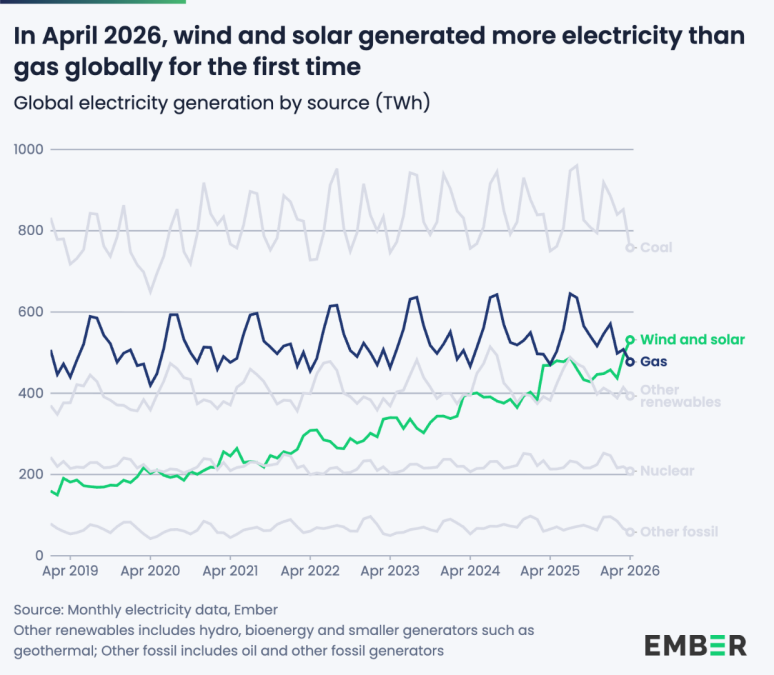
Ember pointed out that this milestone was not caused by sudden factors in a single month, but the result of years of continuous expansion. Continuous installed capacity and technological progress have pushed wind and solar power to almost meet global new electricity demand in April 2026, thus significantly restraining the growth space of gas-fired power generation. It is worth noting that although energy security and fuel prices have triggered concerns about the "resurgence of coal power", relevant data do not show a large-scale retreat from gas to coal.
Looking at major markets, wind and solar power generation grew in April in almost all economies that have released data. Globally, wind and solar power generation increased by approximately 13% year-on-year, including 14% in China, 13% in the European Union, 35% in the United Kingdom, 8% in the United States, 17% in Australia, 24% in Chile, and 4% in Brazil. For the northern hemisphere, April is often one of the months with the strongest wind and solar performance. On the one hand, wind resources are usually relatively abundant. On the other hand, as sunshine conditions improve, photovoltaic output increases. At this time, it is in the "off season" between heating and cooling. The overall electricity demand is relatively mild, and it is more likely to have a "node month" when the proportion of renewable energy reaches a record high. Ember's previously released "Global Power Review" report also pointed out that all growth in global electricity demand in 2025 has been met by wind power and photovoltaics, highlighting that this structural trend is accelerating and consolidating.
At the policy level, governments are accelerating renewable energy strategies to reduce dependence on volatile fossil fuel imports. The latest plans tracked by the Global Renewable Energy Alliance show that Indonesia plans to develop "photovoltaic + energy storage" projects totaling 100 GW, while South Korea proposes to increase installed renewable energy capacity to 100 GW by 2030, approximately three times the current level. In addition, many countries, including the Philippines, Thailand and the United Kingdom, are also accelerating the deployment of a new round of renewable energy projects in an attempt to improve energy security and economic resilience through large-scale local clean energy development.
Ember's global power analyst Kostantsa Rangelova said that one of the reasons why countries are accelerating the deployment of wind power and photovoltaics is that they are "cheap, local, and safe." The current energy crisis has further highlighted the cost advantage of renewable energy compared with imported gas at the economic level, and has also made accelerating the deployment of wind and solar energy an urgent issue at the political level. For countries that are highly dependent on imports, it is increasingly difficult for gas-fired power, dominated by liquefied natural gas, to compete with wind power and photovoltaics in terms of cost and risk. This also lays the foundation for the dominance of renewable energy in the future power system.