An international scientific research team led by the Max Planck Institute for Radio Astronomy in Germany announced that they have obtained the first direct evidence of a pair of closely orbiting supermassive black holes in the Hercules active galaxy Markarian 501 (Mrk 501) hundreds of millions of light-years away from the Earth. Research shows that the pair of black holes are exposed through two high-energy jets. The distance between them is only equivalent to 250 to 540 sun-Earth distances. The total mass can reach hundreds of millions or even billions of suns. Theoretically, they may merge in about 100 years and produce detectable low-frequency gravitational waves.
Current observations and theories generally believe that there is a supermassive black hole lurking in the center of almost every large galaxy, with a mass ranging from millions to billions of suns. However, how these behemoths grow rapidly on the cosmic time scale remains a key unsolved mystery in astrophysics. It is difficult to explain their mass growth solely by slowly accreting surrounding gas, so researchers have always suspected that mergers between large-scale black holes play an important role. Since galaxy collisions are quite common in the universe, it is considered an inevitable process for the central black holes to gradually approach each other under the influence of gravity and form a binary black hole system. However, until this observation, the astronomical community had not clearly identified a pair of supermassive black holes in the final compact stage.
The study targeted Mrk 501, a well-known class of blazar galaxies whose central black hole has long been known and is famous for a relativistic jet aimed almost at Earth. To probe deeply into the core of the galaxy, the team compiled and analyzed high-resolution radio observation data spanning about 23 years and in multiple frequency bands from dozens of observational missions, with a resolution high enough to track the evolution of fine structures in the jets over time. To the researchers' surprise, in addition to the well-known main jet heading toward Earth, they identified a second jet near the core.
Silke Britzen, the first author of the paper, pointed out that this is the first time that the structure of this type of system has been clearly imaged in the core of a galaxy, providing strong direct evidence for a second supermassive black hole. In the images, the team marked bright spots in the jet through equal-intensity contours and model fitting, and compared the displacement and morphological changes of these structures between different observation days to track the movement of the jet. The results showed that the previously known jet (labeled "Jet 1") was clearly pointed towards the Earth, while the newly discovered "Jet 2" pointed in a different direction, changing significantly in just a few weeks, with the starting points of the two jets being extremely close in the core of the galaxy.
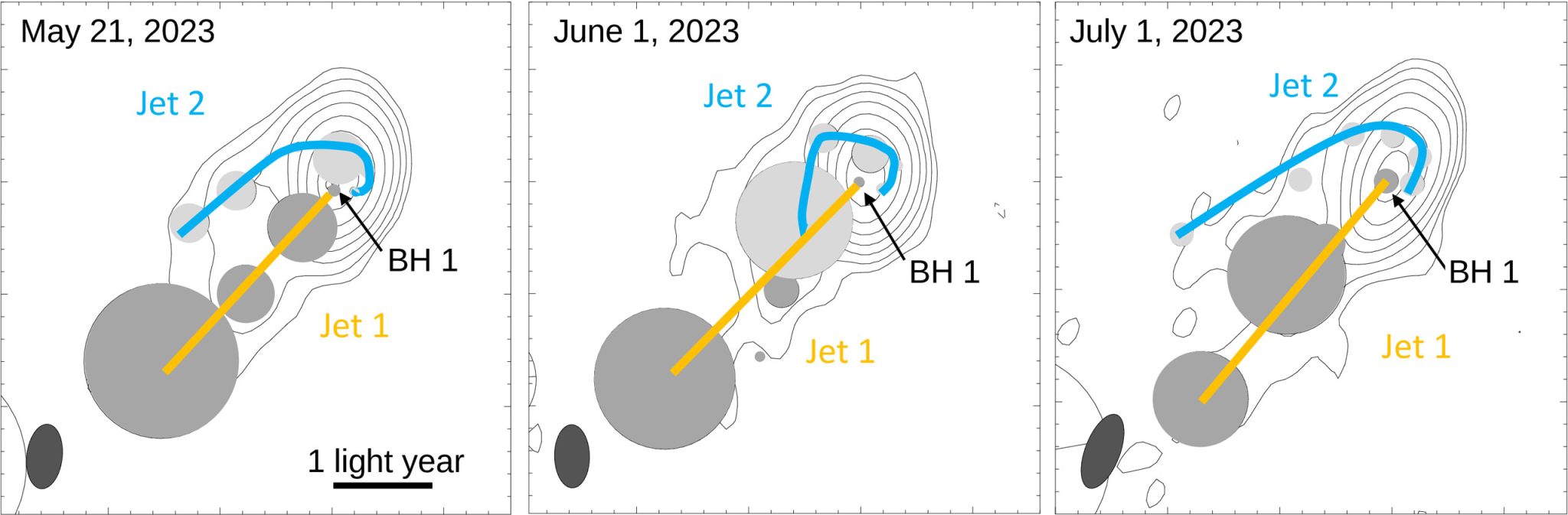
To astronomers, Jet 1 appears unusually bright because it is heading almost directly toward us, and has been a classic example of relativistic jets for many years. In contrast, Jet 2 is oriented away from the line of sight and has long been difficult to resolve from the complex radio structure. In the latest data, researchers found that this second jet seems to "peep out" from behind the more massive black hole and moves around it in a counterclockwise direction, forming periodic geometric changes and brightness changes. Blitzen described the data analysis process as "like standing on a ship and observing the entire jet system swaying." Only by introducing a dual black hole system and allowing its orbital plane to swing can this series of dynamic phenomena be reasonably explained.
Even more dramatically, during an observation in June 2022, the path of radiation from the system was severely distorted, creating an "Einstein ring"-like feature in the image. The research team believes that at that time, the system was almost perfectly aligned with the line of sight of the Earth. The larger black hole in the foreground bent the light from the background jet like a lens, making it appear ring-shaped to us. This is a typical strong gravitational lensing effect. This rare phenomenon further supports the explanatory framework of "dual black holes + dual jets + gravitational lensing".
By analyzing long-term brightness changes and periodic changes in jet morphology, the research team inferred that the pair of supermassive black holes orbit each other with a period of about 121 days. Their distance is equivalent to 250 to 540 Earth-Sun average distances, or about 2.32 to 5.02 billion miles (about 37.4 to 80.8 billion kilometers), an extremely close orbital distance for objects with masses between 100 million and a billion suns. According to model calculations of different mass combinations, the pair of black holes may further lose orbital energy and eventually merge in as little as a hundred years or so, becoming a rare "quasi-real-time" supermassive black hole merger candidate in the history of astronomy.
Nevertheless, because Mrk 501 is so far away from the Earth, even the most advanced facilities such as the Event Horizon Telescope (EHT) are difficult to completely resolve the two black holes into independent points of light in the sky. In other words, astronomers cannot directly image the entire process of the pair of black holes approaching each other and merging like they did when taking the first black hole photo. They can only rely on the evolution of the jet structure and overall brightness behavior to indirectly track their orbital contraction.
However, researchers predict that as the twin black holes continue to spiral closer to each other, they will release extremely low-frequency gravitational waves, which are expected to be detected by the Pulsar Timing Array (PTA). In recent years, results released by multiple cooperation projects such as the European Pulsar Timing Array have shown that a gravitational wave background formed by the superposition of many supermassive black hole binaries has been initially detected, and the supermassive black hole binary system is regarded as the dominant source of this background. Mrk 501 was confirmed as a candidate for a close binary black hole this time, making it one of the best targets for unifying PTA signals with specific celestial systems in the future.
Héctor Olivares, a co-author of the paper, pointed out that if a clear gravitational wave signal can be captured in this system in the future, and its frequency steadily increases with time, there will be an opportunity to "witness" the entire process of a supermassive black hole merger within the human observation time scale. This will not only become a milestone in gravitational wave astronomy, but will also provide an unprecedented laboratory for testing the applicability of general relativity under extremely strong gravitational fields and understanding the growth mechanism of black holes in the centers of galaxies.
Relevant research was published in the "Monthly Notices of the Royal Astronomical Society" on March 27, 2026 in the form of a paper titled "Detection of a second jet within the nuclear core of Mrk 501". As a work that has achieved breakthroughs in radio interferometry, long-term sequence analysis, and gravitational lensing interpretation, this discovery is considered to provide key evidence for understanding how supermassive black holes achieve "leapfrog growth" through mergers, and also points the way for future gravitational wave observations to locate the specific source.