The National Aeronautics and Space Administration (NASA) recently announced that astronomers used the James Webb Space Telescope to obtain for the first time the "chemical fingerprint" of a comet from outside the solar system - 3I/ATLAS - in the mid-infrared band, revealing that it contains methane and a large amount of volatile materials such as carbon dioxide, indicating that this interstellar visitor may have been born in a planetary system completely different from the solar system.
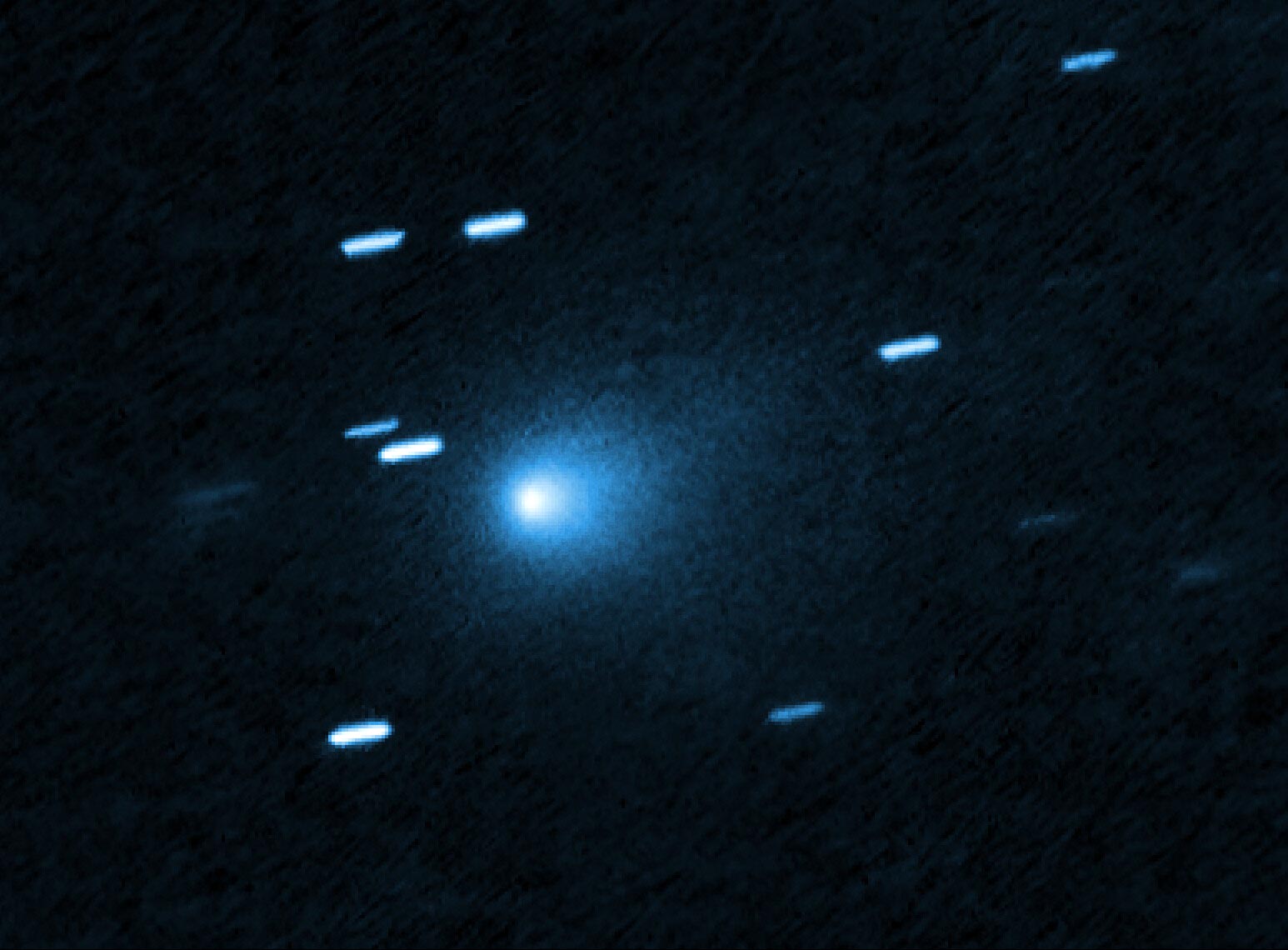
3I/ATLAS is a rare interstellar comet that did not originate in the solar system, but broke into our interstellar neighborhood after breaking away from planetary systems around other stars. The Hubble Space Telescope imaged it as early as July 21, 2025, when the comet was about 365 million kilometers away from the Earth. The latest observations from the Webb Telescope have further revealed the detailed chemical composition of the surrounding gas in the mid-infrared band.
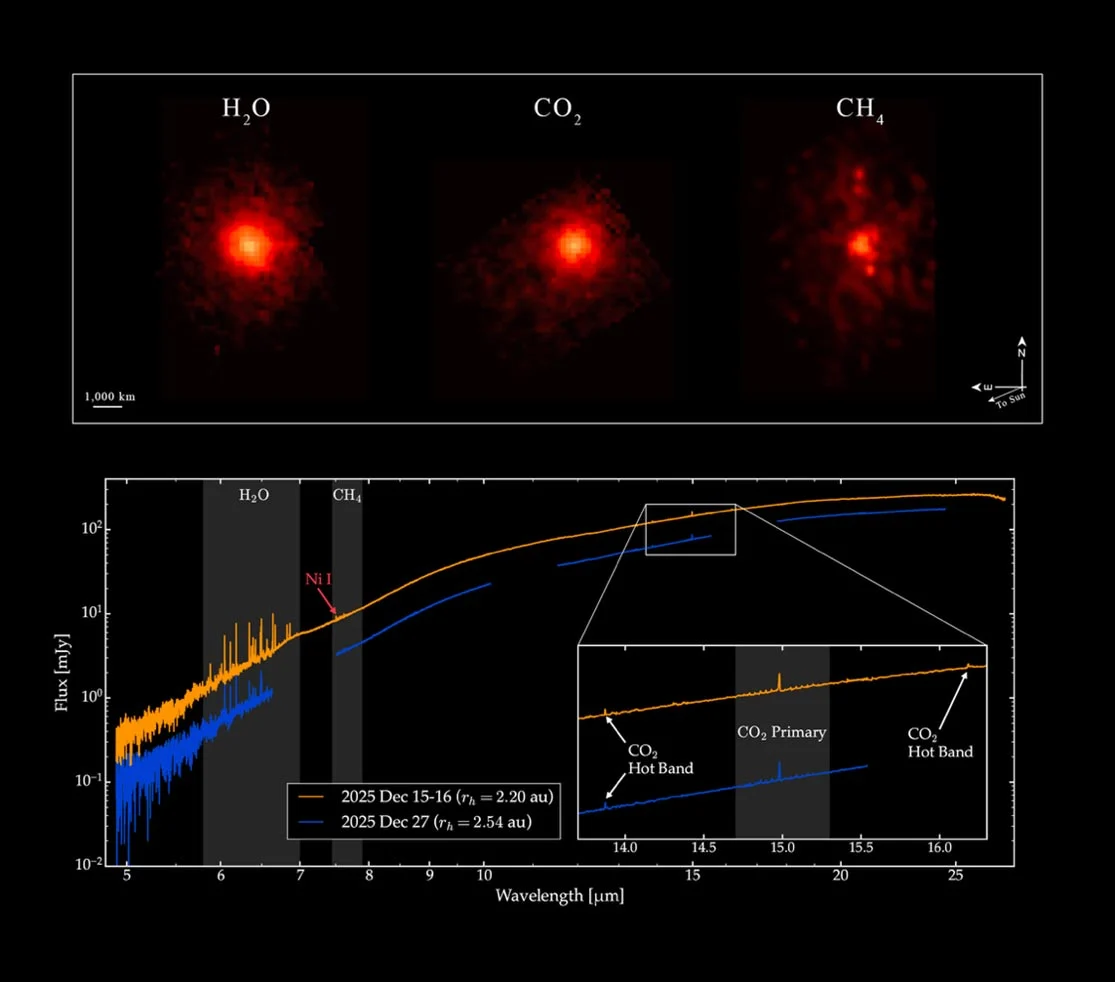
The research team used the mid-infrared instrument MIRI (Mid-Infrared Instrument) equipped with the Webb Telescope to conduct two tracking observations of 3I/ATLAS as the comet passed perihelion and gradually moved away from the sun. The first observation took place on December 15 and 16, 2025, when the comet was about 205 million miles (about 329 million kilometers) from the sun; the second observation was carried out on December 27, when it had moved away to a position of about 236 million miles (about 379 million kilometers).
The observation results show that this is the first time that humans have directly detected methane gas on an interstellar object. Methane is a highly volatile substance that quickly changes from solid ice to gas, usually at a slight increase in temperature. The methane detected this time appeared after the comet passed perihelion, which indicates that the methane may have been buried under the surface of the comet nucleus for a long time, shielded by the outer layer of material, and did not volatilize and escape in the early heating stage.
Scientists speculate that when 3I/ATLAS approaches the sun, sunlight continues to heat the ice in the deeper layers of the comet's core, causing the methane that was previously wrapped and stored inside to be released and diffuse out from around the comet in the form of gas. Surprisingly, the methane detected this time is relatively abundant compared to water vapor. This chemical ratio is extremely rare among comets in the solar system, highlighting the difference in composition between this interstellar comet and local comets.
In addition to methane, MIRI spectra also confirmed that the carbon dioxide content in 3I/ATLAS is also abnormally high. This comet released a significantly higher ratio of carbon dioxide relative to water than typical solar system comets. Combined with the unusual abundances of two volatile species, methane and carbon dioxide, the research team believes that this combination points to a formation site that is very different from the environment we are familiar with in the early solar system.
Researchers pointed out that the high content of methane and carbon dioxide in 3I/ATLAS may reflect that the temperature, chemical composition and radiation conditions of the protoplanetary disk around its parent star are significantly different from those in the solar system. For example, it may have formed in a colder region rich in certain carbon-based molecules, or it may have undergone different migration and evolution processes after formation, thereby "sealing" chemical signatures in the ice that are different from those of solar system comets.
As the comet continued to orbit away from the sun, the Webb Telescope recorded a significant decrease in its gas release activity, especially the most significant decrease in water vapor production. The scientific research team explained that this phenomenon is in line with the general expectations of the physical process of comets: the farther a comet is from the sun, the less heat it receives, and the sublimation efficiency of surface and internal ice bodies decreases, so the gas release rate of various volatile substances will decrease.
Water ice is less volatile than methane and carbon dioxide, so when the comet moves away from the sun and the temperature continues to drop, the production of water vapor will be the first to show a sharp decline. This change provides scientists with a dynamic perspective to observe the release behavior of different volatiles at different locations in the comet's orbit, thereby constraining the composition and structure of different levels within the comet's nucleus.
At the technical level, this observation relied on the Medium Resolution Spectrometer (Medium Resolution Spectrometer) in MIRI. The instrument can break down mid-infrared light into different wavelengths and simultaneously acquire spectral data at various locations in a small sky area in the form of an "Integral Field Unit". In this way, scientists can both identify the specific gas compositions surrounding the comet's nucleus and map the spatial distribution of these gases in the coma.
Image analysis shows that the water vapor is distributed far beyond the comet nucleus itself, because a significant amount of the water is released when icy particles in the coma are heated. In contrast, carbon dioxide and methane are more concentrated near the comet nucleus, indicating that they mainly originate directly from the sublimation of the ice layer inside the comet nucleus. By comparing the spatial distribution of different types of gases, the research team was able to more precisely characterize the sources and volatilization mechanisms of materials in each layer inside 3I/ATLAS.
Astronomers point out that each interstellar comet is like a "chemical sample" from an alien planetary system, which can help humans compare the planet formation environments of different star systems. The observation results of 3I/ATLAS show that there are rich and diverse planetary systems and chemical types of small astronomical bodies in the universe, and the solar system is only one possibility. As equipment such as the Webb Telescope continues to operate, detailed observations from more interstellar visitors in the future are expected to further reveal the formation conditions and evolution trajectories of icy objects in other planetary systems.
Relevant research results have been published in "The Astrophysical Journal Letters", with the title of "The Volatile Inventory of 3I/ATLAS as Seen with JWST/MIRI". The author team includes Matthew Belyakov, Ian Wong, Bryce T. Bolin, M. Ryleigh Davis, Steven J. Bromley, Carey M. Lisse and Michael E. Brown. The article was officially published on April 8, 2026.