The FBI built a "fake town" in Huntsville, Alabama, to study and simulate the evolution of cyber attacks in the real world, covering everything from ordinary homes and vehicle systems to critical infrastructure such as hospitals and electricity. This facility, known as the "Cyber Range," covers an area of approximately 22,000 square feet and is equipped with gas stations, hospitals, convenience stores, and multiple fully furnished residences. The overall layout is similar to a small community.
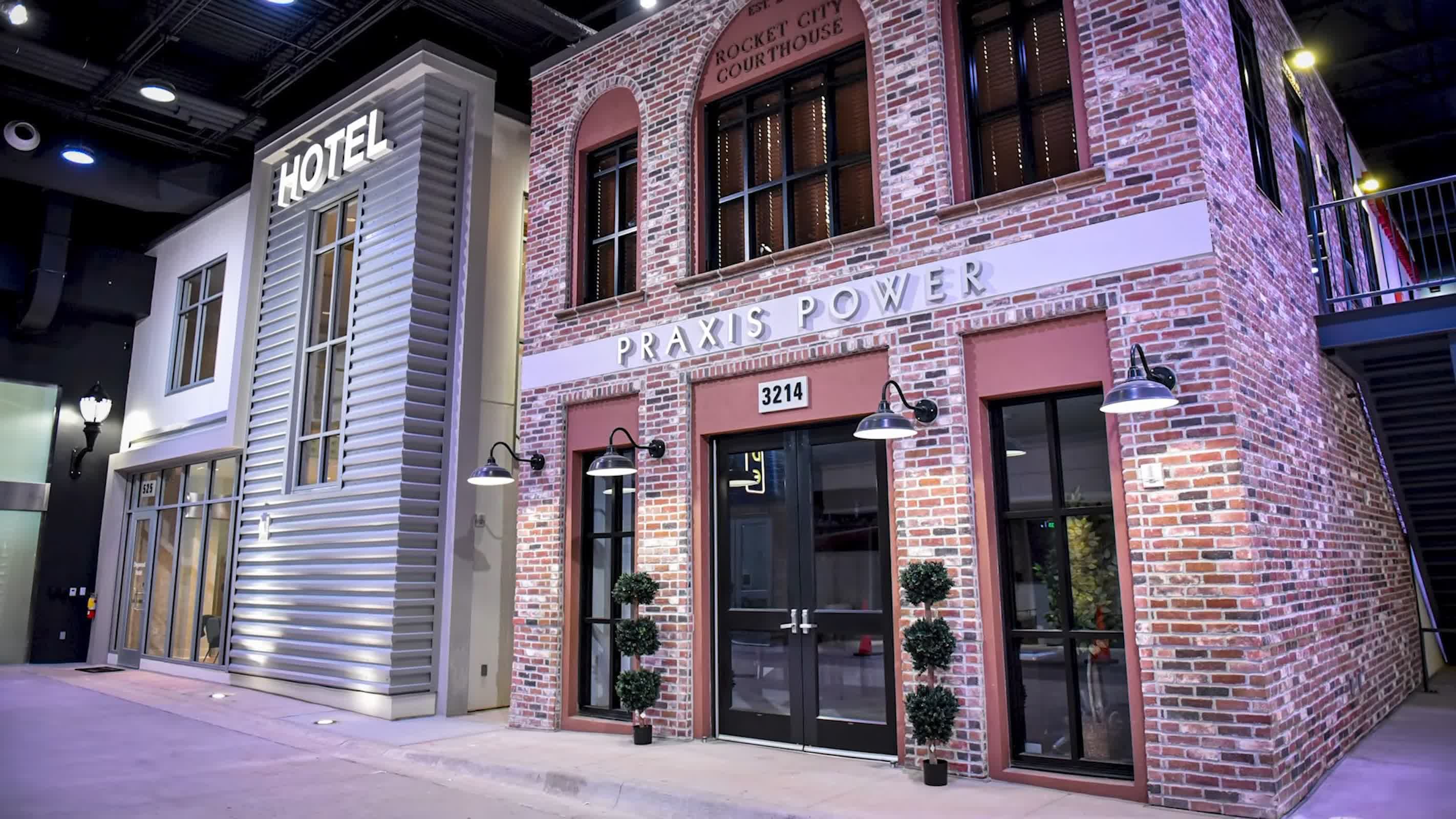
From the appearance, this network shooting range looks more like the scene layout used for traditional offline exercises, but in fact, almost all systems inside the facility have been connected to the Internet and are wired and configured according to the real community network environment, so that the network behavior of various equipment and systems can be as close as possible to the actual use status, which is one of the core purposes of its construction. The FBI officially opened this facility last year, and recently demonstrated its operation for the first time through a public video. The footage shows that the entire system is highly interconnected and is not spliced together from multiple isolated test environments, but operates as a unified and complete digital ecosystem.
This design aims to restore the development path of network events in the real world. In reality, network attacks are often not limited to a single system, but move laterally along the network, using various weak links to break through the defense line at unexpected nodes. For example, a compromised home device may become the entry point for a larger-scale intrusion. The FBI stated that the cyber range is designed to simulate such attack paths, hoping to observe the process of threats spreading between different systems by approximating real connectivity and complexity.
In this facility, everything from home networks to enterprise-level systems can be targeted for attack drills. Trainees and investigators will conduct various simulated scenarios here, including vehicle infotainment systems, hospital information technology infrastructure, and corporate security environments, focusing on observing the behavioral trajectory of attacks after gaining initial access and the way malicious code spreads between different interconnected systems. Through these practical exercises, relevant departments can better understand each stage of the attack chain and its impact on real-world infrastructure.
The cyber range is equipped with a small data center with more than 200 servers deployed, which is used to run various attack simulations, host malware samples, and record the evolution of different attack types in the time dimension. In this environment, researchers can observe the speed of threat spread, the specific vulnerabilities exploited by attackers, and the actual effects of defensive measures at different stages, providing data support for subsequent protection strategies and emergency response.
A key feature of the facility is its complete isolation from external networks. The FBI emphasized that all systems in the shooting range are not connected to the Internet or real production networks. This physically and logically "closed environment" allows them to conduct high-risk, highly experimental drills and tests without endangering external systems. In the context of the widespread existence of modern sophisticated malware and highly automated attack tools, ensuring that any experimental code or attack load cannot "escape" into the real environment is regarded as a prerequisite for the operation of such facilities.
In terms of exercise content, the cyber range is not limited to cyber security exercises in the conventional sense. Participants might study how an attack crippled a hospital network, or analyzed how malicious code planted within a system spread further along the interconnected systems of critical infrastructure such as power systems. In some cases, the focus of the exercise will shift to digital forensics and traceability, focusing on the event reconstruction process after the attack, and how investigators can restore the intrusion path and locate the source of the attack in a complex environment.
This facility has also been compared to the physical simulated town "Hogan's Alley" used by the FBI for a long time. While the latter is primarily used for tactical and law enforcement training in a physical environment, the Huntsville cyber range targets a completely different threat landscape—one in which digital systems are highly intertwined with real-world physical infrastructure. The FBI believes that as critical infrastructure, business systems and personal devices are fully connected to the network, the consequences of cyber attacks are no longer limited to data leaks, but may directly lead to security and operational risks in the real world.
Through this cyber range, the FBI and partner agencies can test defense hypotheses and contingency plans in a "failure-controllable" space. In a real production environment, security testing and attack drills must be strictly restricted to avoid affecting actual business operations, but in a shooting range, these restrictions can be deliberately relaxed to allow the system to be deliberately compromised in simulated attacks. Studying the "chain reaction" caused by attacks under controlled conditions can help relevant departments more systematically assess vulnerabilities, optimize defense configurations, and improve actual combat response capabilities.
The FBI pointed out that as the number of connected devices and online services continues to grow rapidly, the potential attack surface is also expanding, making it difficult to fully grasp the interactions between complex systems and the security issues they cause by relying solely on theoretical modeling and traditional experiments. In their view, in order to truly understand how these systems are interconnected and how attacks spread within them, it is necessary to have a "digital town" that can truly reproduce the experimental environment without causing real-life consequences, and this facility in Huntsville is one of the basic platforms built to meet this need.