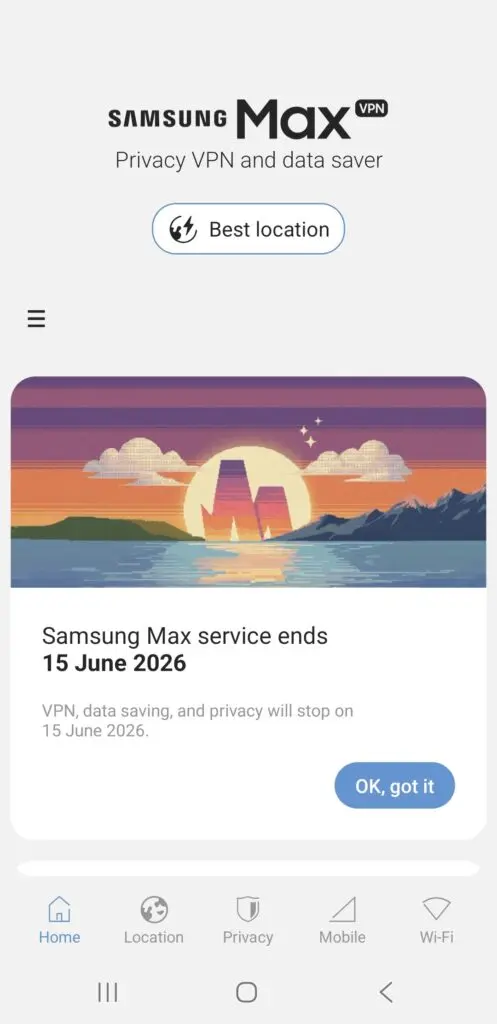
Samsung recently announced that its data saving and privacy protection application Samsung Max VPN will officially cease services starting from June 15, 2026. All VPN, data saving and privacy-related functions in the application have been completely terminated. The app, which has more than 50 million users worldwide, is now on Samsung's software "deactivation list."
Samsung Max was first launched on February 23, 2018. Its predecessor was Opera Max, a data-saving VPN service launched by Opera. After Opera announced the discontinuation of the service, Samsung acquired and took over the operation, renamed the product and transformed the interface to make it more in line with the system style of the Galaxy ecosystem.
As a tool focused on traffic compression and safe Internet access, Samsung Max can compress pictures, finely manage background data usage by application, reduce the traffic consumed by video playback, compress music files and optimize web page loading. In terms of privacy, it can block ad tracking in incognito mode and encrypt users’ network communications under public Wi‑Fi networks to improve online security.
Currently, when opening Samsung Max, users will first see an outage announcement banner, prompting that all VPN, data saving, and privacy services have stopped operating on June 15, 2026. Samsung did not explain the specific reasons for the shutdown, but only issued a farewell message in the announcement and Google Play application description, expressing its gratitude to users who have used the service for many years, saying that "your support and use mean a lot to us and have helped this app grow into what it is today."
The withdrawal of Samsung Max is the latest in a series of recent service adjustments by Samsung. Just two months ago, the South Korean tech giant announced that it would completely shut down its own text messaging app Samsung Messages, giving users until next month to fully switch to Google Messages.
According to the current plan, this messaging application switching will have less impact on older devices running Android 11 or earlier systems, and these devices will not be directly affected by the full suspension for the time being. For users who need to migrate to Google Messages, Samsung hopes to reduce the transition resistance by relying on the latter's series of functional advantages.
Google Messages provides features including AI-driven fraud SMS identification and suspicious link blocking, a quick reply generation tool integrated with Gemini AI, and customizable chat bubbles. At the same time, it also has universal RCS support, which can share higher quality pictures and videos when communicating with iOS users, and achieve seamless synchronization across devices such as tablets and smart watches.
On this basis, Google Messages also provides functions such as scheduled message sending, intelligent classification, and automatic classification and sorting for heavy communication users to optimize the multi-channel message management experience. As Samsung Max and Samsung Messages have successively withdrawn from the stage of history, Samsung's integration pace at the software and service level has further accelerated, and users have been guided more to communication and privacy tools under the Google ecosystem.