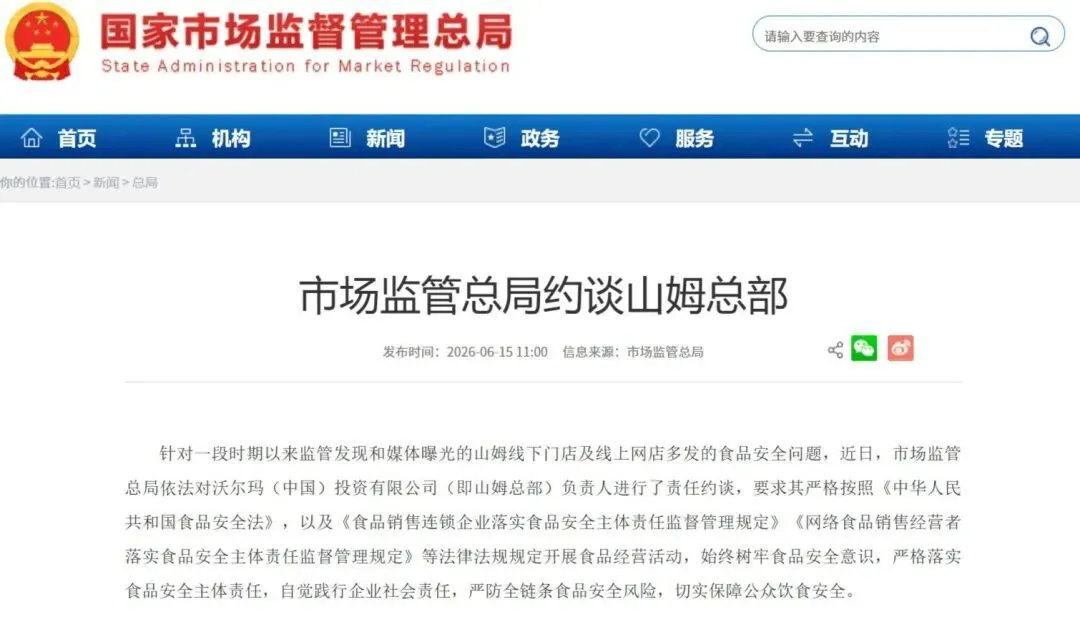
Sam's, which continues to expand rapidly in China, has once again attracted attention from the outside world due to food safety issues. On June 15, according to a report from the State Administration for Market Regulation, in response to the frequent food safety issues discovered in Sam's offline stores and online stores over a period of time, the State Administration for Market Regulation recently conducted a responsibility interview with the person in charge of Walmart (China) Investment Co., Ltd. (Sam's headquarters) in accordance with the law.
As a high-end membership-based supermarket that focuses on the "quality" label and is regarded as a standard for middle-class consumers, Sam's opened its first store in Shenzhen in 1996. As of May 2026, the number of stores in China has reached 67. This interview undoubtedly revealed the deep hidden dangers of its rapid expansion and sounded the alarm for Sam that food safety control cannot be relaxed.
In the past six years, the number of stores has doubled to 67:
Less than a year after Sam China’s coaching change, quality control has repeatedly been embroiled in controversy
In May 2026, two Sam stores in Jinan and Qingdao, Shandong Province, will open simultaneously. So far, the number of Sam's stores across the country has reached 67.
A reporter from "Daily Economic News" (hereinafter referred to as a reporter from "Daily Economic News") found that before 2021, Sam's expansion rate was not very fast. As of the opening of the first store in Huizhou in April 2021, Sam's has only 32 stores in the Chinese market for more than 20 years. At that time, Sam stated that it had maintained a rhythm of 4 to 5 new stores every year for consecutive years, and it was expected that by the end of 2022, there would be 40 to 45 stores open and under construction in China.
However, from April 2021 to May 2026, in less than six years, Sam has doubled the number of domestic stores.
Walmart’s first quarter results for fiscal year 2027 released in May showed that Walmart China achieved net sales of US$8 billion in the first quarter, a year-on-year increase of 22.3%, and comparable sales increased by 13.1%. Results show that Sam’s Club continues to maintain strong growth momentum, with 9 new stores added in the past 12 months and transaction volume continuing to grow at double digits.
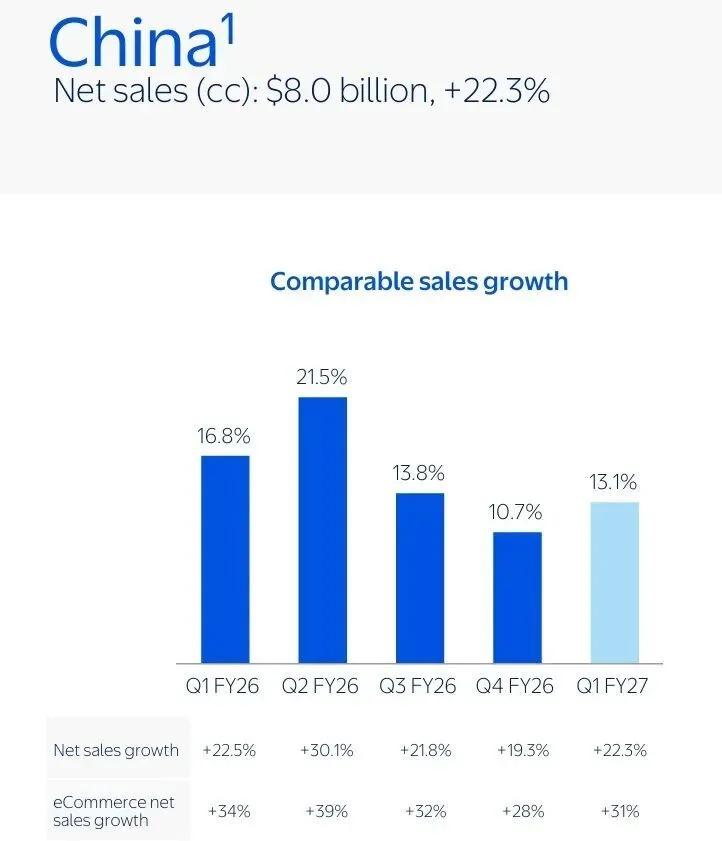
Image source: Walmart China official website
What continues to accelerate is not only sales and store expansion, but also Sam's "fast delivery" service.
According to Walmart’s financial report for the first quarter of fiscal year 2027, this quarter, Walmart’s China e-commerce business net sales increased by 31%, accounting for 50% of sales, an increase of 335 basis points compared with the same period last year.
In November 2025, during the conference call for the third quarter financial report of fiscal year 2026, Douglas McMillon, Walmart’s president, CEO and director, said: Nearly one-third of Walmart’s business outside the United States is digital business, and China’s e-commerce business accounts for 50%. He mentioned that the team in China is delivering orders quickly, with nearly 80% of digital orders arriving within an hour.
In May 2025, Walmart International President and CEO Kathyn McLay made it clear at the 41st Annual Strategic Decisions Conference of Bernstein's (Bernstein's Strategic Decisions Conference) that the core of Sam's success in the Chinese market is to combine high-quality selected products with highly impactful and affordable pricing, coupled with the convenient service of one-hour ultra-fast delivery. According to Kathyn McLay, customers can enjoy one-hour home delivery service. "The implementation method is to take each Sam store as the core, with about 8 to 10 cloud warehouses surrounding it. The cloud warehouse is a dark warehouse that is only responsible for online fulfillment and is completely under the coordination of the corresponding store."
According to this rough calculation, when Sam's stores in the Chinese market expand to 67, its latest number of cloud warehouses will be at least 536.
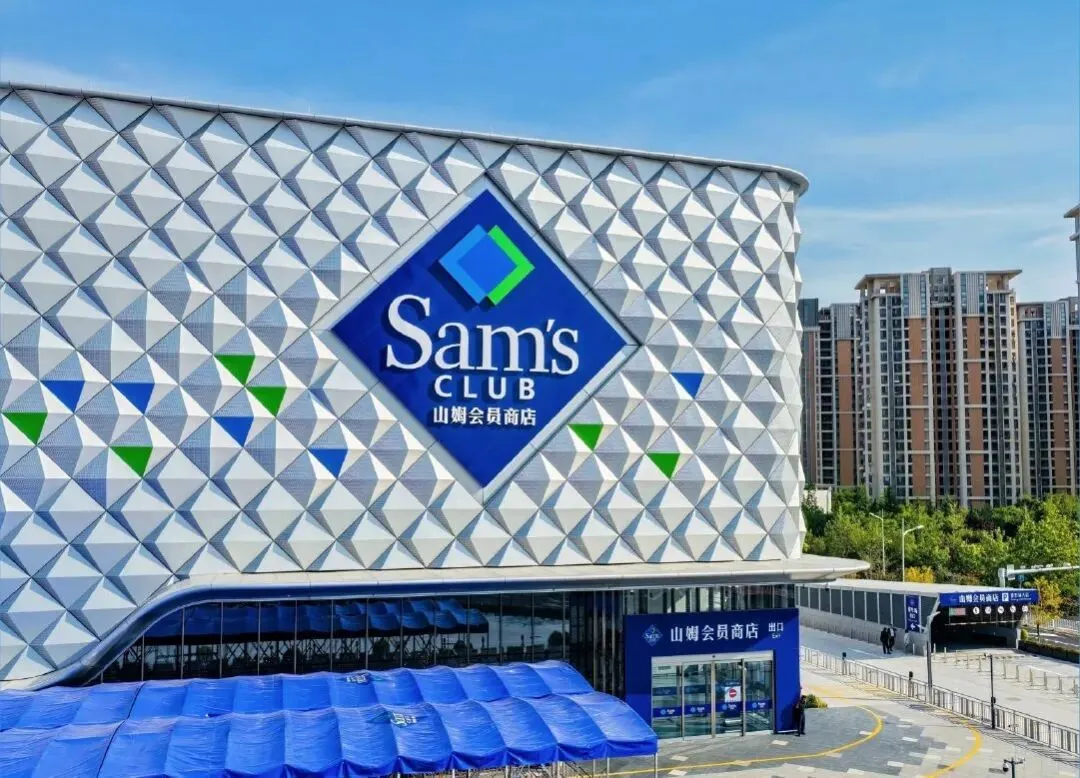
Image source: Sam’s Club official account
However, Sam China, which has been accelerating its expansion, has been exposed to food safety issues in the past two years. Controversies over product selection have also frequently arisen, and they have even been accused of "stabbing the middle class in the back."
In October 2025, a Shanghai netizen posted a video saying that he ate a tooth out of a jujube paste walnut cake purchased at the Waigaoqiao store of Sam's Club in Shanghai.
In December 2025, a piece of news that "live mice were found in Shenzhen Sam's Speedy Mochi boxes" spread quickly on social platforms. Sam's responded to reporters at that time, saying that it was initially determined that the product was accidentally invaded by surrounding pests while being placed at the pick-up point.
It was also reported that in May this year, consumers in Jiangsu reported feedback that a vegetable salad they ordered on May 10 through "Jisuda" turned out to be an expired food - the production date was May 7 and the shelf life was until May 11. In other words, there are less than 24 hours left before expiration when the goods are received. In addition, in April this year, some consumers reported eating maggots after buying udon noodles at Shenzhen Sam's. Officials responded at the time that no abnormalities had been found yet and that they were working with suppliers to conduct comprehensive inspections.
It is worth mentioning that in July 2025, Sam also launched large-scale regular brands such as Orion, Weilong, Liuliumei, and Hsu Fuji that can be purchased in ordinary supermarkets, which aroused strong doubts among its member groups: "Why do you have to pay high membership fees for brands that can be purchased in ordinary supermarkets?"
At that time, in January 2025, Andrew Miles, deputy CEO of Walmart China and president of Sam’s Club, who joined Walmart China in 2012 and has been responsible for the Sam’s Club business for a long time, had just retired. This deepened the outside world’s doubts about Sam’s outdated product selection ideas. It was not until October 2025 that Sam China officially changed its leadership: Liu Peng, a former Alibaba executive, joined Walmart China and served as president of Sam’s Club stores, reporting directly to Walmart China President and CEO Zhu Xiaojing.
It is understood that Liu Peng has successively served as general manager of Tmall International, president of Tmall's import and export business, vice president of Alibaba Group and president of B2C retail business group, and president of Taotian Group's Brand Business Development Center. Some people believe that the introduction of Liu Peng, who has many years of experience in operating Internet platforms, is related to Walmart China’s plan to accelerate Sam’s digital transformation and increase retail technology innovation.
However, judging from the timeline, Liu Peng's joining coincided with Sam's troubled years, and quality control was still plagued by controversy.
In response to the interview at the headquarters, Sam's responded to reporters on June 15: "We fully recognize, deeply reflect on and sincerely accept the problems and rectification requirements pointed out by the regulatory authorities during the interview. We deeply apologize for the trouble and inconvenience caused by related issues to members."
Sam's said that the company has set up a special rectification working group led by the management and launched an all-channel and all-link special self-examination and rectification as soon as possible. "We will strictly abide by relevant laws and regulatory requirements, comprehensively optimize food safety control and product quality control, strictly adhere to the bottom line of food safety, and improve member experience. We will regularly report rectification progress to regulatory authorities and actively accept supervision from all walks of life."
Market competition intensifies, and the impact of AI is coming:
Parent company Walmart is also at a turning point
Regarding the frequent problems related to Sam's quality and service, Zhuang Shuai, founder of Bailian Consulting, told reporters that the rapid expansion of the company will inevitably lead to some quality control and organizational problems. "With many people, many stores, and many products, management is more difficult. Managing 100 purchases is not the same level of difficulty as managing 1,000 purchases."
Hu Chuncai, founder of Shanghai Shangyi Consulting Company, told reporters that for companies like Sam's, which mainly focus on mid-to-high-end customer groups, their quality control and service must be the first in the industry in order to meet customers' expectations. Hu Chuncai believes that quality control of retail companies is difficult in the fresh food sector. "Fresh food is not standardized, and if you are not careful, it will lead to food safety accidents." In his view, faced with issues such as food safety, companies must sound the alarm during the expansion process.
It is worth mentioning that at the current stage, Sam's parent company Walmart itself is at a turning point, and the continued intensifying competition in the Chinese market has also brought certain pressure to it.
On April 27, Metro China announced that Andrew Miles will serve as executive chairman of Metro Commercial Group with immediate effect. Metro China said that Wen Ande will focus on promoting the company's strategic changes and long-term value construction. This time Wen Ande comes out again. Metro China obviously hopes to learn from its mature operating experience to boost its competitiveness in the member supermarket track.
In addition, German discount retail giant Aldi China is expanding simultaneously and rapidly. On June 19, ALDI will officially enter Yangzhou, and the renovation has been completed; on March 21, ALDI opened two stores in Zhenjiang. On the same day, ALDI opened another store in Minhang, Shanghai, and the number of stores nationwide officially exceeded 100.
At the same time, competition in the real-time retail track is further intensifying.
At the current stage, Hema is rapidly expanding stores across the country. As of May, Hema’s fresh food business has operated more than 490 stores. As of the first quarter, Meituan’s instant retail business Xiaoxiang Supermarket has covered 55 cities, with more than 2,000 front-end warehouses, and about 60% of them have achieved profitability. In April alone, Meituan’s hard-discount supermarket Happy Monkey announced the opening of new stores in Guangzhou, Foshan, Huzhou, Yuyao, Beijing and Langfang.
Image source: Walmart China official website
In addition to having to deal with increasingly fierce competition in the domestic retail market, Walmart itself is at a turning point in its transformation when looking at the global market.
In November 2025, Walmart officially announced a coaching change, and John Furner will take over as president of Walmart. The appointment will be effective from February 1, 2026. Walmart believes that John Furner is the right leader to lead Walmart into the next phase of growth and transformation.
In the conference call of Walmart’s first quarter financial report for fiscal year 2027, John R. Furner said that the company is fully transforming into an AI (artificial intelligence) native enterprise. "Relying on artificial intelligence, we can meet customer needs that previous technologies could not handle: not only making the shopping process simpler and the service more personalized, but also broadening the consumption scenarios and interaction forms that reach consumers and members." John R. Furner said that the AI shopping assistant Sparky is the core of achieving all this. Customers who use Sparky to place orders, the order price is about 35% higher than those who do not use it.
In the Chinese market, Qianwen, a subsidiary of Alibaba, launched an AI shopping function and fully integrated it with Taobao in May this year; in early April this year, Doubao, a subsidiary of ByteDance, began internal testing of the AI shopping function, eliminating the need to jump to Douyin Mall.
It can be found that in the global market, Walmart, which has recently changed its leadership, needs to face the transformation pressure brought by AI. In the Chinese market, Wal-Mart has to resist the encircling competition from competitors such as discount supermarkets and instant retail, while also adapting to the drastic changes in the domestic retail environment.
Against this background, Sam's, as Wal-Mart's core growth engine in China, is caught in a dilemma: Only by continuing to expand stores can it stabilize its market share, but rapid expansion can easily amplify quality control loopholes and management pressure. How to balance scale, quality and digital upgrade may have become the key to its success.
"For us in the Chinese market, it is crucial to win the trust of consumers." As Kathryn McLay said, this trust is the cornerstone of Sam's development and growth in China, and it is precisely the foundation that Sam needs to solidify most at the moment.