The United States and Iran have begun talks on a permanent peace deal that would seek to address Iran's nuclear program and permanently reopen the Strait of Hormuz. The first round of high-level meetings between representatives of the United States, Iran, Qatar and Pakistan began on Sunday in the Swiss resort of Bürgenstock, with US Vice President J.D. Vance and Iranian Foreign Minister Abbas Araghchi among others in attendance.
But just as the meeting began, U.S. President Donald Trump threatened in a social media post on Sunday to strike again if Iran does not "immediately stop its heavily funded proxies in Lebanon from causing trouble."
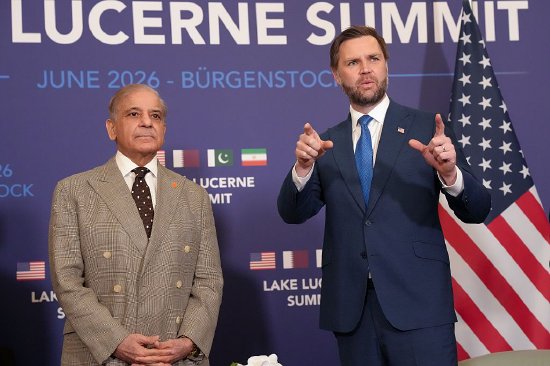
US Vice President Vance meets with Pakistani Prime Minister Shahbaz Sharif
While the hard-won interim deal signals a pause in U.S.-Iran hostilities, the meeting is likely to be just the beginning of protracted negotiations that will include Iran's nuclear capabilities and economic bailouts for Tehran.
"Today actually represents the beginning of a technical negotiation that will not resolve all differences," Vance told reporters, speaking alongside Pakistani and Qatari officials serving as mediators.
Vance said the meeting "will allow us, for the first time in history, to actually sit together as a team and figure out what the biggest concerns are on all sides, address those issues, deal with those issues, and move toward a better tomorrow."
The Iranian news agency quoted a person familiar with the matter as saying that the Iranian delegation refused to take a photo with the US delegation.
Iranian media reported that the current round of negotiations will last one day, with Tehran officials meeting with mediators before discussing with the United States later in the day.
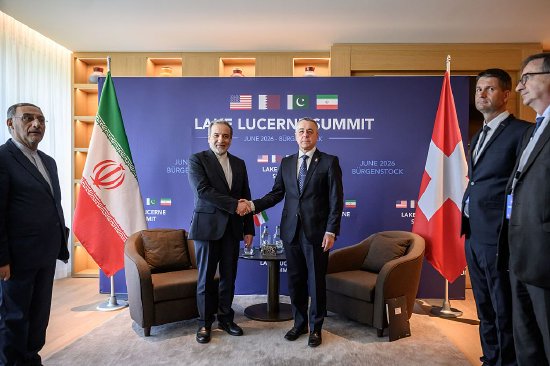
On June 21, Iranian Foreign Minister Abbas Araghchi (left) met with Swiss Foreign Minister Cassis on the shores of Lake Lucerne
The stakes in the negotiations are high, and recent fighting between Israel and Hezbollah, the Lebanese militant group backed by Iran, threatens diplomatic efforts. Israel is not a party to the interim agreement.
Iran's semi-official ISNA news agency said the main topics of the negotiations will be a "comprehensive ceasefire" in Lebanon (Iran demands that Israel withdraw its troops from Lebanon) and the fate of billions of dollars in Iranian assets frozen overseas.
Tehran on Saturday accused Israel of violating a ceasefire in Lebanon and said the Strait of Hormuz would be closed again. Despite the announcement, millions of barrels of oil continue to be transported through the waterway.
Under the terms of the memorandum of understanding signed by Trump on Wednesday, the United States and Iran have 60 days to negotiate, although the deal allows for extensions.
Earlier, Vance said the goal was to establish a "real negotiating structure" and build on technical discussions in Switzerland. Two of Trump's global negotiators, Jared Kushner and Steve Witkoff, were involved in those discussions.
Iran's statements regarding the Strait of Hormuz have cast a shadow over negotiations, but the immediate impact on ship traffic is unclear. Even before the recent ceasefire, millions of barrels of oil were quietly making their way out of the waterway every day.
Three fully laden, India-linked very large oil tankers reappeared in the Gulf of Oman on Sunday, ship tracking data compiled by Bloomberg showed, after they signaled an attempt to transit the strait on Friday.
Vance told reporters in Switzerland on Sunday that the parties had made "very good progress" in the past few hours.
"I expect more progress to be made in the next few hours," he said.