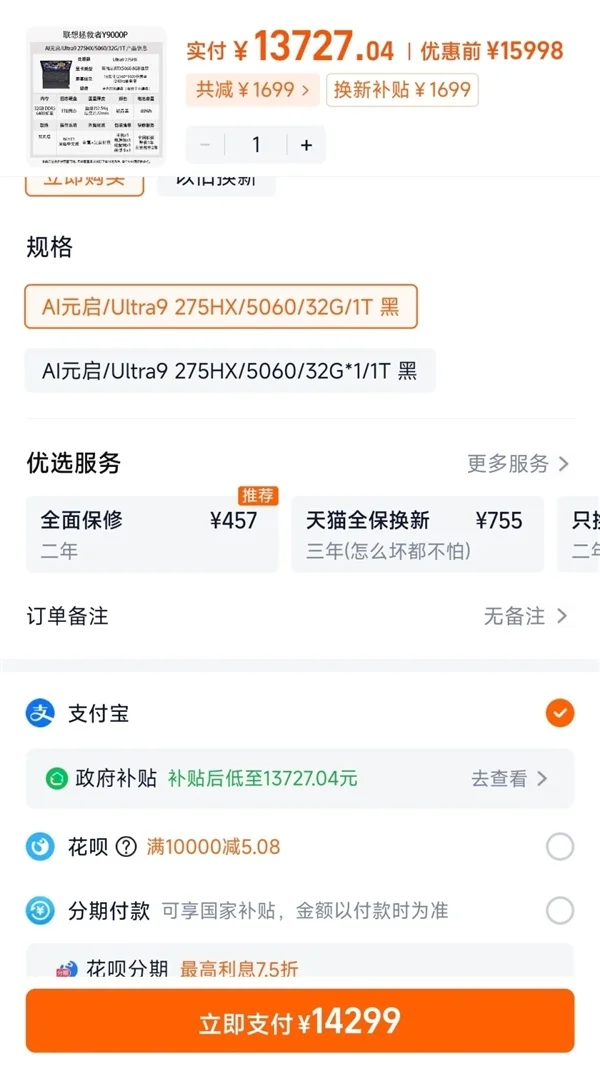
Recently, the computer market has experienced a significant price increase, with mainstream brand terminal prices such as Lenovo, Asus, and HP continuing to rise.At the end of May, a user spent 10,800 yuan on the Lenovo Savior Y9000P with the help of tens of billions of e-commerce subsidies. Less than a month later, the price of the same model had soared to 13,700 yuan, with a price difference of nearly 3,000 yuan.
Another popular model, ASUS Tianxuan 6Pro, has seen a price increase of nearly a thousand yuan in the past month or two. Even with the addition of national consumption subsidies, the price still reaches 8,999 yuan, which is much higher than the previous low price.
All ordinary thin and light laptops in the industry are not spared, and generally see price increases of several hundred yuan.
Faced with crazy price increases, the pressure on offline dealers has increased dramatically.
Many merchants admit that the current computer market prices fluctuate every day and price fluctuations are extremely frequent. In order to avoid the risk of losses, they currently dare not stock up in large quantities. They only maintain the minimum order quantity required by the manufacturer and respond cautiously to market fluctuations.
The overall price increase of notebooks this time is caused by the superposition of multiple factors on both the supply and demand sides.
On the demand side, the end of the college entrance examination has led to a summer purchase boom among students. At the same time, AI notebooks have become widely popular, consumers' demand for replacements has increased, and the overall market purchase enthusiasm has continued to rise.
The supply level is the core reason for the price increase. The global AI computing power industry is developing rapidly. Leading storage manufacturers such as Samsung and Micron have prioritized high-end production capacity for server storage chips, and the supply of consumer-grade memory and solid-state drives has tightened significantly.
The production capacity of core chips such as CPUs and graphics cards is tilted towards the computing power market, and the cost of raw materials for complete computer machines continues to rise. In addition, the prices of accessories such as screens and batteries have increased, and consumer subsidies have gradually withdrawn from the market, further boosting the increase in terminal selling prices.
Industry experts analyze that the overall inventory of the PC industry is currently low, and there is no room for price decline in the short term. Notebook prices will continue to run at a high level in the second half of this year, and popular game notebooks may increase slightly in price.
Based on IDC data, global PC shipments are still on a downward trend. If the industry wants to return to parity and balance between supply and demand, it needs to wait until 2028 for the launch of new storage production capacity.