The 67th Global Supercomputer TOP500 list was released on the 23rd at the 41st International Supercomputing Conference in Hamburg. China's independently developed "Lingsheng" supercomputer ranks first. "Lingsheng" is deployed at China's National Supercomputing Center in Shenzhen. The system's measured sustained performance is as high as 2.19EFlops, making it the world's first supercomputing system with a sustained performance of over 20 exaflops.
On June 23, the International Supercomputing Conference in Hamburg, Germany (hereinafter referred to as the "ISC2026 Conference") released a list of the world's top 500 supercomputers. China's independently developed "Lingsheng" supercomputer achieved 2.19EFlops (10 EFlops per second).18sub-floating-point operations) sustained double-precision floating-point performance ranks among the top 500 global supercomputers. This is also the first time in nine years that my country’s supercomputing ranks first in the world again.
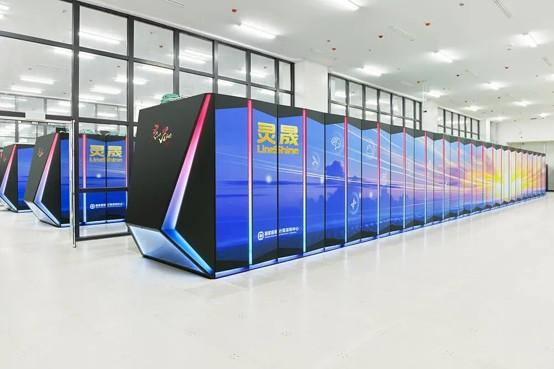
At the ISC2026 conference, the National Supercomputing Shenzhen Center released a new generation of "Lingsheng" supercomputing system with a measured sustained performance of 2.19EFlops. It is the world's first supercomputing system with a sustained performance of over 20 billion times (2EFlops). It innovates a superintelligent fusion architecture and leads the U.S. and European E-class supercomputing. China's supercomputing has returned to the first place in the world.
At the award ceremony, Lu Yutong, chief designer of the "Lingsheng" supercomputing system, director of the National Supercomputing Shenzhen Center, and professor of Sun Yat-sen University, introduced that the development of supercomputing has entered a new stage of super-intelligence integration, and the "Lingsheng" system is the first to be launched online. Acceleration's full-CPU architecture breaks the traditional CPU-GPU heterogeneous architecture barriers, with built-in AI matrix acceleration units, returning to the essence of computing acceleration, realizing efficient collaboration of multiple computing modes such as supercomputing and intelligent computing, and fully empowering scientific intelligent computing. It has achieved dual breakthroughs in computing power performance and widespread application. It has provided a reference solution for global supercomputing technology upgrades and large-scale applications, and has been highly praised by peers around the world.
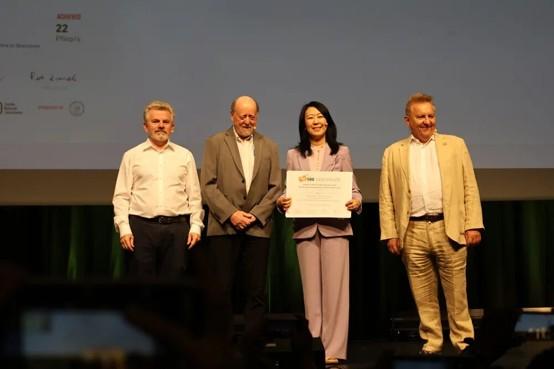
Jack Tangara, winner of the Turing Award and professor of the Department of Electrical Engineering and Computer Science at the University of Tennessee, commented, "China's 'Lingsheng' system has allowed the world to see the light of hope for supercomputing to lead to the new system architecture of AI4Science."
Behind "Lingsheng"'s computing power reaching the top is the comprehensive attack on a series of core technical barriers. Lu Yutong introduced that "Lingsheng" is positioned as a domestic full-stack integrated infrastructure for scientific and engineering intelligent computing.
It is reported that since the deployment of the system, "Lingsheng" has supported applications in many fields such as atmosphere and ocean, engineering simulation, materials science, drug discovery, brain science, scientific AI, and large model reasoning. It supports mixed-precision calculations, workflows, and complex multi-task parallel operations. The average expansion efficiency is 84.4% in a large-scale parallel environment, achieving efficient and scalable operation of the entire system with more than 10 million cores. Facing the large-scale application needs in various fields of science, engineering, and industry, we provide a multi-disciplinary, full-process, and multi-precision integrated scientific intelligent application production-level platform, and have formed world-class application results.