A study published in Nature shows that light not only illuminates the material, but may also "slow down" carbon nanotubes suspended in water. The researchers found that when they shined light on carbon nanotubes in water, the diffusion rate of these tiny structures decreased, and the stronger the light, the slower they moved, a phenomenon the team calls "light-induced quantum friction."
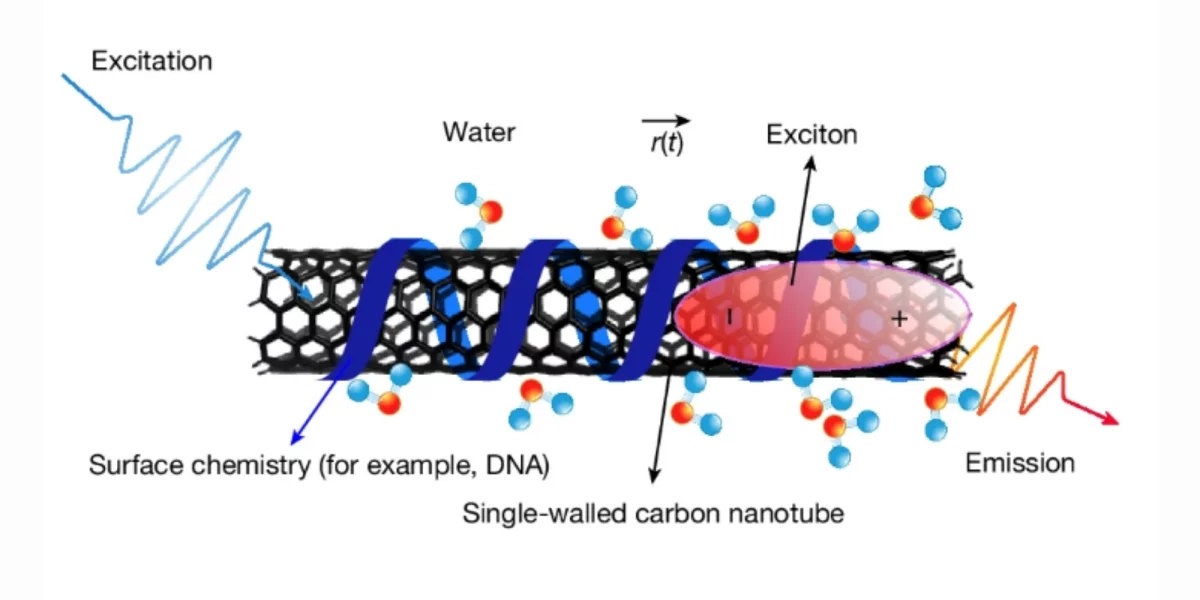
Quantum friction itself is a rather counter-intuitive concept. It is not a drag force caused by direct friction between two surfaces in the traditional sense, but a drag force caused by quantum "noise" that may appear between two surfaces, or between a surface and a liquid. Marialore Sulpizi, a theoretical physicist at Ruhr University Bochum and head of modeling and simulation of this study, said that this phenomenon is beyond the scope of explanation of classical mechanics, and its resistance comes from the special behavior of electrons that follow the laws of quantum mechanics.
The research team did not initially conduct the experiment to look for friction. They were studying a type of carbon nanotube that emits light in near-infrared light, a type of material that has attracted attention for its suitability for biological imaging. But while observing the random motion of these nanotubes in water, they unexpectedly discovered an anomaly: When light hit the material, the particles moved slower than before. As the experiment continued, the team used chemical means to adjust the luminescence intensity of the nanotubes, and the results were still the same—the stronger the luminescence, the slower the diffusion; the weaker the luminescence, the faster they moved.
Researchers believe the key to the answer lies in the way carbon nanotubes respond when they absorb light. After absorbing light, they produce a short-lived excited state called an exciton; unlike many materials, excitons in carbon nanotubes can move along the tube body. These excitons carry fluctuating charges as they move and interact with nearby water molecules with unbalanced charges, creating additional drag forces at the interface between the nanotubes and water, ultimately increasing overall friction and slowing diffusion.
To verify this mechanism, the team conducted computer simulations and further introduced chemical defects in the carbon nanotubes to "trap" the excitons in place. The results showed that once the excitons lose their ability to move, the light-induced friction effect disappears completely. Sulpizi says this shows that once excitons become localized, they can no longer interact with water in the same way. This also means that this kind of quantum friction is not a fixed material property, but a phenomenon that can be regulated and even controlled on and off.
Sebastian Kruss, a physical chemist at Ruhr-Universität Bochum and a co-author of the study, points out that this result is surprising because normally inputting energy into a system makes it move faster, not slower. But this work just shows that light doesn't always drive motion; it can also put the brakes on materials through interactions at the quantum level. Sulpizi said that this research shows for the first time that quantum friction can be induced and controlled by light, which is a new phenomenon that has never been observed before.
The implications of this discovery aren't limited to the laboratory. The behavior of the interface between carbon materials and water has long puzzled researchers. For example, water often flows differently than expected on the surface of carbon nanotubes or graphene, and quantum effects have long been thought to be one of the reasons. This research provides the most direct experimental support to date for this theory, and also provides new clues for understanding the complex relationship between light, matter and liquids in close contact.
However, the research is not over yet. The team doesn't yet know how this effect changes under different wavelengths of light, or whether similar behavior occurs in other nanomaterials. But in a broader sense, this result has shown that there is a microscopic connection between light, excited states and the environment that can directly act. This connection is not only important, but may also bring new application directions in future materials and nanotechnology research.