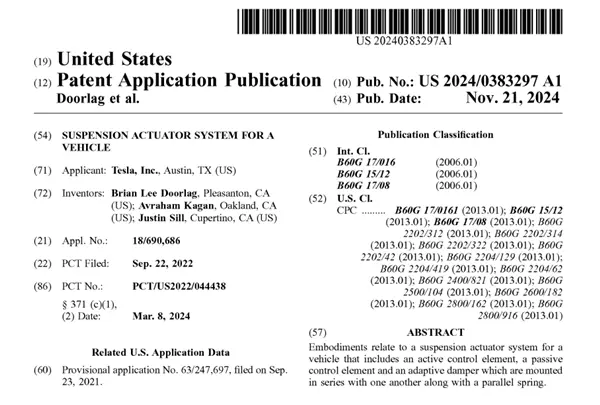
Recently, Tesla's patent application titled "Suspension Actuator System for a Vehicle" has been approved by the United States Patent and Trademark Office. The patent proposes a hybrid active suspension solution that combines active motor drive control with passive suspension components to improve the vehicle's comfort and reduce energy consumption when passing through potholes.
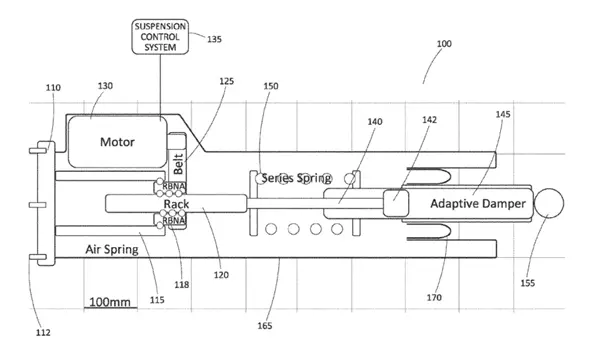
According to the patent description, the entire suspension system consists of four parts: active actuators, passive elastic elements, adaptive shock absorbers and parallel air springs.
The system drives the transmission belt through the electric motor, drives the ball nut and screw mechanism, adjusts the length of the suspension strut in real time, and accurately controls the lifting and lowering of the wheel to offset road bumps.
On-board accelerometers and wheel position monitors transmit data to the suspension control system, which processes it immediately and issues adjustment commands to the electric motors.
The core design of this solution is that an air spring is connected in parallel next to the active actuator, and the air spring bears most of the static body weight. The active actuator does not need to continuously resist gravity, but focuses on quickly responding to road changes.
Minor bumps on ordinary road surfaces are absorbed by passive elastic elements and adaptive shock absorbers, and active actuators only intervene when encountering larger bumps such as potholes and speed bumps.
When passing through dense and continuous potholes, the vehicle will continue to lift. When encountering scattered non-continuous potholes, it will lift briefly and then return to a low-resistance state.
From the perspective of vehicle architecture, this solution can reduce unnecessary energy loss and extend the life of related components.
From the perspective of driving experience, it can not only reduce the discomfort of bumps and high-frequency road noise, but also allow the driver to obtain more precise control when turning or accelerating.
In addition, Tesla has previously disclosed a "Road Roughness Map" patent (Patent No. US12594806B2). The map is generated from millions of data points collected by vehicle sensors. When each vehicle encounters a large bump, position data and suspension movement data will be uploaded and shared among all Tesla vehicles.
When the new patent is combined with the road roughness map, a relatively complete suspension control process will be formed: the vehicle first identifies the road conditions ahead through the shared map, and then the new patented system quickly adjusts the suspension attitude. The active actuator retracts the suspension struts and lifts the wheels before collision, and the parallel air springs and adaptive shock absorbers absorb the remaining impact force.
This means that it is possible for the vehicle to start adjusting the suspension before entering the pothole, rather than waiting until the wheels hit the pothole and then passively adjust it.
Tesla has not yet announced mass production plans for this technology, nor has it revealed which model it will be applied to first.