Affected by the overnight plunge in the Nasdaq index, which is heavy on technology stocks, the share prices of Samsung Electronics and SK Hynix plunged sharply on Thursday, dragging South Korea's benchmark stock index KOSPI lower. At the opening of early trading, Samsung Electronics' stock price fell by more than 7%, and SK Hynix's price fell by more than 9%. The market value of the two leading Asian chip companies has shrunk significantly, becoming the main pressure party in this round of global technology stock sell-off.
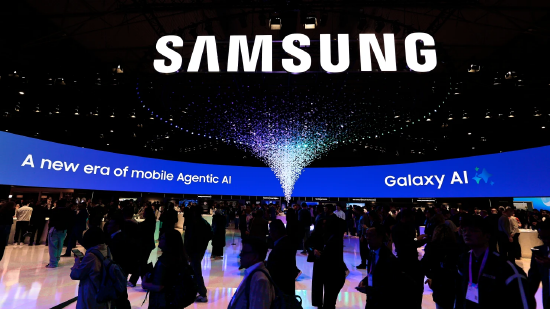
On March 4, 2026, at the Mobile World Congress in Barcelona, Spain, the Samsung booth focused on displaying a full range of terminal ecological products equipped with the Snapdragon 8 Gen5 mobile platform and the new generation of Samsung Galaxy AI technology. Participants experienced this new technology on the spot.
The share price of SK square, the largest shareholder of SK hynix, fell 13.2% to 1.525 million won, and the entire semiconductor industry generally suffered a decline.
At the close of the day, Samsung Electronics fell 9.06% to 286,000 won; SK Hynix plummeted 14.57% to 2.187 million won. Both stocks closed with tragic losses.
eToro market analyst Zavier Huang said in a research report: "At the end of last year, the combined weight of Samsung and SK Hynix accounted for only a quarter of the Korea Composite Index. Now the weight of the two companies is close to half of the total weight of the stock index. This is enough to show the huge influence of these two giants on South Korea's benchmark stock index."
"As long as one of the stock prices fluctuates significantly, it will directly lead to the overall weakening of the market, and the prices of the remaining nearly 900 listed companies will be affected by it."
Hong Kong stocks and mainland technology stocks also experienced widespread selling, and the decline in regional markets continued to spread. The Hong Kong stock price of SMIC, China’s leading domestic wafer foundry, fell by more than 11%; the Hong Kong stock price of Hua Hong Semiconductor, another domestic wafer manufacturer, fell by 14%.
Zhipu Technology, the Hong Kong listed entity of the large model company Zhipu AI, plummeted by more than 17%, and the Hong Kong stock price of domestic chip company Biren Technology fell by nearly 18%.
The current sell-off in the Asian market stemmed from the dismal start of Nasdaq in July, and investors concentrated on selling chip stocks.
On Wednesday's trading day on Wall Street, although Micron Technology's gains for the year were as high as 260%, its stock price fell by more than 10% that day; SanDisk also fell by more than 10% overnight.
Other large technology leaders such as Nvidia and Broadcom were lower in sync, with losses ranging from 1% to 2%.
Enterprise expansion planning
SK Hynix CEO Guo Luzheng announced earlier on Thursday that the company plans to invest 100 trillion won (approximately US$64.37 billion) in South Korea. Its M17 wafer factory will start construction next year and is expected to be officially put into production in the first half of 2029 in the Chungcheong Province area in central South Korea.
According to the investment plan, 80 trillion won will be used to build the M17 flash memory fab, which mainly produces NAND flash memory chips used in storage devices; the remaining 20 trillion won will be invested in the P&T7 advanced packaging base to upgrade the integration, packaging and testing technology of high-end chips.
"With the rapid development of artificial intelligence services, the market demand for high-bandwidth memory servers, dynamic random access memories, enterprise-class solid-state drives and NAND flash memory has skyrocketed," Guo Luzheng said when introducing the expansion plan at a public briefing held in Asan, a city south of Seoul. "This investment is precisely to match the rapidly growing market demand."
High-bandwidth memory (HBM) is a high-end storage chip equipped with artificial intelligence computing systems; dynamic random access memory (DRAM) is a mainstream memory type in computers and servers; enterprise-grade solid-state drives (SSD) are professional storage hardware designed for data centers.
Guo Luzheng also revealed that SK Group, the second largest enterprise group in South Korea and the parent company of SK Hynix, will expand artificial intelligence data center infrastructure across South Korea while laying out semiconductor production bases.
The CEO said: "We will deploy artificial intelligence data centers across the country in stages, with an initial planned installed capacity of 5 GW and a total capacity expansion of 15 GW in the long term."
Just a few days before this news was released, the South Korean government on Monday introduced major supportive investment policies to help the development of the country's artificial intelligence industry. It clearly plans that Samsung Electronics and SK Hynix will invest a total of 800 trillion won to jointly participate in the construction of national-level semiconductor ecological industry projects.
In addition, SK Hynix will officially issue American depositary receipts on Nasdaq on July 10, further broadening financing channels for U.S. investors.