Scientists used physical modeling to reconstruct the history of seismic activity over the past thousand years and found that many important faults in Southern California are currently accumulating abnormally high tectonic stresses. This energy is mainly concentrated along the San Andreas Fault and the San Jacinto Fault, which together bear the relative motion between the Pacific Plate and the North American Plate. In Cajon Pass, northeast of Los Angeles, two faults converge into a complex tectonic intersection that has long attracted seismologists' attention because ruptures on one fault could "cross over" to the other.
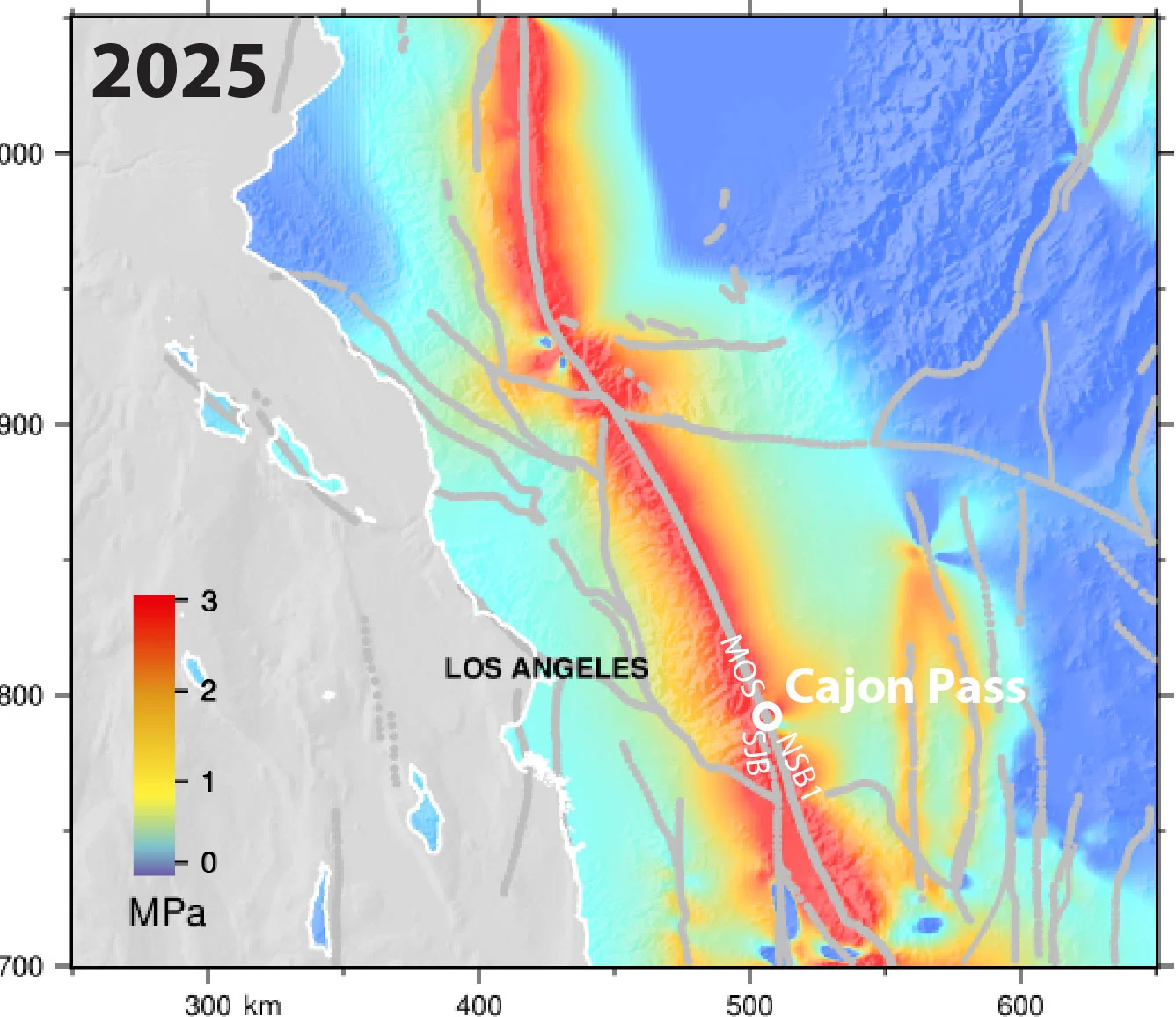
The Los Angeles area has not experienced a major earthquake of similar magnitude since the 7.9-magnitude Fort Tejon earthquake in 1857, but stress in the deep crust continues to slowly build. This long period of "relative calm" does not mean safety in the eyes of researchers, but is a signal of rising potential risks. The latest research was led by Dr. Liliana Burkhard from the Department of Space Research and Planetary Science at the Institute of Physics at the University of Bern, and was completed in collaboration with institutions such as the University of Hawaii at Manoa, the U.S. Geological Survey Pasadena Earthquake Science Center, and the Scripps Institution of Oceanography at the University of California, San Diego.
The team built a "four-dimensional" earthquake cycle physical model to simulate the evolution of faults in three-dimensional space and time, and input a sequence of earthquake events of about a thousand years into the model. This historical record comes from a variety of geological and environmental clues, including radiocarbon dating, tree ring anomalies, and historical surface rupture records, so as to restore the time and scale of large earthquakes as much as possible. The model successively tracks the changes in the stress distribution of adjacent fault segments caused by each earthquake, records the continuous accumulation of stress during earthquake intervals, and simulates the slow relaxation process in the deeper parts of the earth's crust after a major earthquake.
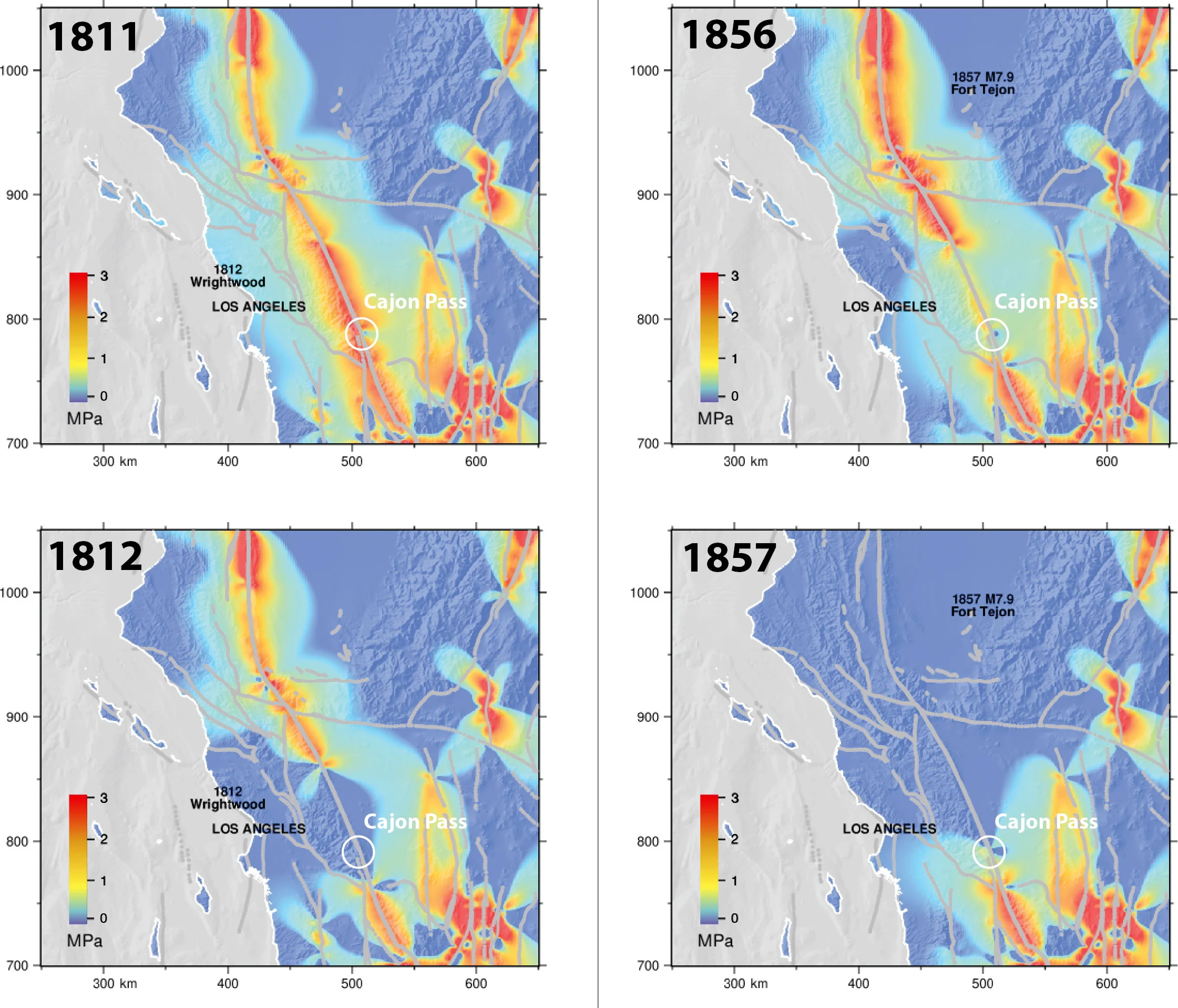
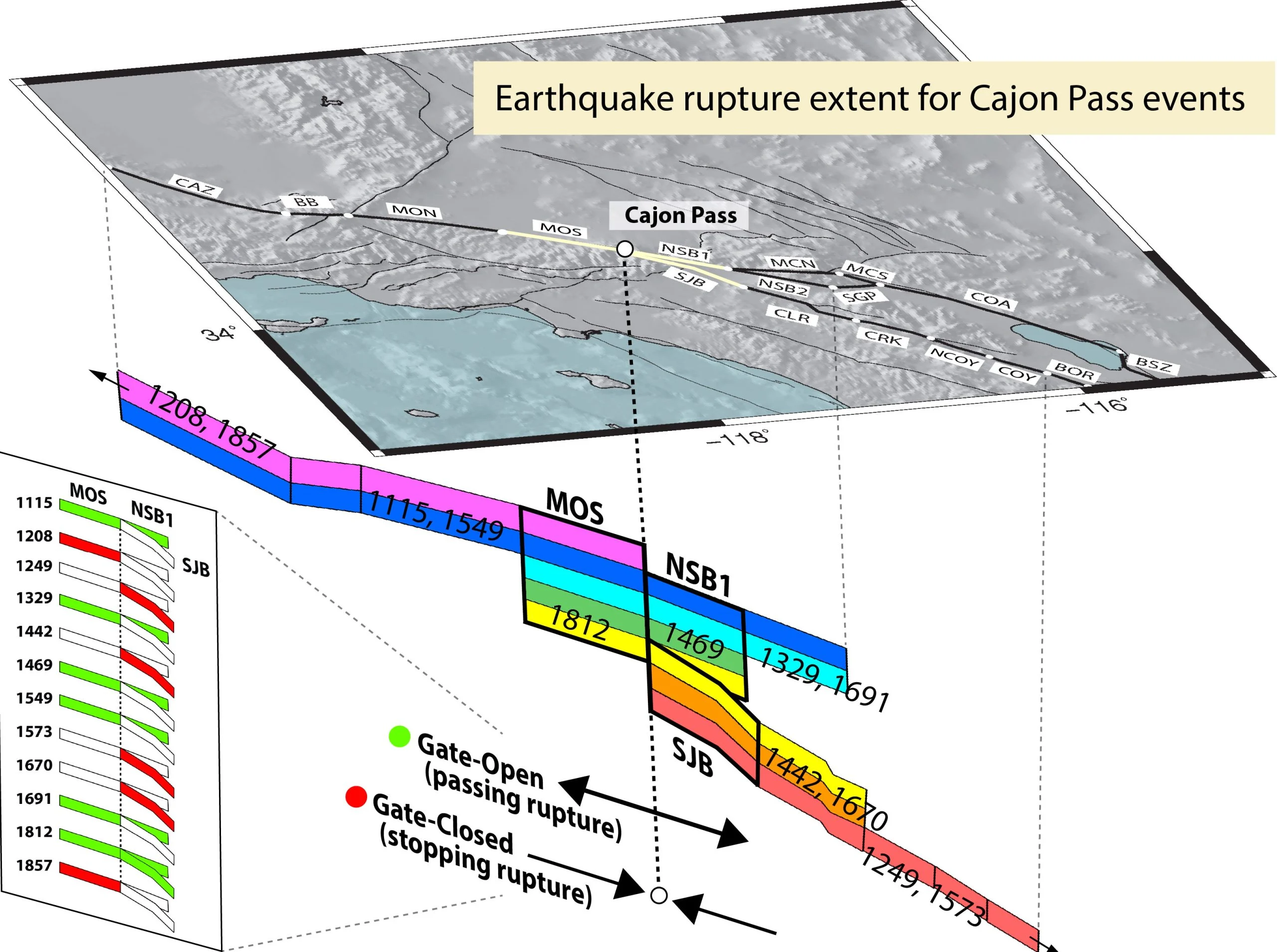
Modeling results show that current tectonic stress on associated faults in Southern California has reached or exceeded the highest levels in the past thousand years. The study specifically pointed out that the Cajon Pass is a typical "earthquake door", that is, this fault intersection area will determine at a critical moment whether a large-scale rupture will stop at a certain fault, or run through two sets of fault systems and evolve into a larger-scale linkage event. Historically, two situations have occurred: the 1812 Wrightwood earthquake passed through Cajon Pass and continuously ruptured the San Andres and San Jacinto faults; while the 1857 Fort Tejon earthquake terminated here and did not continue to affect the San Jacinto fault.
Burkhard noted that the Cajon Pass does not simply "block" or "channel" earthquakes, but responds to changing stress states. The study found that the key to determining whether a rupture can cross the "earthquake gate" lies not only in the stress on a certain fault, but also in whether the stress in the two fault systems increases simultaneously. When the San Andreas Fault and the San Jacinto Fault are in a high stress state at the same time, and the stress magnitudes are similar, it is more conducive to the formation of a large-scale through rupture across the two; on the contrary, if the two stresses are not synchronized, the rupture is more likely to terminate at the intersection.
Current models estimate Coulomb stress on the San Jacinto-Bernardino segment to be about 3.6 MPa, higher than anything seen in a thousand years of simulations. The stress in the adjacent Mojave southern section of the San Andreas fault is about 2.8 MPa, which is also at a high level and is not much different from the former. This pattern, in which two fault segments are highly loaded at the same time and have similar stresses, has often corresponded to large rupture events across both sets of faults in past records, making the research team particularly vigilant about future regional earthquake scenarios.
If a future major earthquake ruptured from one side of the San Andreas or San Jacinto faults and successfully linked the two sets of faults across Cajon Pass, the impact would be far greater than an event confined to a single fault. Threatened areas include some of the most densely populated and infrastructure-intensive corridors in the United States, such as the greater Los Angeles area, San Bernardino, Riverside and the Coachella Valley. The Kahun Pass itself is an important transportation artery, carrying many highways, railways and energy transmission trunk lines. Once it encounters a through-break, it will have a serious impact on the transportation and energy networks.
When and how the next large Southern California earthquake will occur is one of the most pressing questions in applied geoscience, Burkhard said. The physical model developed by the team provides a clearer quantitative picture of the stress state of the current fault system, and this analytical framework is applicable not only to California but also to other complex fault intersection areas around the world for assessing potential earthquake risks. She also emphasized that this study is not a direct prediction of the time of earthquake occurrence, but points out that the current system is in a "critical load" state, and various possible scenarios need to be included in disaster prevention and reduction planning.
According to researchers, through similar physical modeling methods, people can better understand the accumulation process of long-term tectonic stress and the "gating" effect of key fault intersection areas, thereby providing scientific basis for risk assessment, infrastructure site selection and reinforcement, and emergency preparedness. The related paper is titled "Cajon Pass and the Southern San Andreas Fault System: Earthquake Cyclic Stress Accumulation and Current Loading Conditions" and was published in the "Journal of Geophysical Research: Solid Earth". It was jointly signed by the University of Bern and several American research institutions, and was funded by the California State Earthquake Center and the National Science Foundation.