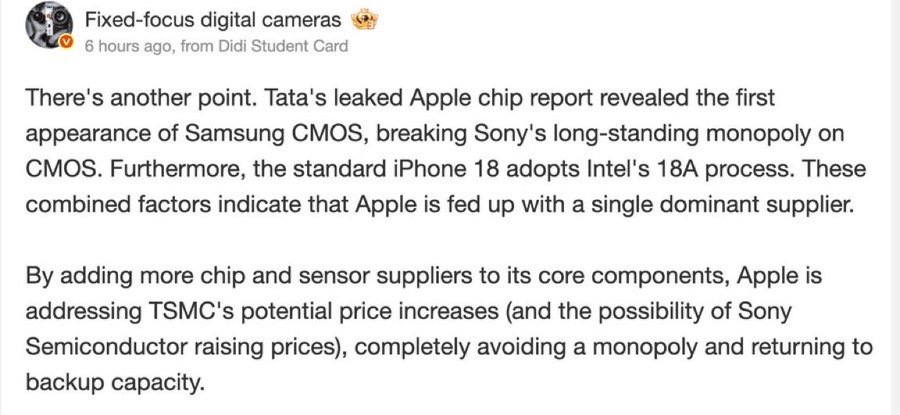
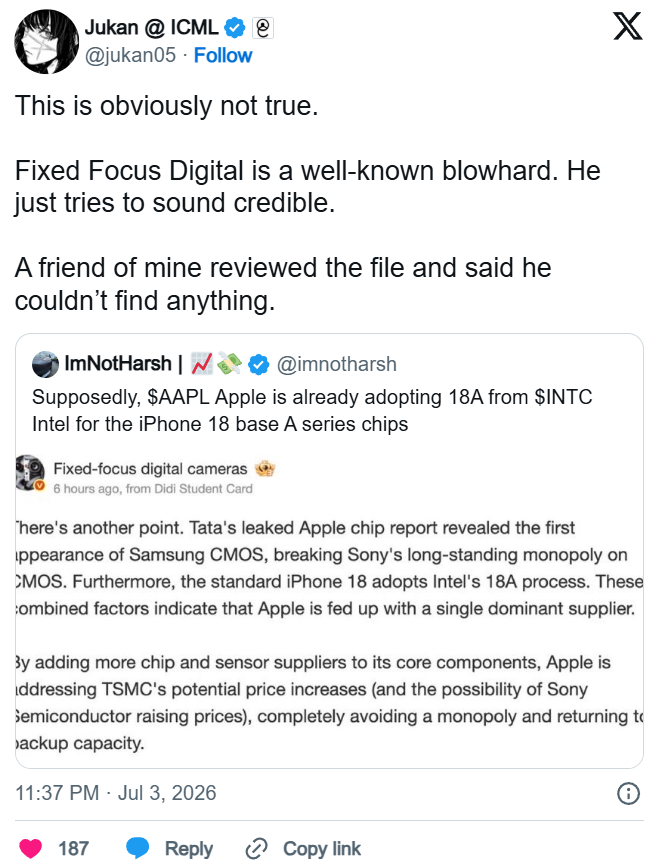
A rumor that Intel would manufacture A20 chips for Apple’s basic iPhone 18 lasted only a few hours before being overturned. Previously, Weibo account "Fixed Focus Digital Camera" claimed that the standard version of iPhone 18 will use Intel's 18A process technology. Therefore, the industry generally inferred that the A20 chip driving this model is expected to be manufactured by Intel.However, the more credible whistleblower Jukan later publicly denied this statement, calling the Weibo blogger a "notorious braggart" and saying that he had reviewed Apple's internal documents recently leaked from a Tata factory in India and "could not find any relevant evidence."
Jukan said on the social platform This means that the possibility of Intel obtaining A20 chip foundry orders for the basic iPhone 18 has plummeted from "discussable rumors" to "almost impossible" in a short period of time. The supply chain turmoil surrounding Apple and Intel also highlights the sensitivity of the current high-end process foundry competition: any news about nodes and order ownership, once amplified and disseminated without documentary support, can easily be reversed within hours.
Nonetheless, Jukan’s denial does not mean that Apple will completely abandon its foundry cooperation with Intel in the short term. In May of this year, the market reported that Apple signed a preliminary chip foundry agreement with Intel, which was regarded as a "hedging" layout for Apple after its long-term and deep reliance on TSMC. This model is believed to be similar to the existing cooperation between Apple and TSMC: Apple designs customized chips based on ARM intellectual property, and then the foundry manufactures them on advanced node production lines.
In this "Intel roadmap" that is still in the formative stage, Apple is widely expected to use Intel's 18A-P process for the base M7 chip in 2027. In the longer term, it is also reported that the A22 chip planned to be launched in 2028 will be partly or entirely manufactured by Intel. The process node may be 18A-P or even the more advanced 14A. There are rumors that about 80% of Apple’s planned orders to Intel will be around the A22 chip for iPhone, which shows the key position of this project in the cooperation framework between the two parties.
At the same time, another supply chain news pointed out that Apple will continue its deep binding with TSMC on high-end versions. It is said that the high-end model of A22, A22 Pro, is expected to be produced using TSMC's 1.4nm node, which increases the probability that Apple will introduce Intel's 14A process for the basic version of A22: the high-end will be handed over to TSMC, and mainstream and some customization requirements will be handled by Intel. This "dual-factory" strategy gives Apple greater room for maneuver in terms of production capacity, price, and geopolitical risks.
In terms of verifying the new process, Apple has obtained PDK (Process Design Kit) samples of the 18A-P process from Intel for internal evaluation. Brokerage firm GF Securities has also predicted that Apple's ASIC product "Baltra" planned to be launched in 2027 or 2028 will use Intel's EMIB packaging technology to build its next-generation AI/server chip platform. This judgment echoes previous reports that "Apple's AI server is currently difficult to fully perform in the library", showing that Apple is accelerating related layout through self-research and cooperation with multi-generation factories.
It is worth mentioning that the rumor that "Intel won the iPhone 18 A20 OEM order" once again reflects the reality that the secondary market is highly sensitive to OEM news. The article pointed out that due to the Independence Day holiday in the United States, the market was closed that day, and Intel's stock price was spared from experiencing a potentially very violent "round trip." However, as more credible sources clarified the rumors, Intel's pace in Apple mobile phone chip foundry will still follow the previously clear route, rather than suddenly "jumping the gun" on the A20 chip.