Amazon said that the number of satellites it has deployed in low-Earth orbit is enough to light up its own satellite Internet service, officially launching a head-on competition with SpaceX's "Starlink". As of the end of the latest launch last night, the Amazon Leo constellation has 396 satellites in orbit.
Chris Weber, vice president of business and products for Amazon Leo, said that this scale is "enough to provide continuous service within the initial latitude range," which means that the project is expected to achieve commercial implementation in mid-2026 as planned.
However, users should not expect a “peak out of the box” experience in the early stages of the service. For reference, when SpaceX launched "Better than nothing beta" in 2020, Starlink had nearly 900 satellites in orbit and was only available to a small number of users in the northern United States and upper Canada. At that time, users generally reported that service interruptions were frequent and extremely sensitive to obstructions. The downlink rate was roughly between 50Mbps and 150Mbps, and the latency fluctuated between 20ms and 40ms. However, by 2022, Starlink’s service quality and coverage have improved significantly.
Judging from this historical trajectory, Amazon Leo’s early experience will most likely follow a similar path. Early adopters may face limited coverage and fluctuating network performance, and subsequently rely on continued satellite launches to improve performance, increase capacity and expand the global availability area. As the constellation is gradually rolled out, service quality is expected to move from "available" to "mature".
Currently, SpaceX still occupies an overwhelming leading position in terms of scale and commercial maturity. Starlink has more than 10,000 satellites in orbit, providing Internet connectivity services to land, sea and air users in more than 160 countries and regions. Under the combined effect of different factors such as terminal type, tariff bracket, usage location and time period, its actual performance varies. However, the current median downlink speed of Starlink has reached about 200Mbps, the uplink speed is between 10Mbps and 40Mbps, and the delay is roughly maintained at about 25ms.
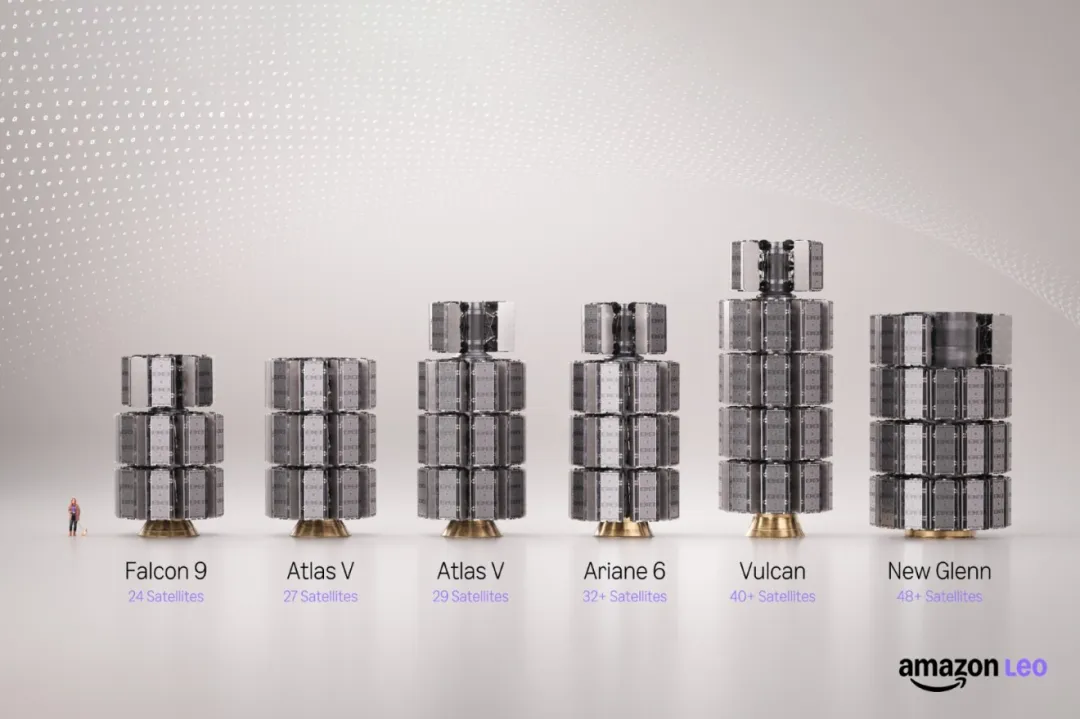
In contrast, Amazon Leo still has a long catching up process. Amazon's planned Leo constellation has a total of 3,232 satellites, but the number currently in orbit is only a small part of it, and the overall project progress is obviously behind the original pace. It is generally believed that one of the key constraints is the slow service progress of Bezos' Blue Origin reusable launch vehicle New Glenn, which affects the launch rhythm and deployment efficiency of Amazon Leo.
In the context of global low-orbit satellite Internet competition accelerating, this "tipping point" is of great significance to Amazon. For Starlink, the formation of Amazon Leo will bring about real competitors of the same magnitude; and for Amazon itself, whether it can quickly complete the constellation scale and improve service quality in the next few years will directly determine its position in the new round of space Internet territory. For users and market regulators in various countries, an additional set of mature low-orbit networks also means more chips and room for choice in pricing, access solutions and regulatory games.