A new international joint study provides key evidence to a long-running scientific debate about climate and the atmosphere. An international team of scientists from China, the United States and Israel discovered that the water vapor supersaturation in deep tropical convective clouds far exceeds previous human observation records. This discovery confirms a hypothesis previously proposed by the scientific community, that is, given the right atmospheric conditions, tiny aerosol particles do have the potential to "catalyze" and enhance tropical storm clouds.
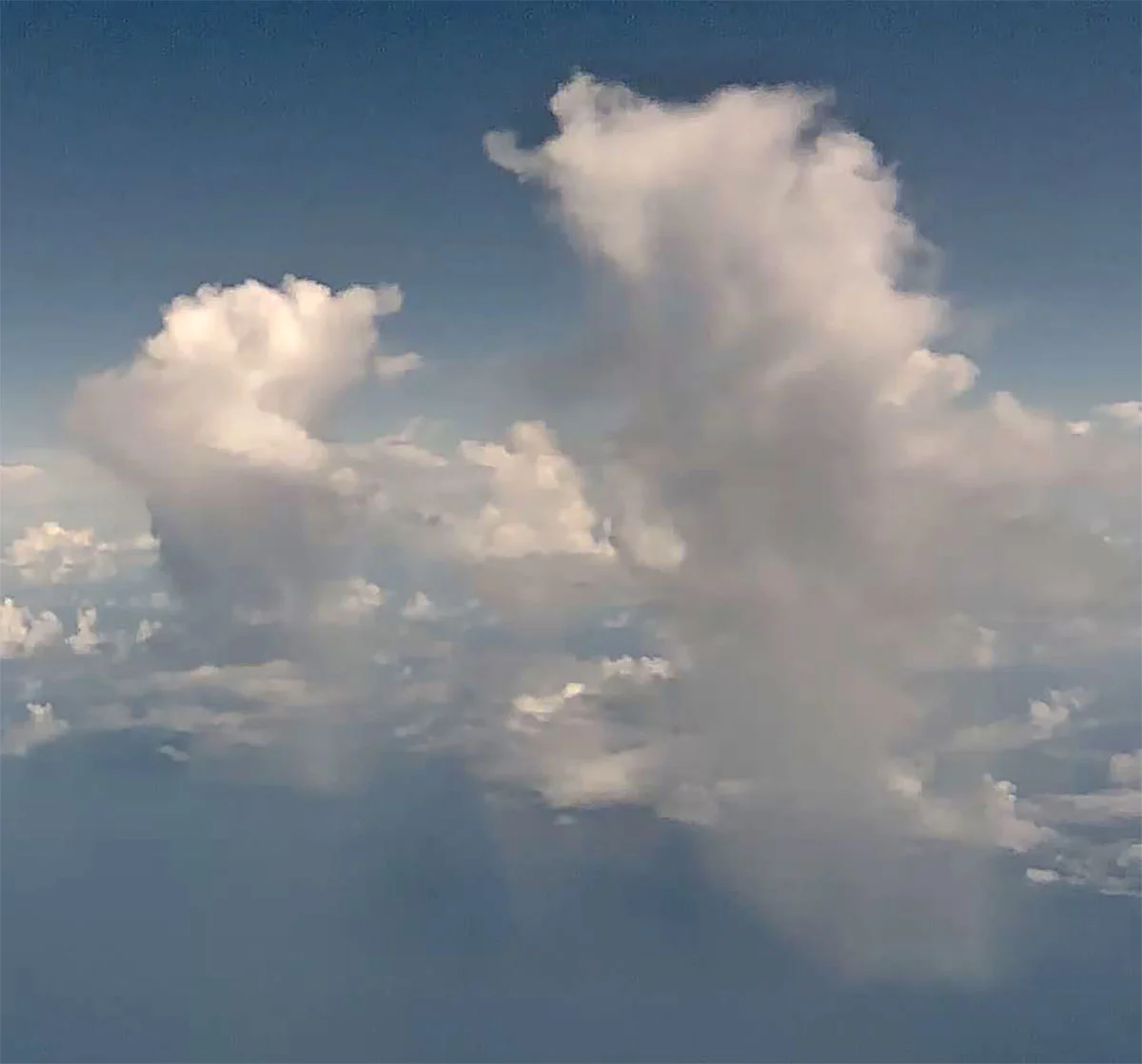
Climate scientists have long debated whether tiny aerosol particles actually make tropical thunderclouds more powerful. The evolution of deep convective clouds directly shapes global precipitation, lightning, and climate patterns, while the tiny particles at the core of cloud droplets alter the physical mechanisms within the clouds in subtle ways. The scientific community has proposed a theoretical mechanism called "condensed aerosol convective excitation". This mechanism believes that when the water vapor inside the cloud reaches an extremely high "supersaturation" state (that is, the water vapor content in the air far exceeds the content in the normal equilibrium state), the introduction of aerosol particles will catalyze the production of a large number of additional cloud droplets, thereby accelerating condensation and releasing more latent heat, ultimately causing the updraft inside the convective cloud to sharply strengthen.
However, before this, because past aerial observations were mostly concentrated in clouds with heavy pollution and shallow warm clouds, or the sampling locations were below deep convection areas, where precipitation and cloud droplets merge very quickly, which can easily weaken the accumulation of supersaturation, so past aircraft measured data rarely captured the high level of quasi-steady-state supersaturation required to support this theory.
In order to solve this mystery, the research team conducted an in-depth analysis of aircraft observation data from the "Clouds, Aerosols and Monsoon Process Experiment" carried out by NASA in the Philippines and surrounding tropical oceans in 2019. They used the measured updraft velocity and cloud droplet size distribution to derive the quasi-steady state supersaturation. This innovative approach perfectly captures the dynamic balance between the rise of air producing water vapor and the condensation of water vapor into cloud droplets.
The results show that the supersaturation that can be achieved in tropical convective clouds is much higher than previously recorded by similar observations. The data shows that the calculated quasi-steady-state supersaturation climbs with increasing altitude, reaching about 10% in the area around minus 5 degrees Celsius, where the cloud layer is still dominated by supercooled water droplets. In areas with cooler temperatures, supersaturation estimates continue to rise. At the same time, another parallel independent study on the "ESCAPE" aerial observation project in the coastal areas of Texas and Louisiana also confirmed this conclusion. This study also found rare but extreme quasi-steady state supersaturation of up to 11% in deep convective updrafts. Together, these two independent studies conclusively demonstrate that extremely high levels of water vapor supersaturation do exist in the cloud environments scientists expected.
The researchers noted that the most significant supersaturation tends to occur when strong updrafts are combined with low concentrations of cloud droplets. Once the cloud droplet concentration increases, the total surface area of the cloud droplets will expand, thereby reducing supersaturation through accelerated condensation, which is completely consistent with the laws of physics.
Although these observations cannot yet be directly deduced and proven that aerosols enhance these clouds, they establish an extremely critical cornerstone: the "atmospheric fuel" required for condensed aerosol excitation does exist in real tropical convective clouds. In such a high supersaturation environment, if fine or ultrafine aerosol particles are added, they will easily condense into new cloud droplets and release additional latent heat. Past studies failed to discover this mechanism mainly because they did not find the right target. If we want to truly uncover the mystery of this mechanism, future scientific exploration must focus on deep and clean ocean convective clouds, and further compare the differences between tropical convective clouds in clean and polluted environments in subsequent aviation missions, so as to ultimately improve humankind's physical understanding of the impact of aerosols on heavy rain, lightning, and global climate predictions.