Recently, it has been reported in the market that due to rising costs, Samsung memory agents have issued price increase notices. From now on, the prices of all Samsung memory products will increase by 80%.In this regard, Samsung said that market rumors are not correct and it has not increased prices of all products by 80%.
It is reported that many dealers and agents related to Samsung have launched a new round of memory chip price increases. The price increase of some products can be up to 80%, and it will take effect immediately. Industry insiders pointed out that this move takes place against the background that Samsung only plans to slightly increase the production of memory chips this year. Superimposed on high demand and tight supply, market expectations for further upward price increases are heating up.
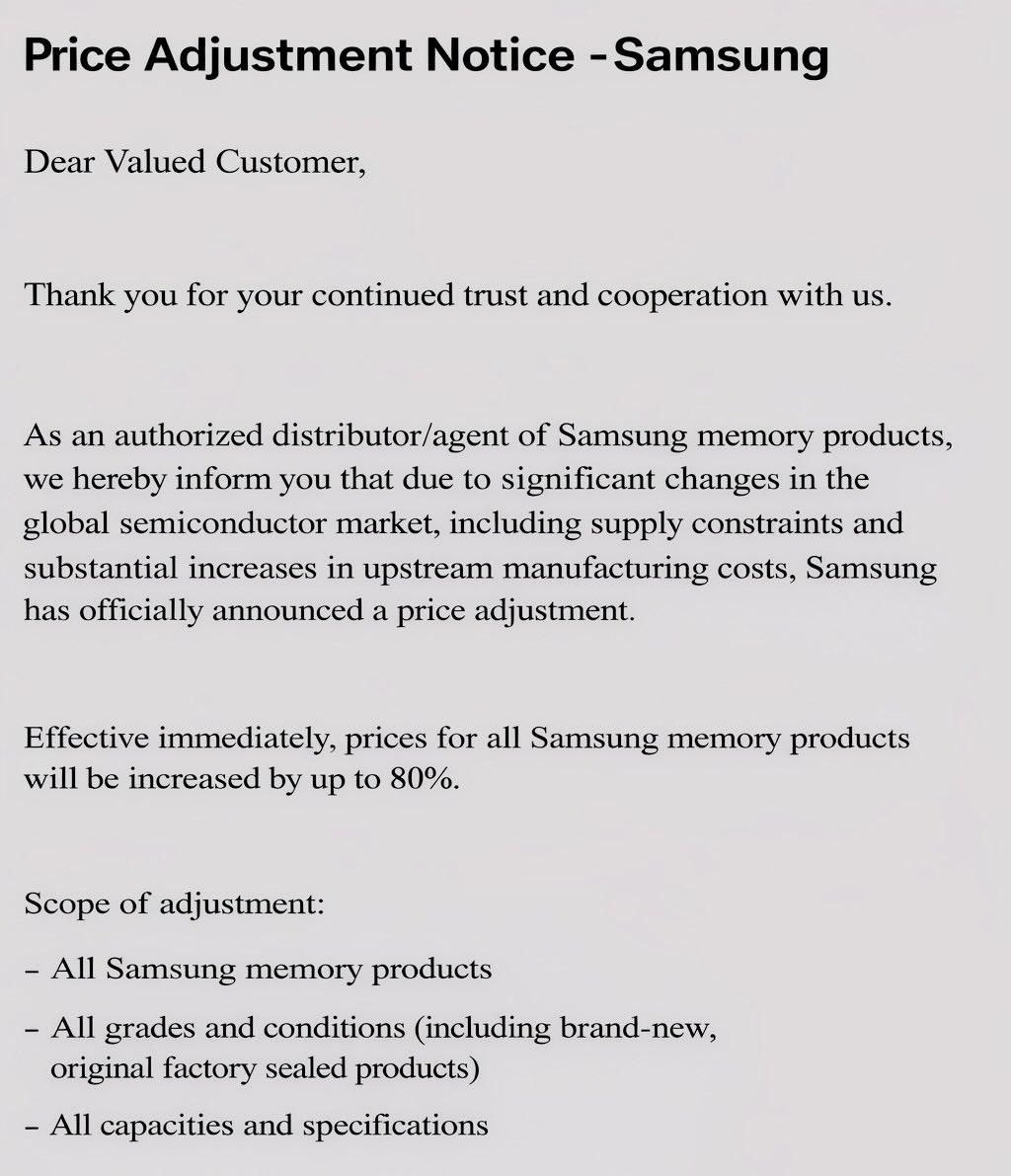
A "price adjustment notice" circulated on social media showed that an authorized distributor of Samsung memory products officially informed customers that due to the "major changes" in the global semiconductor market, including continued supply constraints and a significant increase in upstream manufacturing costs, Samsung has announced a price adjustment. The prices of all Samsung memory products will be increased by up to 80%. The notice emphasized that the price adjustment will take effect "from now on", which means that downstream channels and terminal manufacturers will immediately feel the cost pressure.
The report mentioned that the source of the revelation was pointed to an employee working at Samsung Electronics Equipment Solutions Park (DS Giheung) in South Korea, but the relevant information has not yet been independently confirmed. Precisely because the official has not publicly confirmed it, the rumored sharp price increase is seen in the industry as an extension of the supply side's cautious production control, and may also reflect the manufacturer's intention to enlarge profit margins through price strategies during a high boom cycle.
Currently, market demand for DRAM continues to strengthen driven by artificial intelligence-related applications, and Samsung is said to only plan to increase DRAM production by about 5% this year, which is far lower than the previous expectations of some institutions. On the one hand, manufacturers are worried that once the AI craze subsides, they may quickly fall into overcapacity like in previous cycles; on the other hand, moderate "reluctance to sell" and control of supply will also help maintain or even push up market prices.
It is worth noting that compression does not only occur in the DRAM segment. Previous reports indicate that Samsung and SK Hynix are also considering cutting NAND flash memory production and shifting more resources to DRAM products with higher profit margins. With the prices of storage terminals such as SSDs showing signs of rising, upstream production cuts and channel price increases are superimposed. In the future, consumers and enterprises may have to face a new round of rising costs when purchasing storage products.
The forecast from market research agency TrendForce further strengthens the market's attention to this price increase cycle: the output value of the entire storage industry is expected to reach US$551.6 billion in 2026, and climb to US$842.7 billion in 2027, an annual increase of more than 53%. In the face of such a huge growth space, the outside world is generally worried that the supply side continues to restrain production expansion and channels simultaneously raise prices, which will provide greater room for manipulation of price behavior that "takes advantage of the trend."