On July 9, China’s Unitree Technology (Unitree) G1 humanoid robot successfully completed overseasThe world's first live surgery. A research team from the University of California, San Diego (UC San Diego) used two Yushu G1 humanoid robots to conduct preclinical trials and successfully completed two cases.Live cholecystectomy in large non-primates, the relevant research results were published in the top international academic journal "Nature" on July 8, local time.
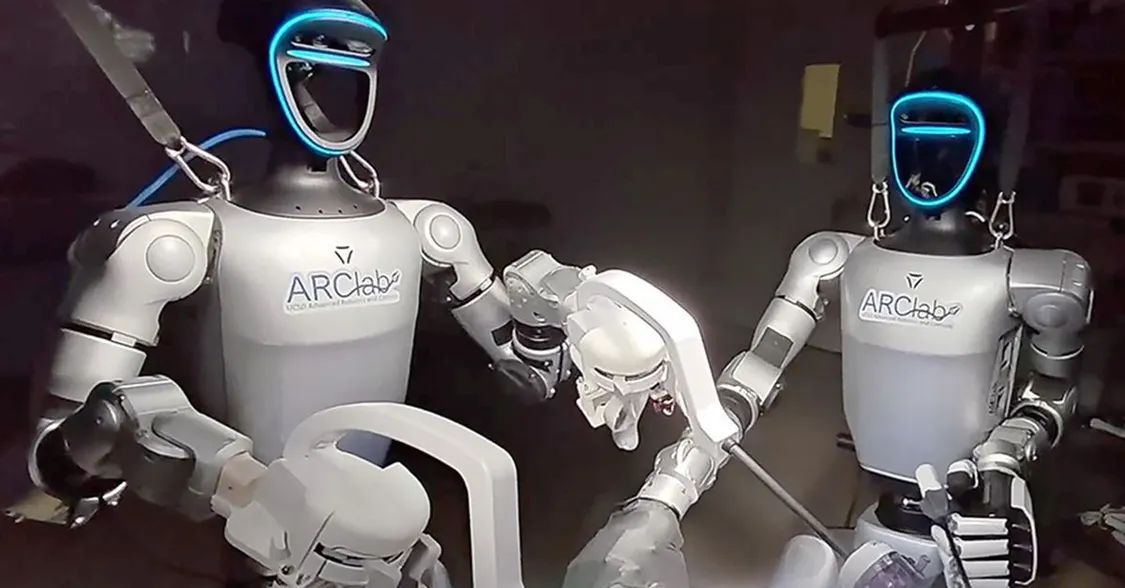
This experiment, jointly completed by the engineering team and the surgical team, verified for the first time the feasibility of humanoid robots and dual robots performing surgical operations collaboratively. In the experiment, two Yushu G1 robots were composed ofThe surgeon performs surgery via teleoperation via the console. It is worth noting that the robot directly uses the hospital’s conventional laparoscopic surgical instruments, rather than specially customized equipment. Among the two surgeries, one was completed by a single robot in collaboration with the surgeon, and the other was completely completed by a team of two robots.
The research team pointed out that compared with the large-scale dedicated surgical robots currently popular in hospitals, Yushu G1 is about 1.52 meters tall and weighs about 27 kilograms.Small size and low deployment costThe significant advantage is that no large-scale modifications to existing operating rooms are required. Its humanoid structure can not only be used for surgical operations, but can also undertake auxiliary tasks such as delivering instruments and organizing the operating room in the future. Michael Yip, corresponding author of the paper and professor of the Department of Electrical and Computer Engineering, said that in the face of the global shortage of surgeons, this type of remotely controlled humanoid robot is expected to extend medical capabilities toRemote areas, disaster relief and battlefield medical careWait for special scenes.
However, this technology is still in the early verification stage. Researchers revealed that during surgery, the robotic systemRequires multiple recalibrations,lead toThe overall surgery time is significantly longer than that of existing dedicated surgical robots.In addition, remote control bringscontrol delayOther bottlenecks also need to be further optimized. Next, the team will continue to advance research and development around remote surgery and autonomous surgical assistants.