
Abstract:
Password management service provider 1Password recently launched a new "1Password for Agents" function, which allows artificial intelligence agents to use the user's saved account credentials to log in to the website and perform tasks after obtaining user authorization, while avoiding directly exposing passwords to the AI model. This feature aims to solve an important security issue faced by the increasing popularity of AI agents: when AI needs to log in to websites and operate accounts on behalf of users, how to let it complete the task without having to hand over the user's sensitive credentials to it.
As AI agents gradually shift from answering questions to performing actual operations, users are beginning to ask them to handle complex tasks that require logging into an account, such as managing online services, accessing work platforms, or completing cross-site operations. But traditional methods often require users to hand over their passwords to the AI, or personally take over the browser every time the agent needs to log in. These two methods have the problems of credential exposure risk and low operational efficiency respectively.
1Password hopes to change this model through a new authorization mechanism. According to the company's design, the AI agent can request login credentials for a specific account, but cannot directly read the password itself. The user still has the authority to decide whether to allow the agent to use a certain credential, rather than opening up the entire password library to the AI.
Specifically, when an AI agent visits a website that requires a login, it uses a unique digital key to prove its identity to 1Password. 1Password will then send a notification to the user stating which account’s credentials the agent needs to use and the reason for requesting authorization. Users can approve or deny the request on their device.
If the user approves, 1Password will populate the required login information directly into the website's login interface, rather than sending the password to the AI agent in text form. The agent can then continue its task without directly seeing or processing the user's actual password.
This design has certain similarities with traditional two-factor authentication: sensitive operations require active confirmation by the user. However, the two are not exactly the same. Two-factor authentication is mainly used to confirm the identity of the logged-in person, and the core goal of 1Password for Agents is to enable users to authorize and control the behavior of AI agents using account credentials.
1Password CEO Ashish Tripathi said that AI agents have begun to complete actual work for users. The past method of directly handing over credentials and expecting the system to operate safely is no longer suitable for this development trend. He believes that the agent should be able to complete the tasks assigned by the user, but should not gain permanent access to all the user's accounts.
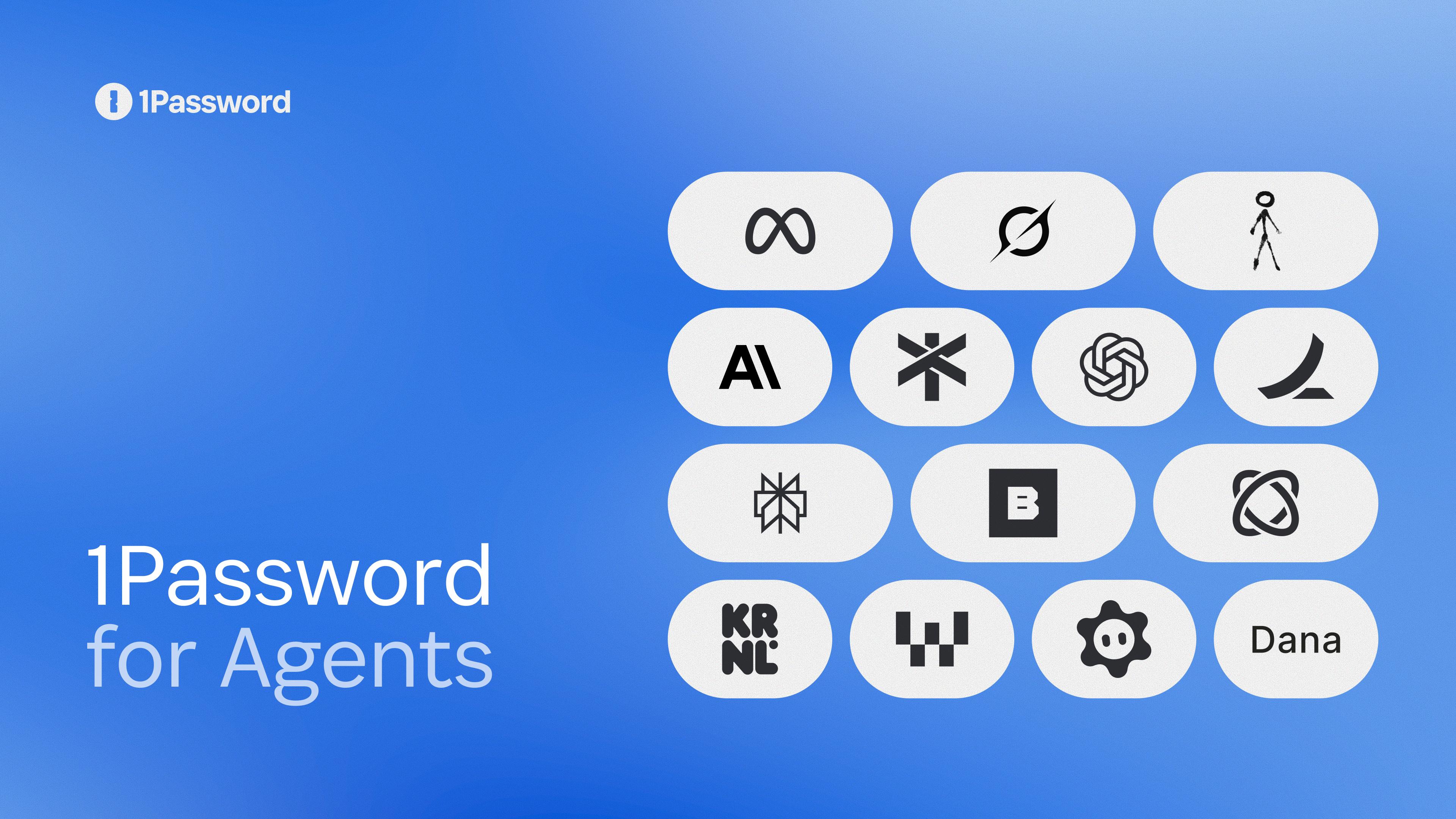
According to information released by 1Password, this feature will support a variety of AI agents and tools, including Meta Muse, ChatGPT Work, ChatGPT Dots, Claude Duet, Grok Bot and Town, etc. At the same time, platforms such as Browserbase, Browser Use, Dana, Instinct, Kernel, Perplexity, Ramp, Tomo and Wajo are also promoting relevant integration, and more partners are expected to join in the future.
This means that 1Password hopes to further develop itself from a traditional password management tool into an authentication and access control layer for AI agents. When AI no longer just generates text, but begins to log in to websites, read information and perform operations on behalf of users, how to confirm the identity of the agent, limit its permissions, and track its behavior using credentials will become increasingly important.
However, this mechanism does not mean that AI agents can operate accounts without risk at all. Even if the agent cannot directly see the password, it may still perform the actions allowed by the user after being authorized. If the AI is misled by malicious web content or is affected by prompt injection attacks, it may try to perform operations that the user does not want to happen. Therefore, users still need to carefully review authorization requests and be cautious about tasks involving funds, personal information, or important account settings.
1Password has previously reminded users to pay attention to the security risks posed by AI-assisted browsing. For example, if an AI assistant in the browser is able to read untrusted web content and the 1Password extension is unlocked, the malicious content could induce the agent to attempt to perform browser operations that the user would otherwise be able to perform. In this regard, 1Password recommends that users turn off unnecessary auto-login features and lock extensions when browsing untrusted content or when leaving the device.
The AI agent credential authorization function launched this time is an attempt to establish a clearer boundary between automation efficiency and account security. Its core idea is not to allow AI to obtain more secrets, but to allow AI to obtain the limited permissions needed to complete specific tasks without accessing secrets.
As AI agents gradually enter office, shopping, account management and enterprise business processes, traditional password management tools may also need to redefine their roles. In the future, password management services will no longer just help users save and automatically fill in passwords, but may also be responsible for managing which AI can access which accounts, the specific scope of each authorization, and when the authorization expires.
For users, this model is expected to reduce the risks of providing passwords directly to AI, while reducing the hassle of repeated manual logins when performing complex tasks. However, whether it can truly become a universal security standard for AI agents still depends on the access of more platforms, the reliability of the authorization mechanism, and the security performance of different AI systems in actual use.
Comments