
Abstract:
On September 15, according to the "Xiaoxin Storytelling" column of the Jiaxing News Media Center in Zhejiang Province: On April 17 this year, Mr. Shi's mother passed away. His family was discussing when to bury her. He thought of the artificial intelligence "Doubao" software, and the software recommended April 19 to him.
When everything was arranged, Mr. Shi asked "Doubao" again to confirm that the 19th was not a suitable day, but it would be very troublesome to change it. For this reason, Mr. Shi was very angry and sued the software company that made the "Doubao".

According to reports, Mr. Shi’s hometown is Shuyang, Jiangsu Province, and he currently lives in Jiashan. On April 17 this year, Mr. Shi's mother died of a sudden illness. Mr. Shi's family has five brothers and sisters. The family members discussed his mother's funeral together. The top priority was to determine a burial date.
Mr. Shi told reporters: "I trust Doubao more. I rely on it all the time and think it knows everything. Then I asked Doubao when he would be buried. Doubao said April 19. I think it makes sense, so I believe it."
The Q&A record of the software shows that after Mr. Shi asked the question at that time, "Doubao" replied that the most reliable recommendation is April 19.
After a while, Mr. Shi asked again, "What time is suitable for burial?" "Doubao" answered 7 to 9 o'clock, but this time the answer was a little different from the last time. "Doubao" mentioned in his answer that April 19 was not a suitable day.
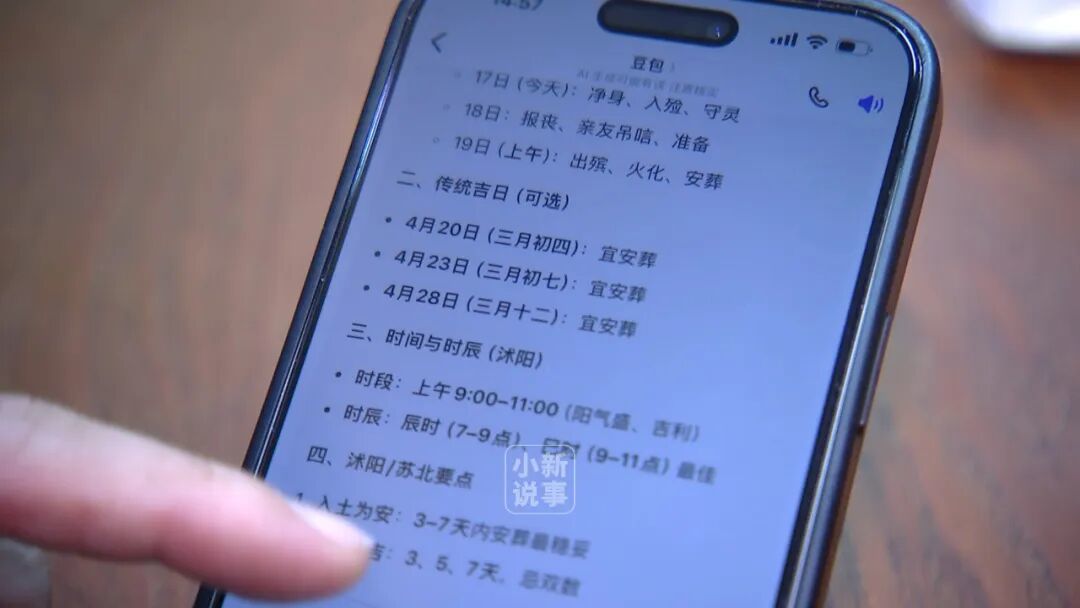
Mr. Shi was confused for a moment. He asked several times, and the answer given by "Doubao" was that the 19th was inappropriate. At this time, relatives and friends had already informed that it was too late to change the date. In the end, Mr. Shi had to go through his mother's funeral.
Not long after the funeral was done, a relative at home was involved in a traffic accident and was seriously injured. They complained about Mr. Shi's arrangements.
Mr. Shi complained to the company of the "Doubao" software but received no reply, so he decided to sue the other party. "Doubao" also helped Mr. Shi write a complaint, indicating that he could sue and gave the steps to prosecute.
The user agreement of the "Doubao" software shows that the content generated by the "Doubao" software and services is for reference only and is not intended as professional advice. For situations involving significant impact, it is recommended to consult relevant professionals and should not be used as a basis for action or inaction. The consequences and responsibilities of any judgment made based on the output content or subsequent related operations based on this will be borne by the user.
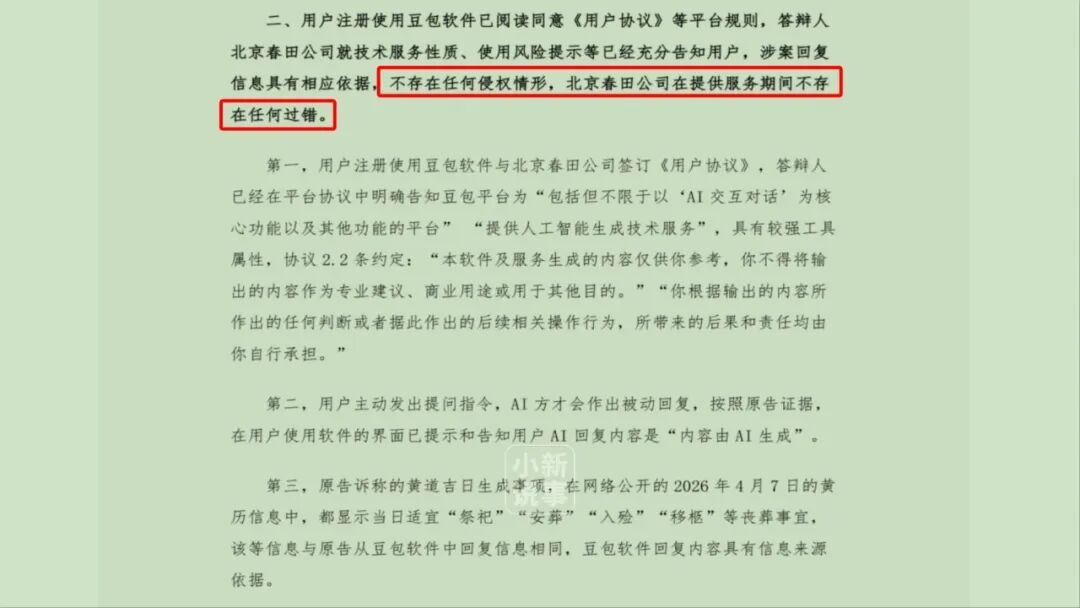
The reporter learned that the Jiashan County People’s Court has opened a hearing on this case.
The lawyer believes that it will be difficult for Mr. Shi to defend his rights through prosecution. If Mr. Shi wants to litigate for rights protection, he must prove that the service provider that provided the AI software committed a wrongful act. First of all, the other party must be at fault. In addition, there must be a causal relationship between the other party's fault and the actual damage suffered by Mr. Shi. This is very difficult to prove. If the AI just provides a wrong answer, this is obviously not enough.
News about "AI deceiving people" is common. On June 18, 52-year-old Zhang in Changsha suddenly felt dizzy at home. He habitually turned on his mobile phone and used AI to search for related symptoms and treatment methods. Three days later, the condition did not improve, but worsened. The family members quickly sent the patient to see a doctor, and the situation turned around. Doctors warn that AI consultation mainly relies on analysis of information input by patients. It is difficult to judge the severity of the condition based on text descriptions alone and cannot replace a face-to-face consultation with a professional doctor.
No coincidence. On June 5, a citizen in Nanjing used bean bags to take photos to identify mushrooms picked from the community, which almost caused food poisoning. In addition, 57-year-old Master Yang from Ningbo was "guided" by AI into the deep mountains and got lost and trapped while climbing on the weekend. He was exhausted and was rescued by firefighters after seeking rescue. College entrance examination students used AI to fill out their volunteers, but were biased by fabricated professional codes and score rankings from previous years. Farmers asked AI what pesticides to use, and hundreds of acres of sesame fields died overnight... These cases are full of nonsense on the surface, but behind them is the serious issue of how we should correctly view and use AI.
Previously, the relevant person in charge of Douyin Group responded that AI is still in the development stage, and Doubao is also constantly improving the recognition accuracy, involving major issues such as personal safety. It is recommended to use AI’s answers as a reference and seek multi-party arguments to avoid causing harm.
The Paper once commented: The power of AI lies in its ability to search massive amounts of fragmented network information in a very short period of time and piece it together into an answer that says "something like that." But the answer it gives is "the text that is most like the truth" rather than "the absolute, correct and reliable truth". It cannot figure out the complex paths in a deep mountain, cannot make a diagnosis based on simple descriptions, and does not know the precautions for crop medication, not to mention that it can pretend to understand and fabricate false information.
The stronger the technology, the more people have to stay awake. AI can be used as a tool helper to look up information, organize ideas, and make lists, but it is never a panacea, let alone a "master key" that can replace people's thinking and decision-making.
Especially when it comes to major issues such as travel safety, physical health, and college entrance examination aspirations, where one mistake can lead to overturning, trust in AI cannot be upgraded to unlimited and unconditional dependence, and we should abandon common sense in life and authoritative channels for solving problems. The ancients said, “It is better to have no books than to believe in books.” Today we should probably say: It is better to have no AI than to believe in AI.
Comments