
Abstract:
With the popularity of artificial intelligence tools in the workplace, more and more companies are beginning to encourage or even require employees to use AI to assist work. However, a recent case in the United States shows that even if employees do not believe in any god, it is still possible for employees to obtain religious exemptions from using AI based on their own beliefs.
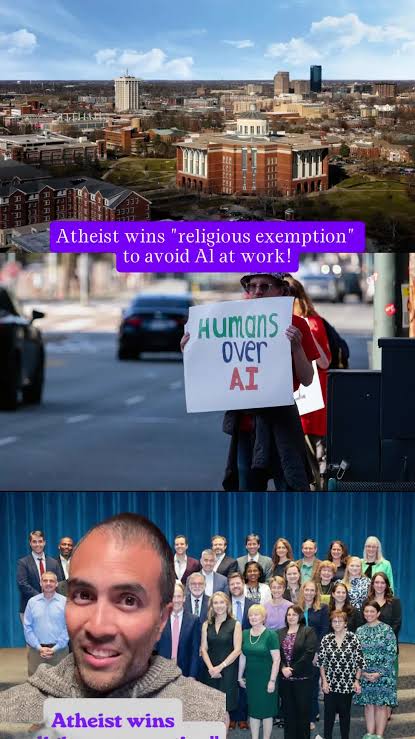
David Durman, an administrator at the University of Kentucky, recently received a workplace religious accommodation that allows him to perform his job duties without having to personally use artificial intelligence tools. The case received widespread attention because Dullman was not a traditional religious believer but an atheist who self-identified as a "humanist."
Durman said that humanism is a set of value systems about human experience and the relationship between people and the world. Its core is to promote individual and collective well-being and development, while encouraging people to continuously improve their own lives and the lives of those around them. He believes that the use of artificial intelligence conflicts with his core beliefs.
As AI technology gradually penetrates into daily work and life, Dullman began to seek legal protection. He then contacted the American Humanist Association (AHA), a nonprofit organization that promotes secular humanist ideals, to help him figure out how to gain job security from using AI.
In explaining his position, Dullman believed that the reason why people can become people with the ability to make moral judgments is because they can actively use their thinking abilities. If more and more thinking processes are replaced by artificial intelligence, human beings’ ability to think critically and make independent judgments will be weakened, which will have a negative impact on personal moral development.
Earlier this week, a statement released by the American Humanist Association further revealed Dullman’s rationale. He pointed out in the statement that artificial intelligence is affecting many people's ability to make a living, and its huge energy consumption and environmental costs may cause long-term harm to human society and the earth's ecology. At the same time, he believes that AI’s large-scale utilization of human creative achievements is also threatening art, literature and other important cultural fields that maintain social prosperity.
While humanism is not typically considered a traditional religion, it has long attracted people who are skeptical of gods or supernatural powers. These people hope to establish their own value system through scientific thinking and moral principles rather than relying on religious beliefs.
Alexandria Huiskens, a lawyer at the American Humanist Association, said that concerns about the relationship between artificial intelligence and human dignity are not limited to one belief system. Whether it is Catholic doctrine, Universalism, or Humanism, similar moral concerns may be developed. She emphasized that humanists and atheists are also protected by relevant U.S. laws and have the right to apply for reasonable accommodation in the workplace.
According to reports, Dullman is the first known employee to successfully obtain an exemption for the use of AI as a humanist, and he is also one of the few people to talk publicly about this process. He said he took action in part because he was inspired by another person involved in the case. Previously, Erin Maus, a software engineer with Unitarian Universalist beliefs, successfully obtained similar protections from using artificial intelligence tools in her work.
Dullman said that applying for an exemption is not to influence whether others use AI, but to adhere to one's own values and moral beliefs. He emphasized that this matter is essentially related to personal conscience and adherence to one's own principles.
This case also reflects that as artificial intelligence gradually becomes a basic tool in the workplace, discussions about religious freedom, conscience rights, and the boundaries of technology application in the United States are entering a new stage. In the future, similar cases involving conflicts between obligations and personal beliefs surrounding the use of AI may become more and more common.
Comments