
Abstract:
In a Sydney office, the entire team erupts in cheers every time the angry expletives and rants of a telecom fraudster come over the loudspeaker. "We use this as a quantified indicator of scammers' frustration," Brad Joffe, co-founder and chief commercial officer of Australian cybersecurity startup Apate.ai, told the media with a smile. "Every time a scammer curses on the phone, we celebrate. We are probably one of the very few companies in the world that is happy because users curse their products."

While most technology companies are busy using AI Agents (intelligent agents) to help humans write code, book flights, and make reports to improve productivity, Apate.ai, which was selected for the 2026 TechCrunch Disrupt Entrepreneurship Competition "Startup Battlefield 200", has given AI a mission that sounds a bit "ill-scrupulous" but very satisfying: to act as an undercover agent, proactively look for scammers, and then drive the scammer crazy.
So far, this "AI victim army" that is online around the clock has had more than 2.5 million conversations with fraudsters around the world, and has consumed a total of 17 years of the fraudsters' crime time.
This is not just a prank to relieve anger.
Behind those paragraphs of nonsense literature that drive scammers crazy, an "anti-fraud business" worth tens of millions of dollars is quietly operating.
A 44-minute picnic phone call
The starting point of this story is a family picnic that was rudely interrupted.
In November 2021, Dali Kaafar, a professor of cybersecurity at Macquarie University in Sydney, was enjoying outdoor time with his family when his cell phone suddenly rang with an unknown call. The person on the other end of the phone claimed to be from a well-known technology giant and used skilled words to try to defraud him.
An ordinary person would probably hang up in a second. But Kaafar, who studies network security, had an idea at that time and decided to have some fun with the children around him. He pretended to be a "perfect prey" who knew nothing about electronic products, was slow to respond, and was extremely polite. He chatted with the scammer on the phone and cooperated clumsily, dragging the phone call for 44 minutes.
The children around him burst into laughter, and the liar on the other end of the phone finally collapsed and hung up. But after the laughter, Kaafar became acutely aware of two things:
First, during these 44 minutes, the scammer was tied to the phone line and unable to harm any real potential victims;
Secondly, he also got 44 minutes of precious family time.
“It’s entertainment to tease a liar once in a while, but if real people do it every day, it’s hard to tell who delayed who.”
An idea formed in his mind: What if tens of thousands of tireless AI robots were trained to answer these calls for humans, draining the scammers of their time and smoothly extracting their criminal cards?
The idea quickly became a major research project at Macquarie University. Kaafar led the team to collect a large amount of real fraud calls, phishing emails and social platform chat records, and used machine learning and natural language processing technology to dismantle the "social engineering" routines of fraudsters and train a dialogue system that can maintain lifelike personalities for a long time.
In 2024, the project was officially separated from the university and the company was named Apate. In Greek mythology, this is the name of the "goddess of deception and trickery" who flew out of Pandora's box.
An anti-fraud company put the "Goddess of Deception" on its sign.
200,000 “AI Movie King”
To make a wary professional liar stay on the phone line for dozens of minutes, AI cannot just answer questions mechanically, it must know how to handle human greed and impatience.
The essence of telecommunications fraud is a funnel screening: if the scammer wants strangers to open unfamiliar links and transfer money out by bypassing bank risk controls, they must go through a long process of explanation, urging and confirmation.
As long as the prey shows "I am rich, I am scared, and I want to cooperate, but I am just clumsy and can't operate", the scammer will never hang up the phone.
Apate’s AI agent takes this “near-away hope” to the extreme.
The company has built thousands of virtual characters with different ages, genders, accents, languages and even cultural backgrounds. For example, an elderly robot named Malcolm who speaks with an authentic British accent will ask slowly after the scammer has been preparing for the unpredictable financial crisis for a long time: "Sorry kid, what kind of business are you talking about just now?"
Mixed with Australian slang and dry humor, they pretend to have a bad signal on the phone, pretend to be unable to find their reading glasses, pretend to press the wrong key on the keyboard, or show just the right amount of panic at pop-up prompts.
What’s even more amazing is that this group of AI undercover agents don’t just sit back and wait.
Telecom operators will seamlessly transfer the identified high-risk fraudulent calls directly to Apate's system; at the same time, Apate has also laid thousands of "honeypot" numbers in the communication network to specifically lure mass text messages and automatic dialing systems to the bait.
Also, they will take the initiative.
The text-based AI agent will patrol various forums, Telegram investment groups, and social media 24 hours a day, just like real netizens. Once they smell the signs of "killing pigs" or fake investments, they will actively click on phishing links, add friends, join groups, pretend to be investors who are eager to get rich, and have in-depth private conversations with scammers.
In a pilot with Australian telecommunications giant TPG Telecom, the record for a single AI call with a scammer was an astonishing 54 minutes. The scammer thought he was only one step away from the victim's pension, but he didn't know that even the sound of breathing on the other end of the phone was synthesized by computing power.
Scammers contribute materials, bank pays information
If it just makes scammers work in vain, Apate can only be regarded as a public welfare spoof project at best and cannot support a commercial company. What really makes venture capital institutions and banking giants spend real money is the "golden information" that is fished out of nonsense literature.
“The entire anti-fraud industry used to be an afterthought,” co-founder Brad Joffe pointedly pointed out. “Telecommunications providers blocked numbers, but scammers could change them for a few cents; banks monitored unusual transactions, but by the time the monitoring alerts were raised, the scammers had already brainwashed the customers and the money had even been transferred away.”
In Apate’s business model, the line of defense is pushed directly in front of the scammer’s lair.
No matter how fancy the scammer’s words are, as long as they want to get money, they must show their trump card at the last moment. They must provide the bank card number for receiving payment, the cryptocurrency wallet address for receiving money laundering, the download link of remote control software, or the domain name of a high-quality imitation phishing website.
Apate's agent has only one core KPI during the chat process: to induce the scammer to spit out this critical infrastructure information.
Once a scammer sends a bank account number or USDT wallet address in a chat, Apate's backend system will extract it, structure it within seconds, and push it directly to banks, telecom operators and government regulators through its real-time intelligence platform (Apate Insights).
Customers can even "assign orders" to AI undercover agents in the background. For example, for a certain type of scam that has been posing as a well-known brand that has been on the rise recently, a group of AI with specific personalities can be assigned to conduct in-depth investigations and dig deep into the fund pool address behind it.
This is equivalent to the fact that before scammers have a chance to target real humans, the "water room" accounts and phishing websites they use to collect money have already been blacklisted in the risk control systems of major banks.
Apate’s actual combat data is extremely eye-catching:
CommBank: Since integrating Apate’s real-time fraud intelligence into the risk control system and cooperating with multiple anti-fraud defense measures within the bank, the bank’s publicly reported customer fraud losses have plummeted 76% from the peak.
TPG Telecom: A total of nearly 590,000 fraudulent calls have been directly connected to Apate’s AI undercover network, and the fraud traffic detection accuracy is as high as 98%.
Active suppression: Another unnamed large Australian bank used Apate’s outbound call agent to proactively counterattack and directly paralyzed 22 large-scale fraud gang projects in operation.
The capital market quickly sensed the value.
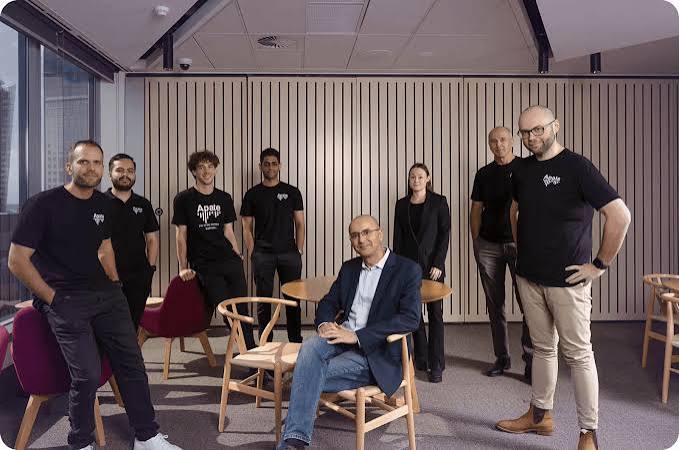
In August 2026, this capable team of only 20 people announced the completion of a seed round of financing of US$8.15 million (approximately AU$11.4 million). Investors include Lobby Capital, OIF Ventures, Investible and other well-known institutions, and the cumulative financing amount has approached US$10 million.
Now, they are planning to open an office in London and make a big push into the US market.
When the liar’s AI meets the anti-fraud AI
The rise of Apate reflects a cruel reality on the current global network security battlefield: the electronic fraud industry itself has completed the "AI arms upgrade" early.
According to the latest data released by the FBI, in 2025 alone, the FBI received more than 22,000 AI-related criminal complaints, causing direct economic losses of up to US$893 million, of which more than US$632 million came from investment scams that used AI chat (hog killing plate) and scams that used Deepfakes to clone the voices and faces of celebrities and executives.
In the past, a salesperson in an electronic fraud park would get smoke from his throat after making dozens of calls a day; now, fraud groups are also using large models to drive automated scripts, making thousands of concurrent group calls and automatic replies. Relying on traditional human volunteers to "play the tricks" has long been of little use. Only computing power can compete with computing power.
Putting it in the Chinese context, Apate deserves a nickname: the strict father of northern Myanmar.
Since scammers are using AI to find victims in batches, and anti-fraud companies are also using AI to disguise victims in batches, will there be a massive "silicon-based proxy war" in the global communication cables and social networks in the near future?
If you think about it further, the picture is a bit absurd.
In a late-night encrypted chat room, the AI in the Electronic Fraud Park is affectionately laying the groundwork for fake love and high-return crypto mining pools, while the Apate AI opposite is playing the role of a wealthy but confused retired old man.
Two emotionless large models went back and forth, chatting for three days and three nights, consuming the graphics card computing power and electricity bills in each other's computer rooms, while humans slept peacefully aside.
For this seemingly absurd ending, founder Dali Kaafar had actually thought about it a few years ago. His answer was simple and firm:
"If at the end of the day, all the fraud bots in the world are busy chatting with our anti-fraud bots, and real humans are saved from losing their money, then I'm more than happy to consider that a complete victory."
Comments