
Abstract:
As artificial intelligence develops from traditional chatbots to agents (AI Agents) that can autonomously plan tasks, call tools, and execute complex workflows, the computing needs of data centers are also changing. AMD officially released the Helion rack-level AI computing reference design on October 12, 2026, proposing a new infrastructure solution that takes the CPU as the core and can be paired with GPUs according to needs.
Its pure CPU configuration can integrate up to 32,768 AMD EPYC processor cores and is designed to provide an execution environment for large-scale AI agents instead of focusing all computing resources on GPU accelerators.
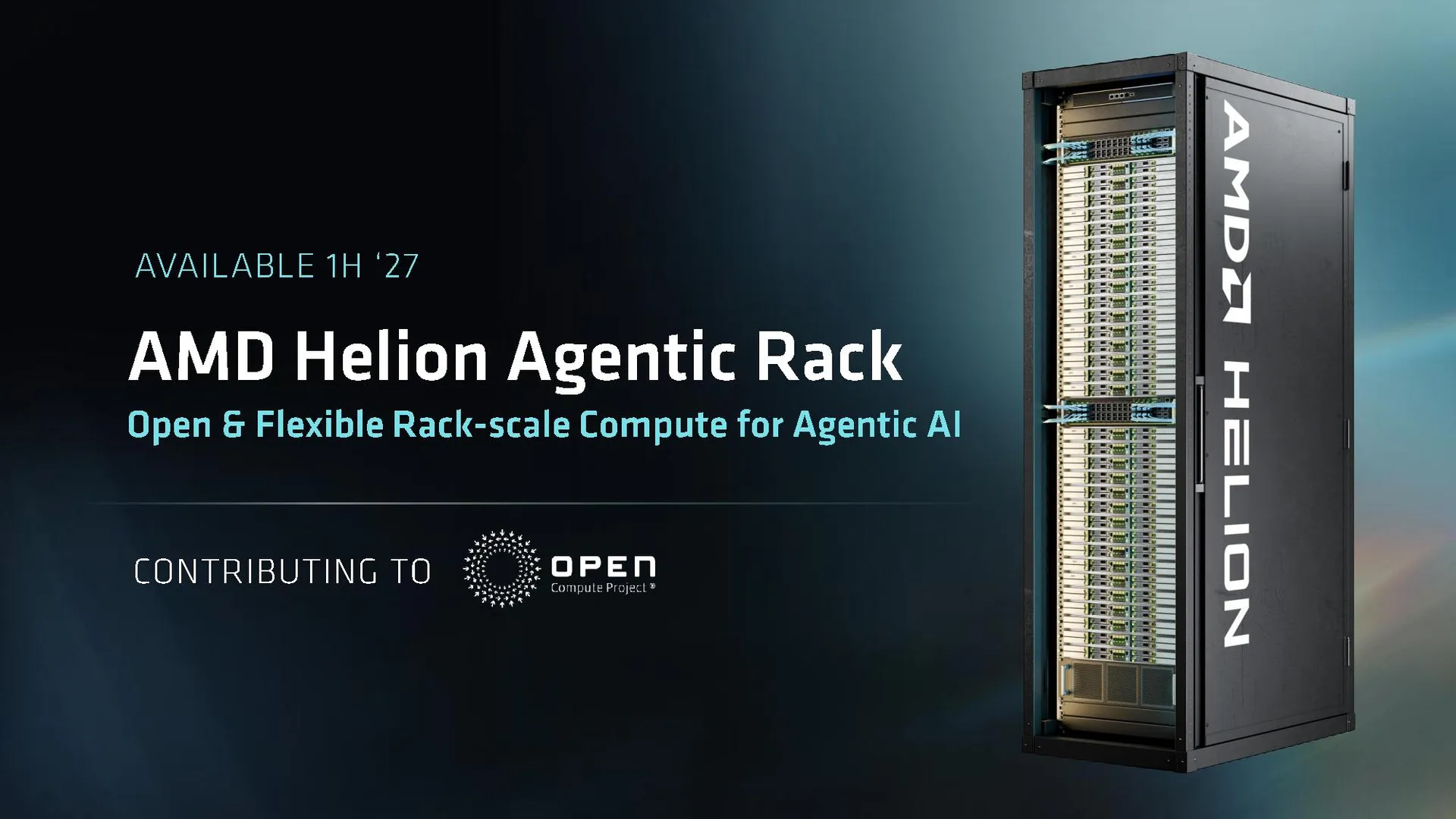
The Helion released by AMD this time is not an independent chip, nor is it a complete server product that users can purchase directly, but an open rack reference design for data centers. AMD plans to contribute relevant specifications to the Open Compute Project (OCP) for further development and adoption by partners. Manufacturers such as Dell, Hewlett Packard Enterprise, Lenovo, AMD, and Foxconn will participate in the development of related systems, and the Helion configuration created by partners is planned to be launched in November 2026.
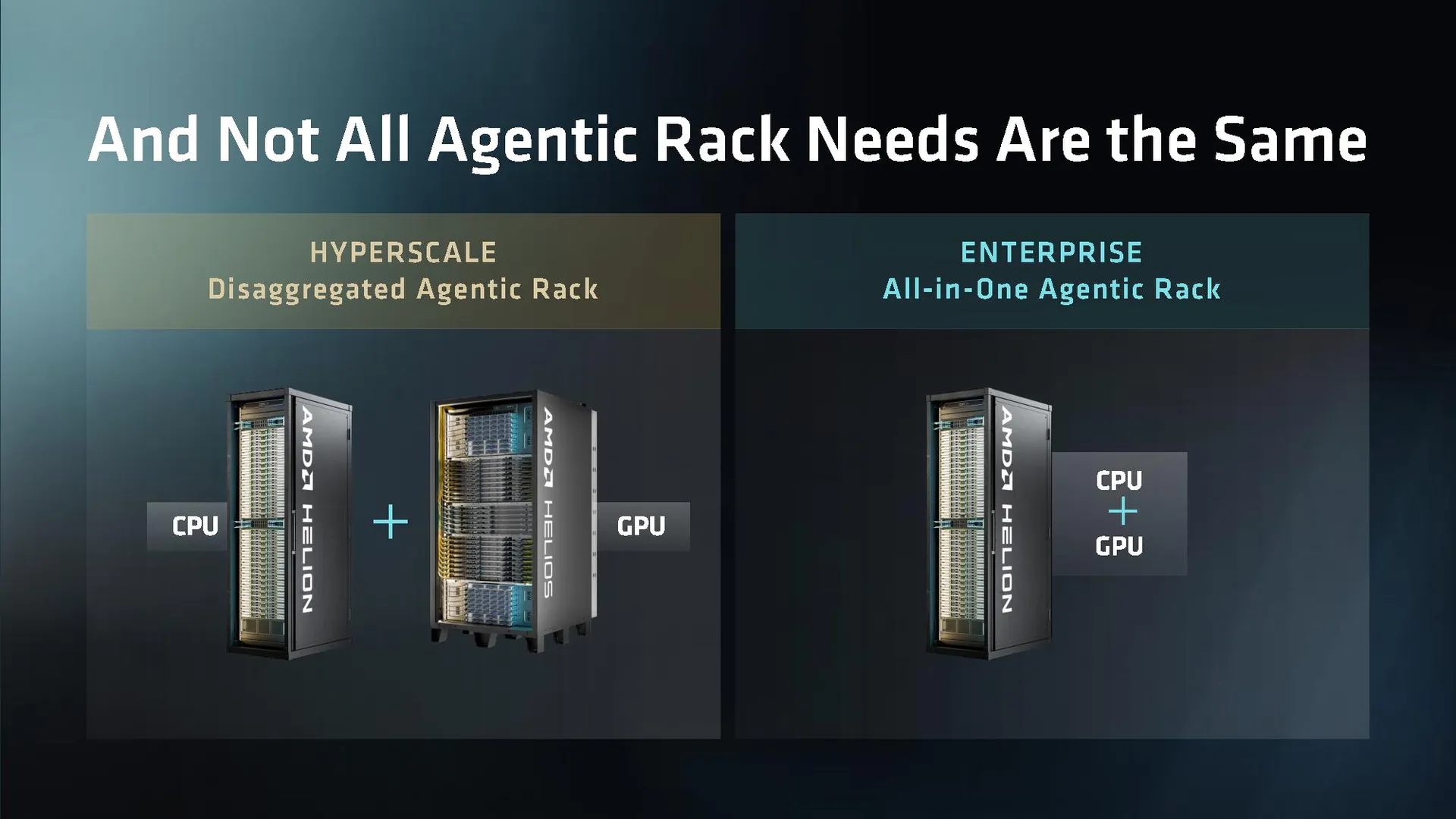
The core idea of this solution is to flexibly configure CPU, GPU, network and other computing resources according to different stages of the AI agent workflow. For very large-scale data centers that need to run a large number of agents, execute code, or process complex business processes, customers can choose pure CPU racks; for users who want to complete agent execution, model inference, and general enterprise computing tasks in the same set of equipment, they can choose a hybrid configuration of CPU and GPU.
This design reflects the emerging new division of labor in AI infrastructure. GPU is still an important computing device for large-scale model training and high-intensity inference, but when AI agents actually perform tasks, they also require a large amount of CPU resources to run programs, access databases, call external tools, manage task status, and coordinate multiple computing steps. As the number of agents increases, these tasks may become new resource bottlenecks in the data center.
Dan McNamara, senior vice president and general manager of AMD's Computing and Enterprise AI Division, said that agent AI is not a single type of workload, but covers a variety of scenarios such as personal agents, enterprise applications, code execution and complex workflows. Each task has different requirements for computing resources. Therefore, data centers need infrastructure that can adjust performance, core density and power consumption based on specific workloads.
He said that AMD hopes to use Helion to combine the performance of EPYC processors, open software ecosystem and flexible rack design, so that partners can build systems around customer needs and make more efficient use of limited power resources.
Helion's most eye-catching configuration is a pure CPU rack that can accommodate up to 32,768 CPU cores. The solution uses AMD's sixth-generation EPYC server processor, the core architecture is Zen 6, and is code-named Venice. According to the design announced by AMD, the entire rack can install up to 128 256-core processors, theoretically forming a computing cluster with 32,768 CPU cores.
It should be noted here that the 32768 cores are not integrated into one processor, but are composed of processors in a large number of server nodes. Helion adopts a rack-level design to integrate multiple computing nodes, network equipment and related infrastructure into a whole for centralized deployment and management in the data center.
This design is particularly suitable for scenarios where a large number of independent or parallel tasks need to be run. For example, an enterprise may run tens of thousands of AI agents at the same time, and each agent requires an independent execution environment to run code, retrieve data, call the enterprise's internal API, or handle complex tasks assigned to it by users. Compared with simply performing model inference, this type of workflow usually involves more routine program execution and system coordination operations, and therefore requires sufficient CPU computing power.
In traditional large language model applications, after the user inputs a question, the model generates an answer, and the computing load is mainly concentrated in the model inference stage. But in an agent application, a request may trigger a chain of operations: the agent analyzes the task, then calls a search tool or database, then executes the code, checks the results, calls the model again if necessary, and finally generates an answer.
In this process, the GPU is responsible for performing highly parallel computing tasks such as model inference, while the CPU is responsible for a large number of program running, data processing, task scheduling and tool invocation. If the number of agents continues to increase, even if the GPU has sufficient reasoning capabilities, insufficient CPU resources may limit the processing speed of the entire system.
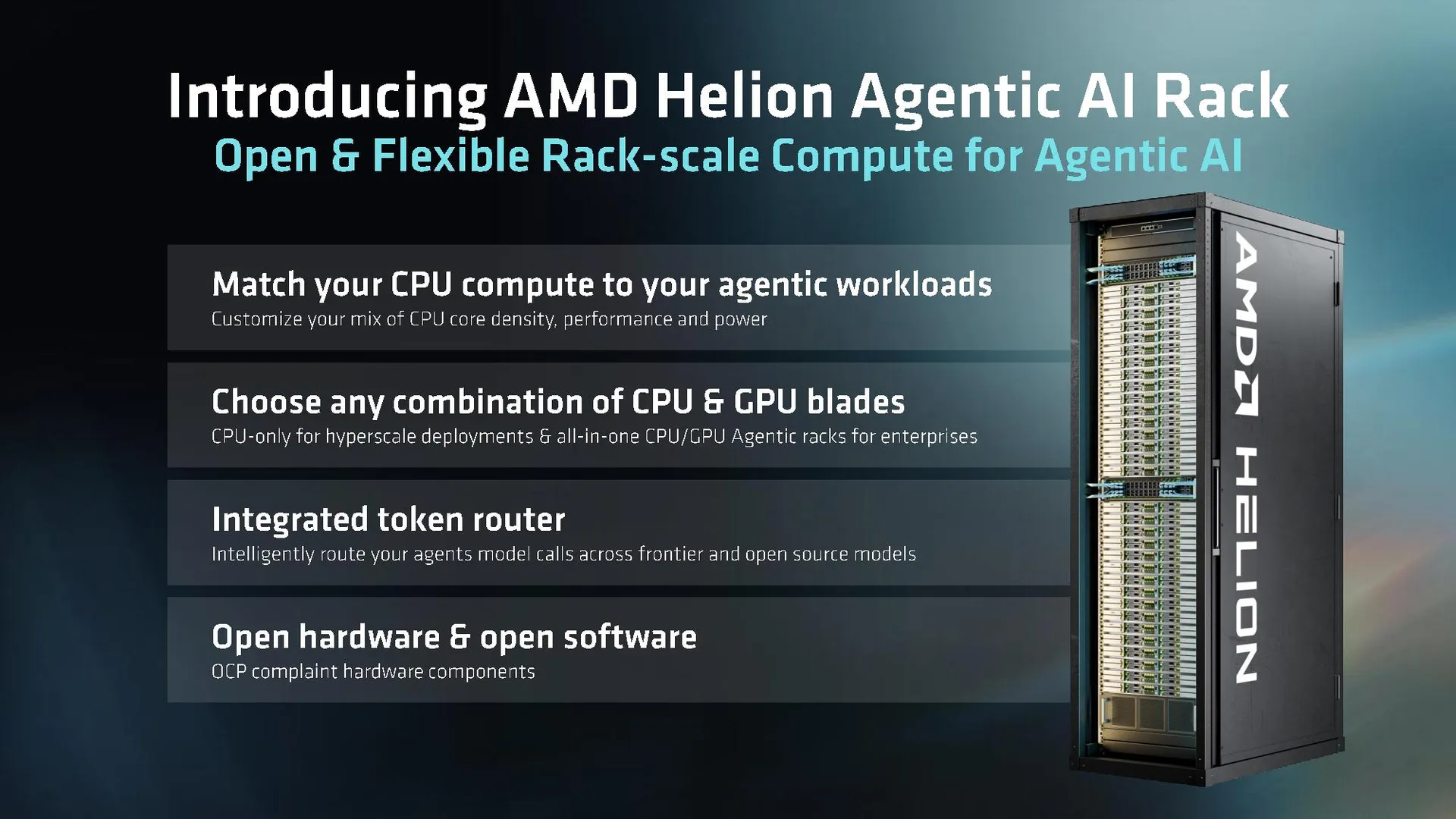
AMD hopes to solve this problem through the Helion pure CPU configuration, providing a large-scale and scalable execution environment for agents, while leaving model inference to independent GPU infrastructure for processing.
This means that Helion is not trying to completely replace the GPU with the CPU, but is trying to further separate the responsibilities of the two. For ultra-large-scale cloud service providers, this design allows different types of workloads to use computing resources that are more suitable for them, preventing expensive GPUs from being occupied by a large number of ordinary program execution tasks.
In addition to the pure CPU version, Helion also provides enterprise-level configurations that combine CPU and GPU. This solution can integrate AMD EPYC processors, Instinct MI350P GPU accelerators and general-purpose computing nodes in the same rack, allowing enterprises to run agents, perform model inference, and handle databases, storage and other general computing tasks in the same infrastructure.
According to the design announced by AMD, the hybrid configuration can be equipped with up to 16 Instinct MI350P GPU accelerators and provide network bandwidth of up to 102 Tbps. The network bandwidth here is the design indicator of the entire system and does not mean that each computing node can independently obtain the same bandwidth. Actual communications performance also depends on network topology, port configuration, traffic distribution, and system software.
In terms of GPU nodes, AMD provides a 5U server design using eight Instinct MI350P accelerators. By combining GPU compute nodes with CPU nodes, enterprises can adjust the number of accelerators based on specific tasks without having to fix the entire system to a single hardware configuration.
For example, systems that need to process large amounts of enterprise data and run complex workflows can allocate more CPU cores; systems that require high-throughput model inference can increase GPU resources. Auxiliary workloads such as databases and storage can also use dedicated general-purpose compute nodes, reducing competition for resources between them and the tasks performed by the agent.
AMD has also designed a variety of CPU computing nodes with different positions for Helion to meet different needs in terms of power consumption, core density and single-core performance.
High-density nodes use EPYC 9006 series processors with a rated power consumption of 400 watts, mainly used to maximize the number of CPU cores per unit space. The balanced node uses a 256-core processor with a rated power consumption of 600 watts to strike a balance between core density and overall computing power.
For workloads that place more emphasis on single-threaded performance, AMD also offers a processor configuration with 96 cores and a maximum frequency of 5GHz. Compared to simply pursuing the number of cores, this type of node is more suitable for tasks that are sensitive to single-thread performance and response speed.
This differentiated design reflects an important reality: AI agents do not always need as many CPU cores. Some tasks can be split into a large number of parallel operations, which is suitable for high-core density servers; other tasks are limited by single-thread performance, memory latency, or external service response speed, and simply increasing the number of cores cannot bring about corresponding performance improvements.
Therefore, Helion attempts to allow data center operators to choose different processor configurations based on actual workloads, rather than covering all scenarios with one specification.
In terms of heat dissipation, Helion supports both air cooling and liquid cooling solutions. For racks with tens of thousands of CPU cores and integrated high-speed network equipment, power supply and heat dissipation design are engineering issues that cannot be ignored. High-density servers can improve computer room space utilization, but will also bring higher heat load per unit space.
Liquid cooling can help systems remove heat generated by processors and other high-power components more efficiently, but it also requires supporting cooling infrastructure, piping design and maintenance processes. Air cooling may be more suitable for some customers who want to continue to use existing data center facilities. AMD offers two solutions, which means partners can choose based on computer room conditions, deployment scale and operating costs.
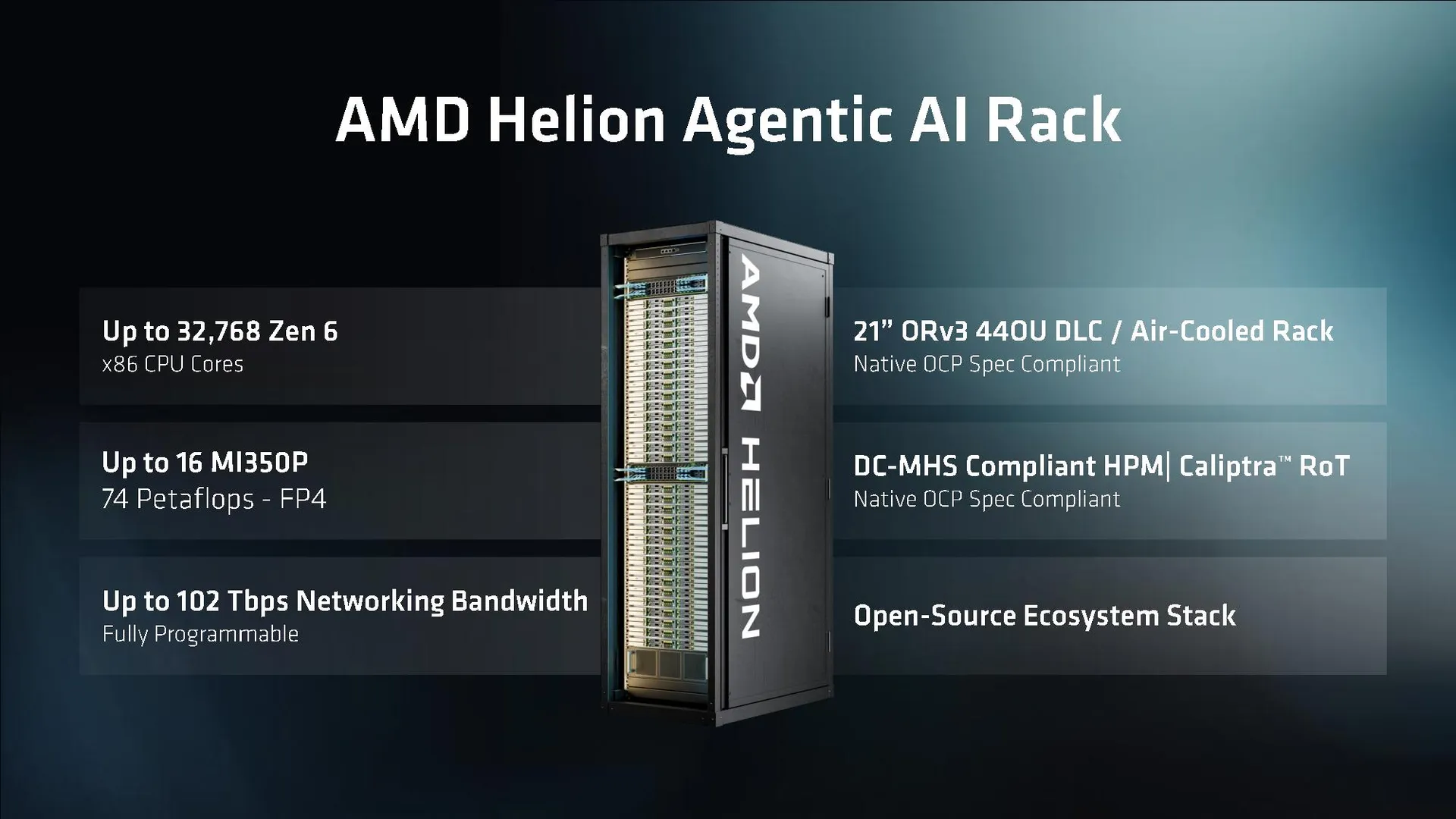
In addition to hardware configuration, Helion also emphasizes open software and system design. AMD plans to contribute relevant reference specifications to OCP so that partners can develop on a common design basis instead of relying entirely on closed systems provided by a single manufacturer.
OCP is an industry organization that promotes open data center hardware design. Its participants include cloud service providers, server manufacturers and other infrastructure providers. Open reference designs can help different manufacturers integrate systems around common hardware specifications and provide different configurations based on customer needs.
AMD hopes to expand Helion's ecosystem in this way, allowing Dell, Hewlett Packard Enterprise, Lenovo, AMD, Foxconn and other partners to develop their own products. What customers ultimately purchase will be server systems produced and integrated by partners, rather than purchasing a complete set of standardized racks directly from AMD.
AMD said the Helion configuration is currently being developed with ecosystem partners and is scheduled to launch in November 2026. The relevant designs still need to go through system integration, verification and actual deployment. What configurations can be finally provided, when they will be delivered on a large scale, and the specific product specifications of different manufacturers have yet to be announced later.
From a market competition perspective, Helion also reflects that AMD is further expanding the role of EPYC processors in AI infrastructure.
In the past few years, the construction of AI data centers has mainly focused on areas such as GPU accelerators, server interconnection and high-bandwidth memory. As the demand for large-scale model training and inference grows rapidly, NVIDIA has established clear market advantages with its GPU products and its software ecosystem.
But as AI applications gradually enter enterprise business processes, the tasks that data centers need to handle are no longer just model calculations. Agents may need to execute a large number of programs, access databases, process documents, run code, and coordinate multiple models simultaneously. These operations place new demands on CPU resources.
AMD hopes to gain more market opportunities in this infrastructure change with the help of high-core EPYC processors. By combining CPU core density, GPU acceleration and rack-scale network design, Helion attempts to provide an open platform that can adapt to different agent workloads.
Of course, 32,768 CPU cores alone cannot directly explain the actual performance of the system. Final performance also depends on processor microarchitecture, memory bandwidth, cache capacity, inter-node communication, software scheduling efficiency, and the degree of parallelism of the workload. For tasks that rely heavily on large model inference, the GPU may still be a critical factor in determining system throughput.
Similarly, increasing the number of CPU cores does not mean that agent tasks will be accelerated proportionally. If a large number of tasks need to wait for database responses, access external networks, or call other services, the system bottleneck may shift to the storage, network, or software level. Therefore, the value of Helion needs to be measured by performance, energy efficiency and total cost of ownership in real applications.
Overall, AMD Helion represents an expansion of AI infrastructure design ideas. AMD no longer only emphasizes the role of GPU accelerators in artificial intelligence, but instead attempts to provide integrated computing solutions for agents from task execution, model reasoning to data processing.
As AI agents gradually take on tasks such as software development, enterprise automation, and complex workflows, the division of resources between CPU and GPU may become more important. If enterprises really need to provide an independent execution environment for a large number of agents in the future, then high-core density CPU servers have the opportunity to become an important part of the AI data center.
However, Helion is still an open reference design rather than a mature product that has been fully deployed. Whether it can achieve performance and cost advantages in actual applications ultimately depends on the system implementation of partners, the maturity of the software ecosystem, and the real needs of enterprise customers for agent computing infrastructure.
Comments