
Abstract:
In early May this year, a five-second video of X went viral. This is a Korean Professional Baseball League broadcast, the Hanwha Eagles play against the Doosan Bears. The camera panned to a woman in the stands wearing a white top and jeans with her legs crossed. At one point, she seemed to sigh and looked away, looking dissatisfied with the game.

The caption of the video is "Ordinary Korean women". As of the publication of this article, the video has been played 15.25 million times|Video source: X @kangminlee
But soon a group of senior fans saw something was wrong. The scoreboard said the batter was Cho Inseong, but Cho Inseong retired in 2017 and is now a coach at Doosan.
In addition, the cheering slogan in the stands has one more word than the Doosan Bears’ official slogan, which seems to be a blunt and literal translation by AI. As for this broadcast, the commentary was in a standard American accent, which was also very suspicious.
This woman does not exist, she was generated by AI. But the video did not disappear after it was exposed. Instead, it became a template. Everyone put their faces into the same broadcast screen, creating a picture of themselves captured by the stadium camera, which quickly became popular on social networks.

"Myself captured by the stadium camera" quickly became a popular template|Photo source: RADII
Every time AI image capabilities are enhanced, there will almost always be a popular hit. For example, in March 2025, GPT-4o was able to draw pictures, and the screen was filled with photos redrawn in the style of Ghibli animations; at the end of August, Google’s Nano Banana was launched. Everyone’s favorite way to play it was to turn selfies into figures that were placed on the computer desk. Users generated more than 200 million pictures in two weeks.
The popular items are changed every time, and most of them are based on the "put yourself in" gameplay. But this time on the court, a sequence that was not so obvious before was exposed: first, a non-existent beauty deceived tens of millions of people, and then developed a template that everyone can play.
Beauty is not a supporting role that accidentally appears in the scene, she is more like a default value
.This default predates AI by half a century. In 1973, in the early days of image digitization, a group of engineers wanted to test a new image technology, and they also chose a beautiful woman.
01
The First Lady of the Internet
Lena Soderberg began her career as a print model in Chicago, Illinois. She had previously moved to the United States from Sweden as an au pair. In 1972, she posed for the centerfold of the November issue of Playboy magazine. That issue of Playboy sold more than 7.16 million copies, making it the magazine's best-selling issue.
Most people who have studied digital image processing have seen her: wearing a wide-brimmed hat, bare shoulders and looking sideways at the camera. Over the decades, countless image compression and processing algorithms have been tested on this face.
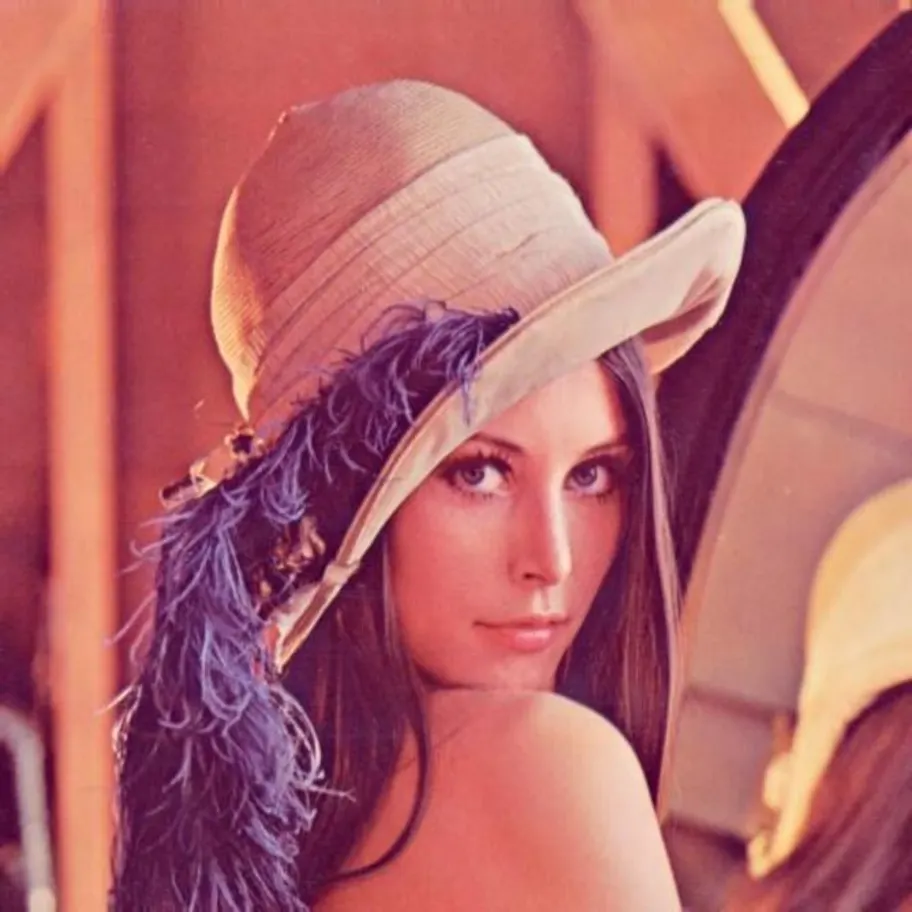
Lena Soderberg is the first lady of cyber | Image source: SIPI IMAGE DATABASE
In 1973, researchers at the University of Southern California's Signal Image and Processing Institute were scrambling to find a new image for a research paper. They have exhausted their usual stock of test images. At that moment, a colleague reportedly walked in with the November 1972 issue of Playboy. Seeing the researchers' predicament, he tore a 5.12-inch strip from the top of the center insert and fed it into their scanner.
Since then,
this image has been widely used in the image processing community and has even become the industry’s default test image
.In 1996, David Munson, editor-in-chief of IEEE Transactions on Image Processing, wrote a short article explaining how this randomly scanned image became an industry standard. He gave two reasons. The first one is technical. This picture has all the details, flat areas, shadows and textures, so it is suitable for testing algorithms. The second article is more in line with human nature:
This is a photo of an attractive woman. It is not surprising that a research circle dominated by men is attracted to it
.Given the origin of this image, its use was not without controversy. In 1991, Playboy discovered the image on the cover of an academic journal, sent a letter claiming copyright, and eventually let it go, allowing it to continue to be used in research. The company's vice president of new media said that since it has become a phenomenon, it is better to take advantage of it.
There are also some different voices from within the image processing research community. They noted that engineers should not use material from any publication that could be seen as demeaning to women.
Even Lena herself stated in the documentary "Losing Lena" that she hopes to stop using this picture.

In the documentary, Lena herself holds up the famous photo of herself from more than 50 years ago | Image source: IMDB
As a result, starting from April 1, 2024, the IEEE Computer Society will no longer accept papers using this picture.
Fifty-one years have passed since that scan
.02
Average face
Now, the test questions in the technical circle have long been changed.
AI cannot draw a full glass of red wine. The liquid level in the glass always stops in the middle. When AI draws a clock, the hands always stop at 10:10. The reason is the same: most of the red wine photos on the Internet are not full glasses, and the convention in watch advertisements is to display them at 10:10. The model will replicate the distribution of the training data and cannot get rid of the inertia of the data.
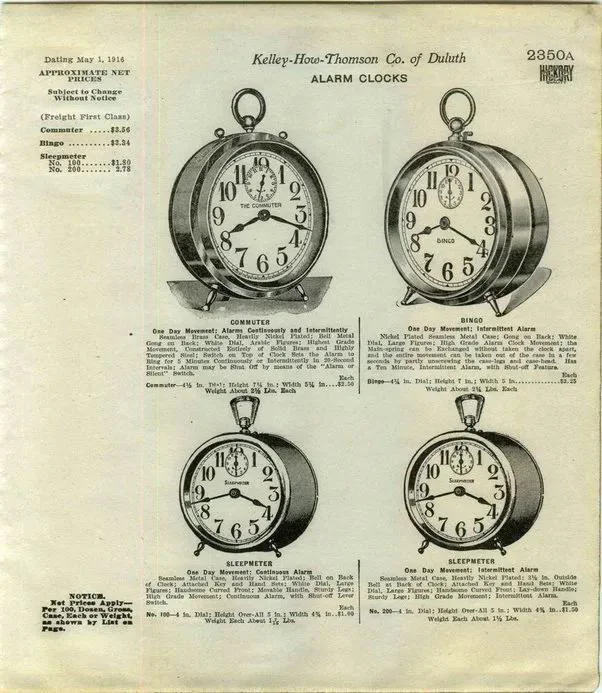
The most popular explanation for why clock ads always stop at 10:10 is that it looks like a "cheerful smile," but before the 1950s, it was more popular to stop at 8:20 | Image source: Reddit
Red wine and clocks are evidence that “models are not good enough.” But when it comes to beautiful women, the situation is different. "Her" inertia happens to be aligned with people's aesthetics.
In 1990, psychologists Judith Langlois and Lori Roggman conducted an experiment: they mathematically averaged a batch of faces to synthesize a new face, and then asked people to rate it. As a result, the synthetic face is more attractive than almost every real face involved in the synthesis, and the more faces involved in the average, the better the synthetic face looks. This effect holds true for both male and female faces, and across different ethnic groups.
The title of the paper is simply called
"Attractive Faces Are Only Average"
.Similar observations occurred earlier. In 1877, someone wrote to Darwin and told him that by superimposing two portraits of a lady using a stereoscope, the resulting face would be significantly more beautiful every time.
The essence of the generative model is actually to learn a data distribution and then sample from near the center of the distribution. In other words, the model is programmed to draw average faces, and average faces happen to be what humans see as beautiful.
Human psychology combined with machine principles has become the technical foundation for beauty as the default value of AI
.A 2023 Australian National University study took this collision to an extreme. Psychologists found that AI-generated white faces were judged as “real” by experimental participants more often than real white faces. Researchers call it "AI hyper-realism", explaining that the training data are mainly white people, and the faces generated by the model are closer to the average of this group, and will be perceived as more typical and more like real people.
After Langlois’s experiment was published, he received a criticism: The synthetic face looks good only because the spots and blemishes on the skin are easily erased when averaging. This criticism was methodological in 1990.
But today it looks like a prophecy.
The most typical feature of AI beauties is excessively smooth skin. More than three decades later, fact-checking organizations are teaching people to identify AI images, and one of the flaws listed is excessively smooth skin. That statistical artifact that critics pointed out more than three decades ago characterizes the AI beauties of 2025.
03
Gypsum egg
Lena was selected in a laboratory. Today's default value is grown from the data.
At the end of 2022, the "Magic Avatar" function of the photo editing application Lensa suddenly became popular: upload a few selfies, and AI will generate a hundred portraits of different styles for you. Melissa Heikkilä, an AI reporter at MIT Technology Review, also used it to generate 100 avatars of herself, 16 of which were topless and 14 with minimal clothing and sexy poses. And her male colleagues all got astronauts, explorers and inventors. None of them gave the model any hints during this process.
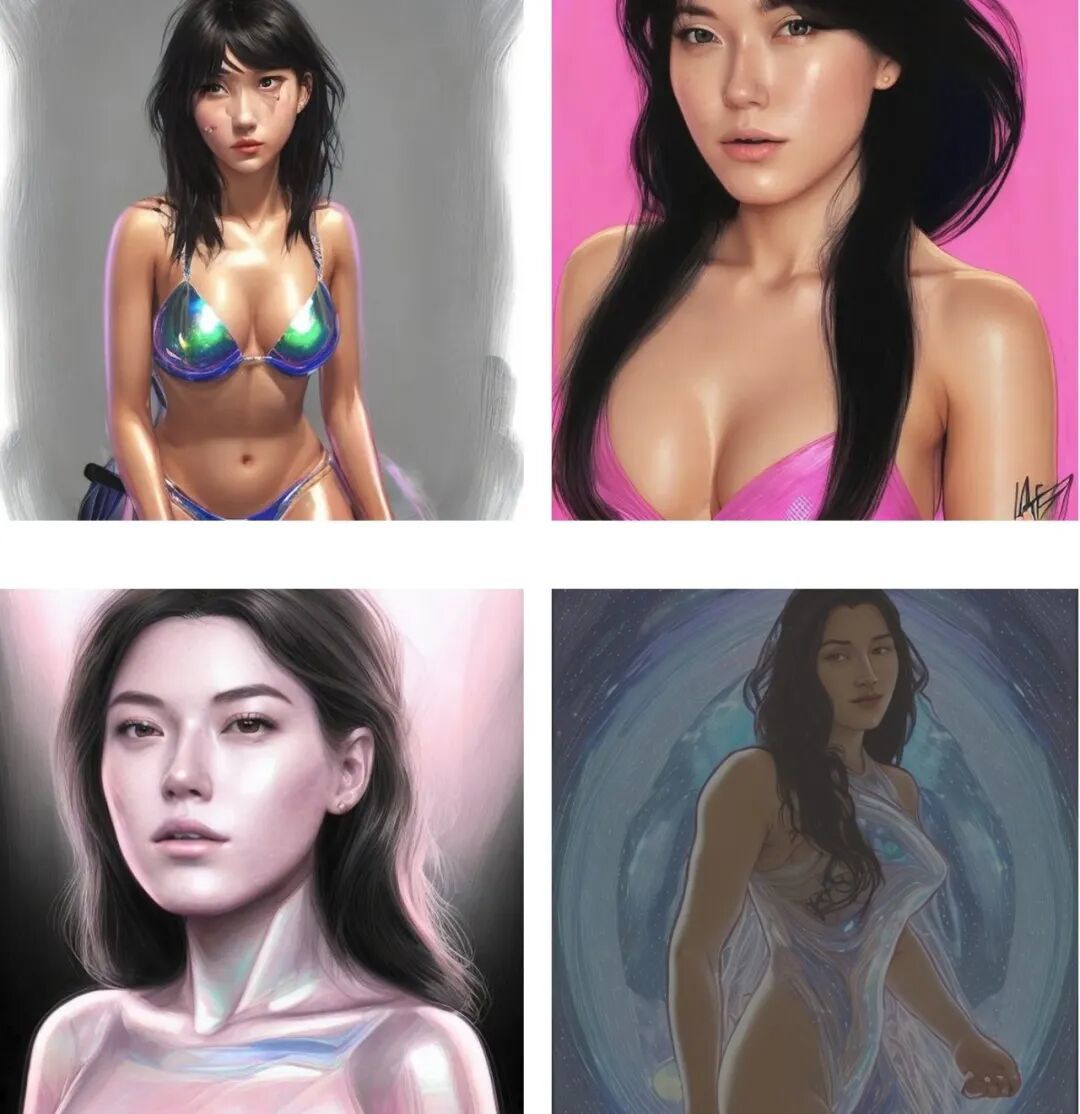
Image generated by Melissa via Lensa|Image source: MIT TECHNOLOGE REVIEW
Melissa explained in her article that the model behind it was trained on pictures captured from the Internet, and
the Internet is already full of photos of scantily clad women. This causes the model to generate "scantily clad women" as the default value
.Then, user behavioral inertia will continue to drive this tendency. Every generation, saving, and forwarding is a vote. A 2025 study counted content changes on the AI image community Civitai: the proportion of NSFW (adult-oriented) images rose from 41% in January 2023 to 80% in December 2024.
Finally, the manufacturer will write these votes into the model. In order to allow the image model to generate more pleasing images, manufacturers will train a "scorer", which is technically called a reward model or aesthetic scorer. Its job is to learn what pictures people think are good-looking, and then use this standard to train the model: go more in the direction with a high score, and go less in the direction with a low score.
One of the most commonly used scorers is called PickScore. Its training data comes from a web application: the user writes a prompt word, the system gives two pictures, and the user chooses the one he likes more.
This data will be reviewed, and users who generate NSFW content will be eliminated, but there are still a lot of NSFW prompt words mixed in. A 2024 paper studying reward models found that using PickScore to fine-tune the model,
even if the prompt words have nothing to do with sex, the model will draw more NSFW pictures
.A picture then appears: the content reviewer at the front desk is intercepting, but the scorer at the backend is pulling back. The manufacturer's official demos never feature NSFW beauties, and the generation policy is very strict. But as we all know, today’s large models are not entirely controllable. It has been trained by the user's taste, and the user's taste has gone very far in inertia.
In the 1930s, Dutch ethologist Niko Tinbergen observed a species of seagull. This bird lays small, pale blue eggs with gray spots. But when he placed huge, bright blue, black-dotted plaster dummy eggs next to the nest, the birds would abandon their own eggs and climb onto the plaster eggs to hatch them. He called these exaggerated imitations, which are more attractive than the real thing, "supernormal stimulation."
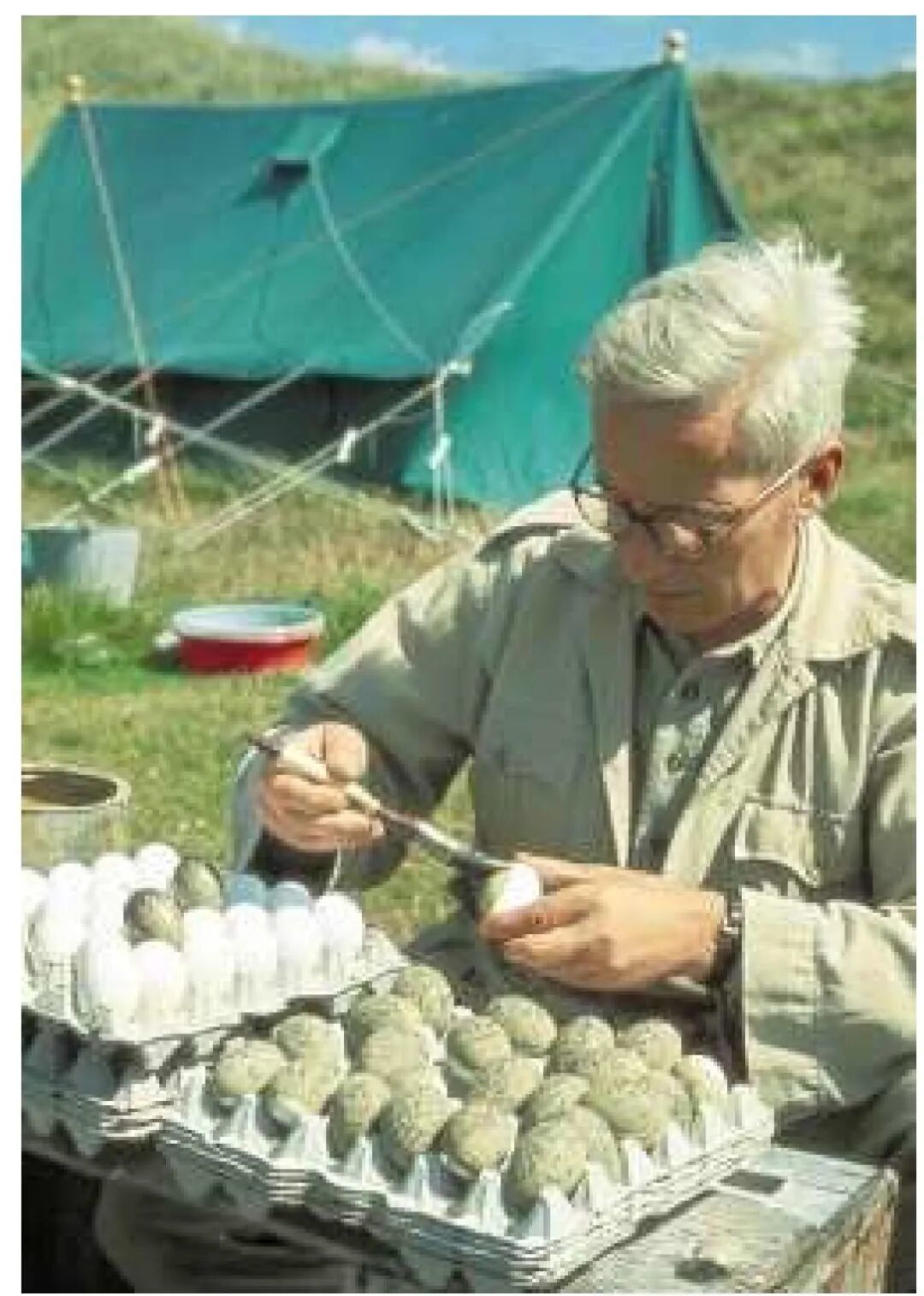
Niko Tinbergen paints eggs during an outdoor expedition | academia
The human face also has extraordinary stimulation, and it takes the "average is the most beautiful" concept one step further. In 1994, David Perrett and others published a study in Nature: a group of the best-looking faces was synthesized to be more likable than the average face of all people; and if the difference between it and the average face was amplified by 50%, the score would be even higher. Japanese subjects and white subjects chose the same direction.
Among the mainstream AI companies, at least one has directly turned this psychology into a product feature. Grok's image generation has four modes, one of which is called Spicy. When turned on, content filtering will be relaxed, allowing the generation of suggestive content and partial nudity, and is only open to paying users.
In January 2026, users discovered that they could upload photos of anyone to "digitally undress" Grok. The victims included children, and many governments stepped in to put pressure. X responded by limiting image generation overall to a paid feature.
The British Prime Minister’s spokesman commented: This is just a function of generating illegal images, turned into a paid service.
AI grows into the shape of the group of people who press "Like" most often
. In 1973, this group was a predominantly male lab. Today, they are the users who click most, forward most, and save most. People's preference for beauty does have a biological basis. Babies as young as two and three months will look longer at faces rated as attractive by adults.Lena, the First Lady of the Internet, was an accident. Today's default is for the model to grow from the center of the data. The user's clicks pushed it farther and farther, and finally someone put a price on it.
The statistical characteristics of the AI generation model, human aesthetic preferences for the "average face", as well as user clicks and commercial incentives form a feedback loop. They are independent of each other, but together they happen to point in the same direction, becoming our default option for content consumption today.
Comments