
Abstract:
Alaska Airlines is comprehensively upgrading the cabins of Alaska Airlines and Hawaiian Airlines, adding hundreds of high-end seats, and building a new airport VIP lounge. The company is betting that travelers are willing to pay a premium for travel enjoyment, boosting corporate profits over the next decade.
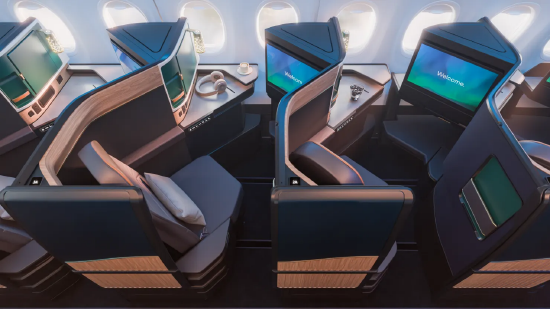
Alaskan Airlines' new 737 MAX new suites
The news was announced ahead of an investor day in Seattle on Tuesday. At the investor day, executives will face multiple questions: new product plans, the erosion of profits from high jet fuel costs this year, and whether it can achieve its goal of adding $1 billion in profits from the end of 2024 to the end of 2027. Alaska Airlines said Tuesday that it is now two-thirds of the way there.
Investors will also link new products to the development prospects of corporate credit cards and membership loyalty programs, which have generated billions of dollars in revenue for airline companies.
Alaska Airlines said that the company plans to further increase the proportion of revenue from high-end seats, international routes, membership systems and cargo services. The gross profit margins of these businesses are higher than those of ordinary economy class. The company forecast on Tuesday that such high-yield businesses will account for nearly 60% of total revenue by 2030, from 53% currently.
Although the cabins have been renovated, Alaska Airlines and Hawaiian Airlines, which completed their merger in September 2024, still maintain dual-brand independent operations.
Main renovation content
Alaska Airlines Boeing 787 Dreamliner: Equipped with 34 lie-flat "Aurora" premium suites; 787‑9 and 787‑10 models have added a new super economy class "Premium Reserve" with 35 seats, which will be put into use starting in 2028.
At least 25 Boeing 737 MAX 10s awaiting airworthiness certification: equipped with 12 flat-bed Aurora suites and premium economy seats, aiming to compete with other airlines on high-yield US transcontinental routes.
Hawaiian Airlines' 24 Airbus A330 aircraft: Starting in 2028, each aircraft will be equipped with 22 new first-class suites with sliding doors, and for the first time, a premium economy class will be added with a total of 28 seats.
Airport facilities:
Alaska Airlines will build a new 41,000-square-foot VIP lounge at Seattle-Tacoma International Airport, with an exclusive area for Aurora suite passengers, in line with the hierarchical lounge systems of Delta, United Airlines, and American Airlines.
Hawaiian Airlines is building a new 13,000-square-foot lounge in Honolulu Terminal 1, which is expected to open to the public in early 2028.
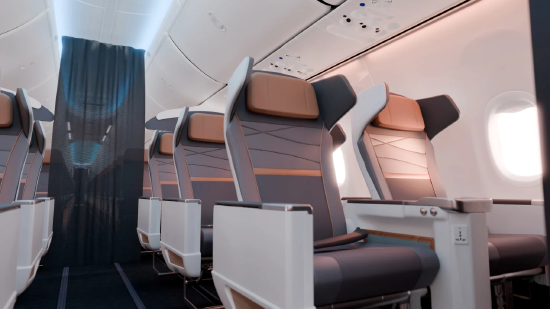
Alaska Airlines’ new Premium Economy Class cabin
In the past few years, major U.S. airlines have continued to renovate their cabins and add high-end seats, often squeezing the number of regular economy class seats. The first-class ticket price can be several times that of ordinary economy class, and passengers are willing to pay to choose a seat near the front. Most of Alaska Airlines' fleet previously lacked the lie-flat seats and other high-end features commonly equipped by its competitors.
Alaska is not the first airline to revamp its cabins, but being a latecomer can also be an advantage.
Henry Harteveldt, founder of Atmosphere Research Group, a travel consulting agency, said: "Being a latecomer has advantages. You can see the design of competing products and you can do better than your competitors."
Hawaiian Airlines A330 mainly flies to and from Hawaii, Asia and Oceania. Fleet chief Shane Jones said frankly that the aircraft’s “cabin interior is old.” After the transformation, the number of seats on a single A330 dropped from 278 to 254. Jones said the upgraded products can cover diverse needs and are suitable for high-end consumption by honeymooners and repeat Hawaiian customers who want to upgrade their experience from economy class.
He revealed that the team compared a large number of fabric samples under different lighting environments at the Seattle headquarters before finally selecting the material. Some fabrics are too bright in pink, and some shades are too dull. The seats are sewn with wave patterns, and the design hopes to restore the colors and atmosphere of a tropical vacation in Hawaii; the team also repeatedly tested the density of the wave patterns to avoid visual dizziness caused by too many patterns.
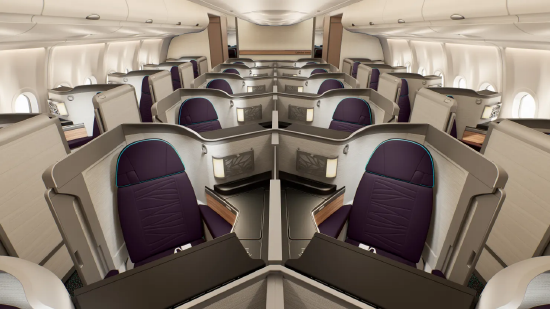
Hawaiian Airlines' new first-class suite
Hawaiian Airlines CEO Diana Burkett Lacko said that more than half of the tourists to Hawaii come from the West Coast of the United States. "From the perspective of income, travel budget, consumption and travel habits, these customers have extremely high commercial value. This upgrade can improve their travel experience."
At the same time, Alaska Airlines continues to expand international routes from Seattle, and has opened routes to London, Iceland, and Italy, and will add more destinations this fall. Airlines executives say demand for international travel remains strong even as jet fuel prices soar.
New debit card products and adjustments to frequent flyer programs
Alaska Airlines plans to launch a rewards debit card for its Atmos membership system early next year, expanding its co-branded card product line with Bank of America. Airlines such as Southwest Airlines and United Airlines have also launched similar rewards debit cards with JPMorgan Chase.
The new debit card is aimed at young Americans and newly arrived residents, "allowing the membership system to cover people who cannot be reached by traditional credit cards."
In addition, starting from this Thursday, Atmos frequent flyer members need to choose one of three mileage accumulation rules: mileage accumulation based on flight distance, air ticket consumption amount, and flight segment. The general trend in the industry has been to gradually abandon accumulation based on flight distance and instead issue miles based on passenger consumption amount or reward credit card consumption.
Comments