
Abstract:
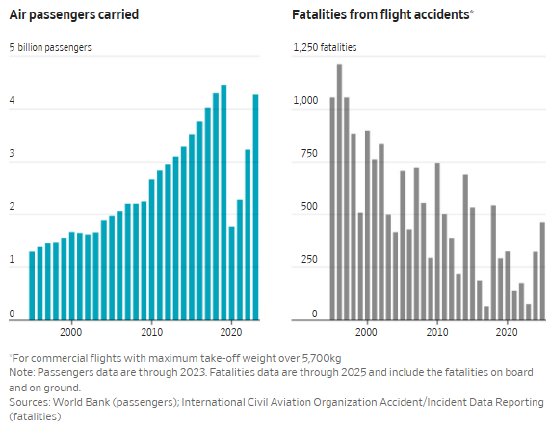
Since 2005, at least 800 people have been killed around the world in crashes suspected or confirmed to have been deliberately caused by pilots. A pilot allegedly tried to crash a Boeing 737 MAX passenger plane (Dubai incident), which exposed the aviation industry's biggest safety hazard lurking in the cockpit. As the overall safety of commercial flights continues to improve,
The number of fatalities caused by suspected intentional crashes
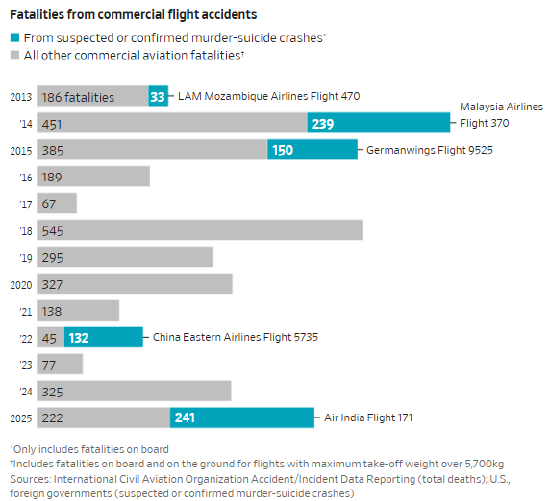
More and more shocking. Accident data show that since 2005, at least 800 people around the world have been killed in air crashes that U.S. officials suspect or have confirmed were intentionally caused by pilots.
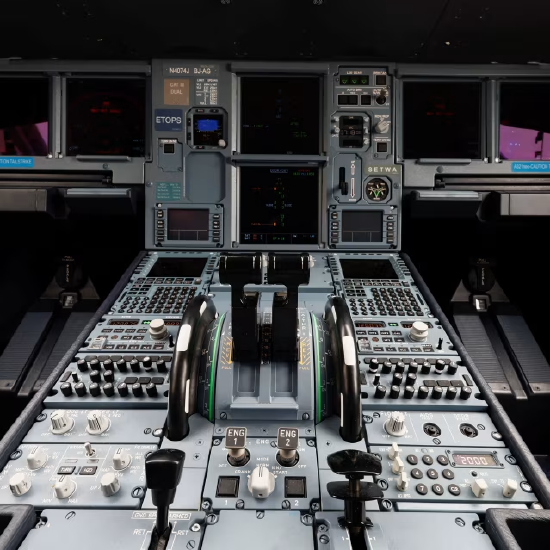
Flight control devices and instrument display screens in the aircraft cockpit.
Disasters that current and former U.S. officials have determined were caused by intentional actions by pilots include the 2014 disappearance of a Malaysia Airlines flight in the southern Indian Ocean and the 2025 Air India crash in western India. The local investigation agency of the above-mentioned accident has not reached the same conclusion as the United States, and has not yet issued a final investigation report.
The crash of a Germanwings airliner in the French Alps in 2015 was officially confirmed to be a deliberate crash.

2015 The families of the victims of the Germanwings crash held a memorial service at the scene of the accident in the French Alps last year.
Airlines, regulators and aviation equipment manufacturers have long been committed to eliminating fatal accidents, including runway overruns, aircraft accidental collisions with terrain, and fuselage structural failures.
The total number of flights flown globally has grown by 37% over the past two decades, according to aviation data agency Cirium. Accident statistics show that the total number of global civil aviation fatalities fell by 35% between 2005 and 2025. In the United States, until last year's mid-air collision in Washington, D.C., there had been a 15-year record for no major civil aviation accidents resulting in the death of a passenger.
Aviation safety experts said that if there are shortcomings in screening potential out-of-control pilots, no matter how good the pilot training and the technical protective measures of modern passenger aircraft are, their effect will be very limited.
John Cox, an aviation safety consultant and former pilot union leader, said: "The aircraft will only carry out the operating instructions it receives."
According to people familiar with the matter, executives within Boeing privately regard intentional crashes as one of the leading sources of fatal accidents in civil aviation. People familiar with the matter said that engineers have taken this risk into consideration when designing the next generation of passenger aircraft.
Thomas Anthony, director of the Aviation Safety and Security Project at the University of Southern California, said that if cockpit system failures or mechanical problems cause multiple fatal accidents one after another, it will immediately trigger widespread panic and prompt regulators to take strong measures.
"Relevant personnel will take urgent action." He said.
Although such accidents are rare, they are extremely fatal and it is difficult for officials to quantify their risks. A major obstacle in some cases is the inability of all parties to agree on the cause of the accident.
Malaysian authorities released the final report on the Malaysia Airlines MH370 accident in 2018, stating that they could not determine the cause of the flight's deviation from the route and could not rule out the possibility of hijacking. A spokesman for the Malaysian Ministry of Transport said there was no new information on the cause of the accident.
As for the Indian aviation accident, the Indian pilot group does not agree with the inference that the pilot's operation caused the crash. India's Aircraft Accident Investigation Bureau said it would insist on conducting an "objective, evidence-based investigation."
Relevant authorities in the Middle East said that the suspected out-of-control co-pilot involved in the Dubai Air incident on September 30 held extremist views. The authorities identified him as Hamam Hammami and accused him of using an emergency ax to attack the captain in an attempt to crash the passenger plane. Hammami told investigators that he specifically sought out airlines and routes to Israel and nearly carried out an attack in July.
Reporter Benjamin Katz interprets the high-speed descent data, flight tracking information, and its rare safety implications in this cockpit conflict.
Relevant authorities are investigating why Hammami was qualified to fly the route from Dubai to Tel Aviv.
Cockpit Control
A fundamental principle of civil aviation: pilots have ultimate control over the operation of the aircraft.
However, after the 9/11 hijackings in 2001, the U.S. government and industry quickly sought technical means to prevent deliberate destruction of aircraft.
Later in September of that year, President George W. Bush pledged to advance a number of improvements, including strengthening cockpit doors and developing technology that would allow controllers to take over distressed aircraft and land them remotely.
Companies such as Boeing and Honeywell have studied technology that can override pilot instructions. The late Honeywell engineer Don Bateman once told an industry journal: "Aircrafts should be able to 'refuse to be destroyed'."
However, the remote landing system has never landed on a passenger aircraft. One concern is the risk of the system being hacked.
Boeing applied for a patent in 2006 for "uninterruptible autopilot": once activated, it cannot be deactivated from the cockpit. The aerospace giant said the system has never been installed on any commercial aircraft.
The research and development of automated safety protection continues, and the ground anti-collision system was later applied to some US military jet fighters.
In recent years, Airbus has proposed a plan to allow the aircraft to keep only one pilot on duty during the cruise phase, and the remaining pilots can rest.
European and American pilot associations, US regulators and Boeing are all skeptical of Airbus' plan. According to people familiar with the matter, Boeing executives have discussed the potential safety vulnerabilities caused by having an out-of-control pilot alone in the cockpit.
Mike Whitaker, administrator of the U.S. Federal Aviation Administration (FAA) during the outgoing administration, said: "This is a huge risk. This is also the fundamental reason why the entire idea will not work."
Airbus said that the company supports two-person cockpits and plans to rely on technology to improve flight safety.
Boeing said that the design of the next-generation new passenger aircraft is still based on a two-person cockpit. People familiar with the matter said that although Boeing still plans to leave the final decision on aircraft control to the pilot, the advanced computer equipped with the new aircraft is expected to be equipped with a new automatic protection mechanism, making it more difficult to operate an accidental or deliberate crash.
Boeing declined to discuss the issue of intentional crashes. The company said it supports legislation recently advancing in the U.S. Congress aimed at addressing pilots’ mental health issues.
Pilot behavior that continues to attract attention
After the Germanwings crash in 2015, pilots’ mental health issues received widespread attention. In this accident, the co-pilot locked the captain out of the cockpit door while he was leaving the cabin to go to the toilet, and deliberately drove the Airbus A320 into a mountain, killing all 150 people on board.
The French accident investigation report records: A few weeks before the accident, the co-pilot had developed obvious mental symptoms. The doctor recommended that he be hospitalized and prescribed a variety of drugs. But German privacy laws restrict doctors from reporting to aviation regulators, leaving regulators with missed opportunities to intervene.
In the wake of the Germanwings tragedy, regulators, industry figures and advocates have pushed to reduce barriers to pilots seeking psychological treatment. Airlines have successively established pilot peer support networks; the European Union has begun requiring doctors to report serious mental illness in pilots to the competent authorities.
Regulators and relevant people believe that the key to preventing such extreme incidents is to first eliminate the stigma caused by mental health problems and eliminate pilots' concerns about loss of income and license revocation after seeking help.
The FAA says it is revolutionizing mental health management. Critics say the old system is outdated and overly punitive. For example, pilots can now continue flying while taking a wider variety of psychotropic drugs; and the FAA has shortened the wait time for pilots to receive treatment before returning to flying.
Dr. Susan Northrup, the FAA's federal aviation surgeon responsible for medical certification of pilots, said in August: "We want to simplify the process so that more people can come forward and get the treatment they need."
Relevant authorities investigating last year's major Air India crash said in court documents that they were examining a number of factors, including conducting a "psychological autopsy and assessment." A draft final report is expected to be completed this month. The Indian government agency responsible for the investigation did not comment.
The Dubai Airlines incident exposed that even if a pilot is determined to be unfit to fly, loopholes in the entire management system may still exist. Hammami, the co-pilot of flight 1073 involved, was grounded by his former employer Oman Air two years ago, was included in the de-radicalization project, and was transferred to a back-office position.
He joined the rapidly expanding Dubai-based carrier in February after leaving Oman Air last year and has since been assigned to fly the region's most sensitive routes.
Comments