
Abstract:
Before the release of AMD's official fix, community developers have launched a temporary solution around the issue of the Radeon graphics driver abnormally writing to SSD, providing affected users with an alternative path without shutting down critical driver services.
It is understood that German ComputerBase forum user Necandi recently released a free open source tool called "Radeon-atieclxx-SSD-Fix". This tool is designed to prevent AMD driver components from producing abnormal disk writing behavior while keeping related background services running, thereby avoiding affecting the normal use of some functions of the graphics card.
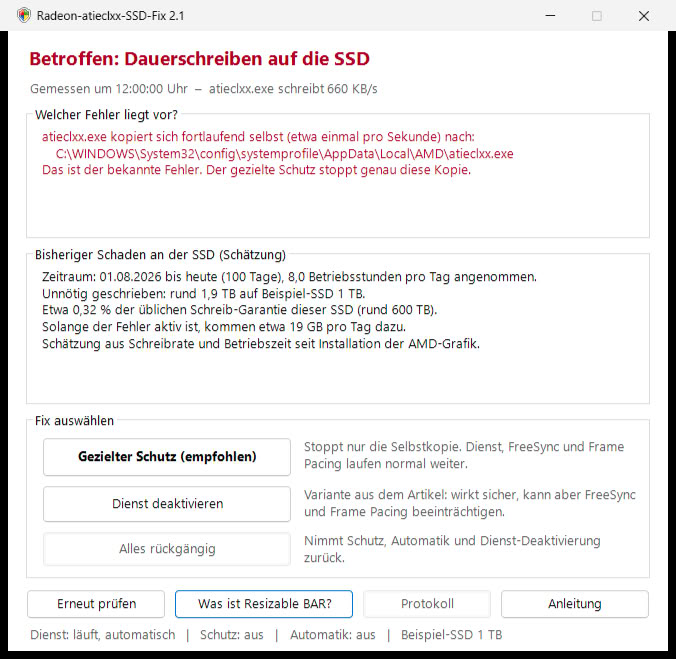
Previously, users discovered that the atieclxx.exe process in the AMD driver will continue to copy its own executable file of approximately 660KB from the driver directory to the Windows system configuration directory, and this process will be executed approximately once per second. At this speed, approximately 56GB of data writes may be generated every day.
More worryingly, there are large differences in write speeds reported by different users, ranging from 0.3MB to 5MB per second. If calculated based on the maximum speed, the write volume in a single day can reach approximately 432GB, which will significantly increase the wear and tear of the solid-state drive and cause users to worry about the life of the SSD.
The newly launched open source tool does not directly shut down the AMD External Events Utility service, but uses the Windows file permission mechanism to prohibit the SYSTEM account from writing to target files that are constantly being copied. When the driver attempts to perform a copy, the write request is rejected by the system, preventing new data from being written to disk.
Because related services remain running, features such as FreeSync, adaptive frame rate, frame time management, and Radeon shortcut keys can theoretically continue to work normally without sacrificing graphics card functionality like some previously recommended workarounds.
The developers have also added several auxiliary capabilities to the tool, including detecting whether a system is affected by the issue, estimating the amount of additional writes generated to date, and a scheduled task to automatically reapply protection measures after driver updates. In addition, the tool also has a design idea to automatically cancel relevant restrictions after AMD officially fixes the problem.
However, the developer also reminds that this is an unofficial tool and the interface is currently only available in German. Users should evaluate the potential risks before deciding whether to use it.
AMD has previously officially confirmed the existence of this abnormal writing problem and stated that it will provide an official fix in the upcoming Adrenalin 26.11.1 driver. But as of now, the new driver version containing the patch has not yet been pushed to users.
Prior to this, users mainly had two temporary coping methods. One is to disable the External Events Utility service, but this may cause FreeSync and frame synchronization related functions to be affected; the other is to turn off the Resizable BAR function in the motherboard BIOS, but doing so may cause a certain loss of game performance.
With the emergence of an open source community initiative, affected Radeon users are given a third option before the official patch is released. However, since this solution is not officially provided by AMD, users still need to carefully evaluate the compatibility and potential risks before deciding whether to deploy it.
Download:
https://github.com/necanditool/Radeon-atieclxx-SSD-Fix
Comments