
Abstract:
Anthropic, an artificial intelligence company, officially released Sonnet 5.5, the latest member of the Claude product line. Positioned as a "work partner", this new model focuses on faster speeds and lower costs, hoping to further enhance its practicality and commercial appeal amid fierce competition among large models.
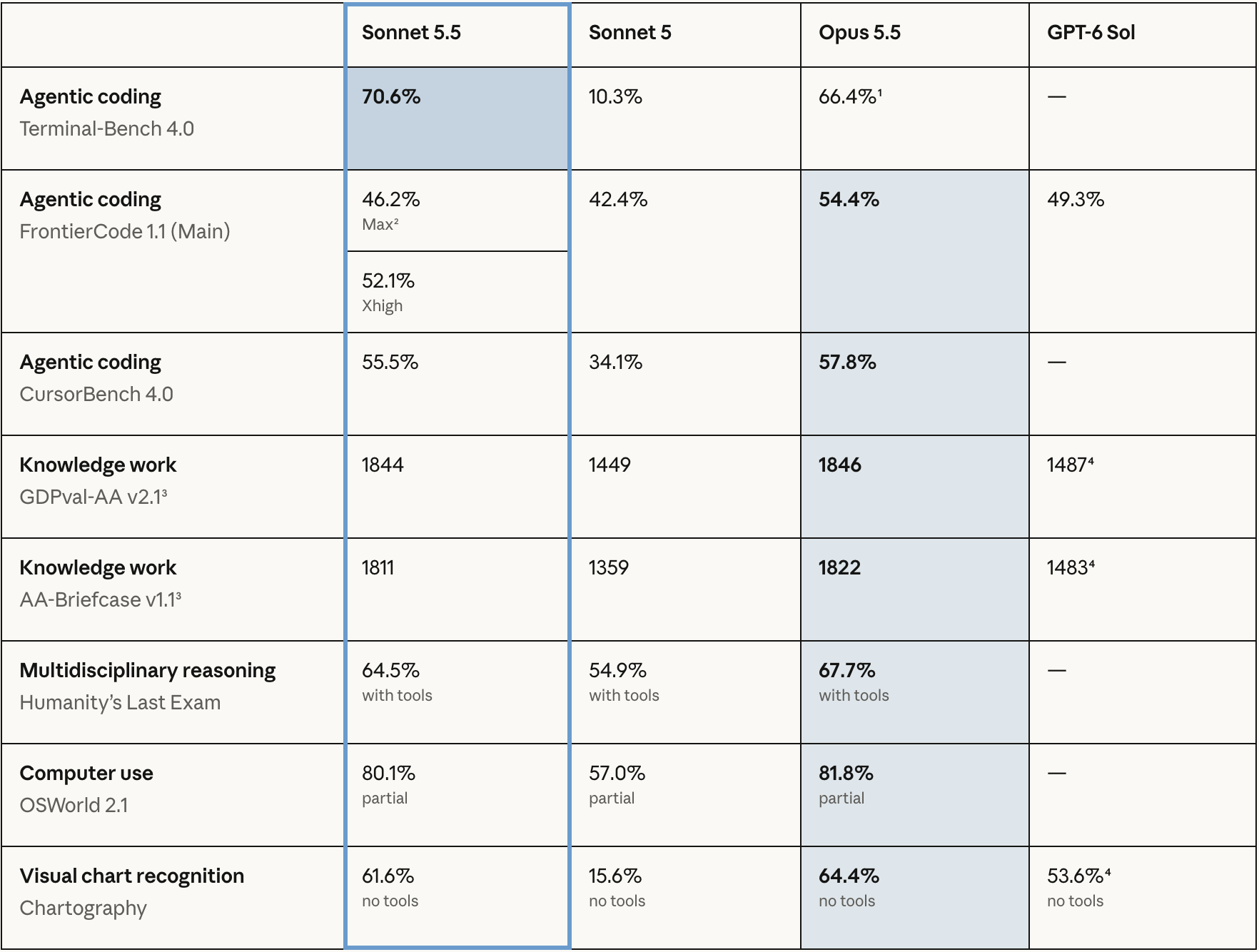
Anthropic said that Sonnet 5.5 is the latest generation mid-range model of the Sonnet series, which is mainly targeted at daily work scenarios, including software development, document writing, spreadsheet processing and various office tasks. The company believes that for a large number of enterprise users, daily work efficiency is often more important than the pursuit of extreme capabilities, and Sonnet 5.5 is optimized around this need.
Compared with Sonnet 5, which was released about three months ago, the biggest change in the new version is not the upper limit of capabilities, but the operating efficiency.
Anthropic said that the output speed of Sonnet 5.5 is more than 30% higher than that of the previous generation, and the number of Tokens consumed during task processing is significantly reduced. This means that users can complete the same work at a lower cost, and it also allows enterprises to have better economics when deploying large-scale AI workflows.
In Anthropic's current product system, the Sonnet series is located under the Opus series. According to conventional understanding, Opus has stronger overall capabilities, while Sonnet undertakes actual work tasks with higher frequency and higher efficiency.
However, Anthropic pointed out that in some specific scenarios, Sonnet 5.5 can even surpass Opus 5.5, which has a higher positioning.
According to test results announced by the company, Sonnet 5.5 performs better than Opus 5.5 in tasks related to agent programming (Agentic Coding). Anthropic believes that this is mainly due to Sonnet 5.5’s ability to mobilize multiple agents to perform tasks at the same time at a lower cost, thereby achieving higher efficiency.
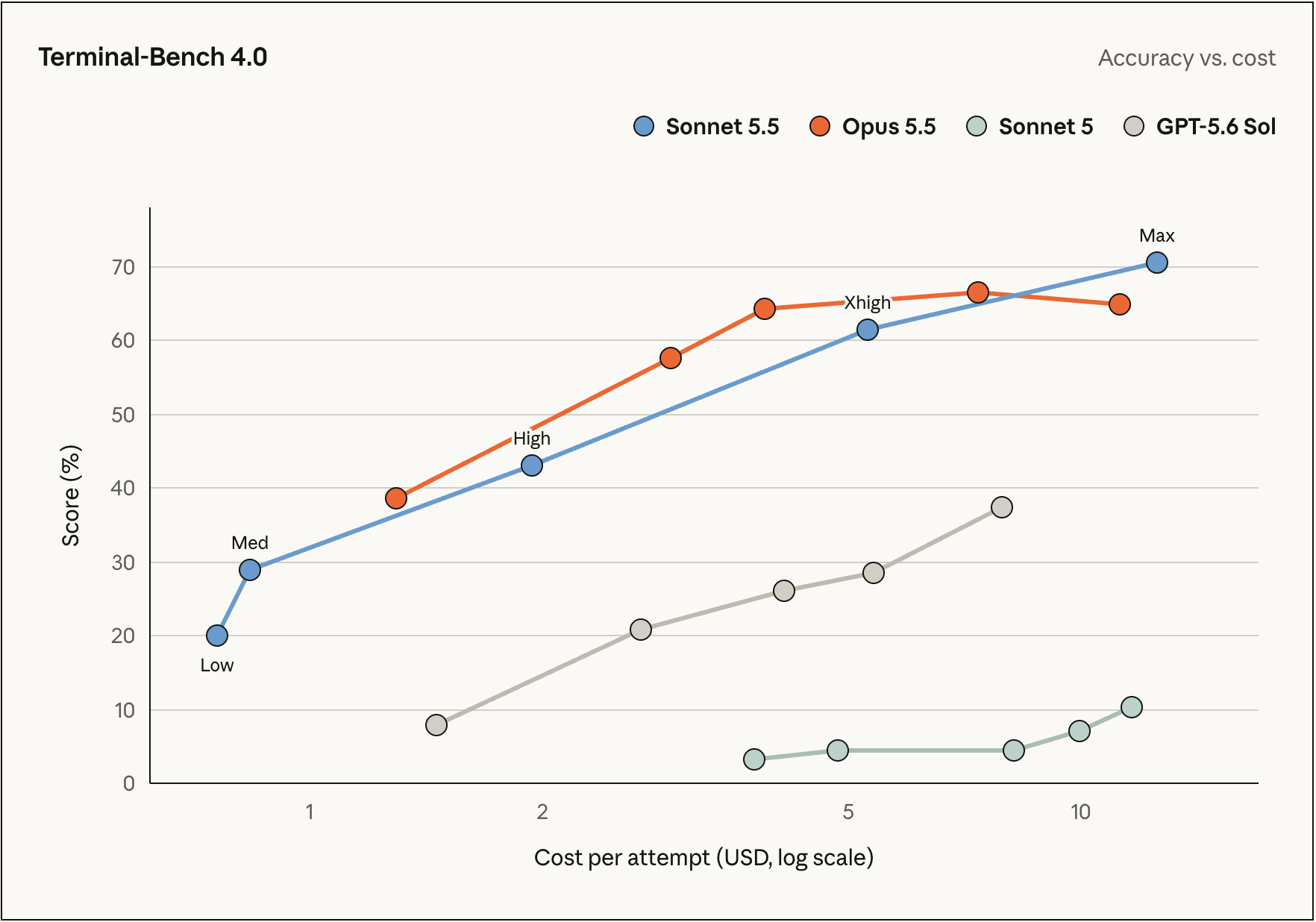
In addition to performance and cost improvements, Anthropic also highlighted Sonnet 5.5's network security capabilities.
The company said that the new model already has similar network security-related capabilities as Opus 5. Therefore, Sonnet 5.5 becomes the first Sonnet model to be included in the advanced security management framework, and will apply network security protection measures that were previously only implemented for the Fable and Opus series.
This means that as model capabilities continue to increase, Anthropic is extending stricter security controls to more product lines to reduce potential risks.
At the same time, the company also revealed that Haiku, another model of the Claude family, will also receive an update.
Haiku is the smallest and lowest-cost model in the Anthropic system, mainly targeting high-throughput and lightweight application scenarios. The new version of Haiku is currently under development and is expected to be released in the next few weeks, but Anthropic has not announced a specific timetable.
The launch of Sonnet 5.5 coincides with the global competition for large models entering a new stage.
Just in recent weeks, OpenAI has successively launched a new generation of model systems, including the Sol and Luna series targeting the mid-range and economical markets. Meta also released a new model and plans to apply it to the next generation of smart glasses functions. At the same time, Google, xAI and other AI manufacturers are also continuing to update their product lines.
Analysts believe that the current artificial intelligence industry is gradually shifting from simply comparing model capabilities to a new stage of competition that places equal emphasis on performance, cost and efficiency. For enterprise customers, a model that is faster, cheaper, and has sufficient capabilities is often more valuable than a model that is simply the most capable.
In this context, Anthropic obviously hopes to occupy this market position through Sonnet 5.5. Rather than pursuing a flagship model with the highest capabilities, the company hopes to create an artificial intelligence assistant that can take on a large number of daily tasks and attract enterprise users with lower deployment costs.
With the official launch of Sonnet 5.5, the Claude product family has formed a complete layout covering high-end, mid-range and lightweight applications. A new round of competition around speed, cost and agent capabilities is also pushing the entire AI industry into a development stage that pays more attention to actual production efficiency.
Comments