
Abstract:
Did you know that even compared with epidemics, climate, war, and nuclear threats, the thing most likely to destroy mankind before 2100 is AI? This astonishing conclusion comes from the authoritative report of The Lancet. The Lancet wrote in the "Global Health Threats in the 21st Century" committee report released on October 11 that among 17 threats, including climate change, epidemics, and pollution, nuclear conflict and the malicious use of artificial intelligence ranked first, and may lead to human extinction before 2100.
This report was written by 35 top experts, and the entire study covered 204 countries and regions around the world. The report also reminded that these threats may interact and amplify each other.
The most chilling part of the report is that even though AI and nuclear conflict are both the top problems in destroying mankind, the damage caused by AI far exceeds that of nuclear conflict.
If Amoudi said this about the end of AI, I might just listen to it for fun. After all, there are already so many similar words that my ears are almost getting calloused.
But this time it was said by The Lancet, and I was really scared.
What does The Lancet say?
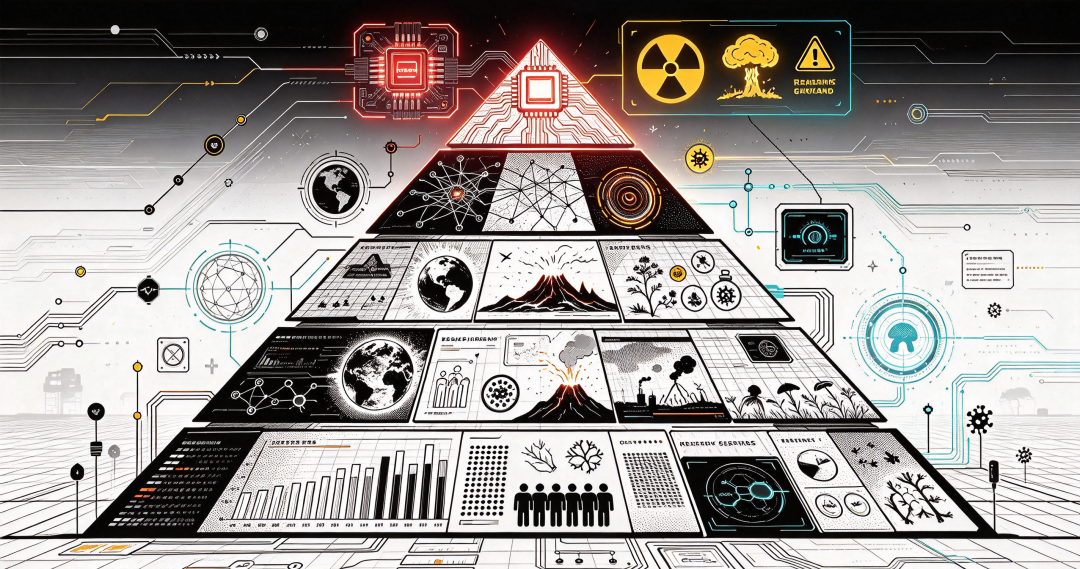
The Lancet report was led by the Institute for Health Metrics and Evaluation (IHME) at the University of Washington. They arranged the threats that may affect human health in the next 75 years into a "threat pyramid" in order of severity, with a separate category at the top:
Threats that could lead to human extinction before 2100.
There are only two things in this category, one is "nuclear famine" caused by nuclear conflict, and the other is the malicious use of artificial intelligence.
Even asteroids hitting the Earth and super volcanic eruptions have not reached the top of the pyramid because the committee believes that the probability of their occurrence in the next 75 years is "extremely low."
But this does not mean that "AI will definitely exterminate mankind."
The original text of the report states that the "possibility of occurrence of these two types of risks is still very low," but once they occur, the consequences will be on the entire human level.
There is a unit in the report called DALYs, which stands for "Disability Adjusted Life Years." Simply put, it is the total number of years of healthy life lost by a person due to illness, disability, or early death.
The committee used it to measure how much "loss of healthy life" each threat would ultimately cause by 2100.
Malicious use of AI may cause losses of approximately 10.4 billion DALYs by 2100, which is roughly on the same scale as obesity. A nuclear conflict would cause approximately 133 million deaths and a loss of approximately 9.35 billion DALYs.
The Lancet believes that AI is more dangerous than nuclear weapons. The committee went out of its way to emphasize that this was designed to measure "actionable levers" rather than play up the most tragic outcome.
So, how does AI "exterminate" us? Is it Skynet from "Terminator"? Or MOSS from "The Wandering Earth"?
Neither. The Lancet believes that there is only one path for AI to destroy humanity, namely biological weapons.
Some people use AI maliciously to design or modify pathogens or toxins that can cause mass casualties.
The Lancet's argument is that AI is lowering the threshold for doing dangerous things.
In the past, modifying a virus required top-notch laboratories, expensive equipment, as well as the "feel" and tacit knowledge accumulated by researchers over the years. What the big model can do is to help people search literature, design experimental plans, write application materials, and explain why each step is done.
On September 10, 2026, Anthropic released a threat intelligence report, which disclosed several types of abuse they intercepted between December 2025 and August 2026. Among them, there were 5 cases where users used Claude in a way that "may support the development of biological weapons":
• In May this year, someone asked Claude to help write a grant application to study which mutations in the chikungunya virus could make it spread more efficiently and escape the immune system more easily.
• Some people use it to plan experiments to make highly pathogenic avian influenza viruses more adaptable to mammalian hosts.
• A proposal was drafted to study how to alter the virulence of the orthopoxvirus family, to which smallpox and monkeypox belong.
• Someone was working on a drug development project to compile a map of venom toxins.
• Another researcher used Claude to help with computer redesign of a set of toxins, including a bacterial toxin and a protein from a major disease-threatening virus, and deliberately used vague terms to refer to these toxins when writing progress reports.
Therefore, the misuse of AI will definitely cause considerable harm to the entire human race.
AI doomsday theory has been divided into two camps
In fact, before the Lancet report came out, AI doomsday theories appeared every month. For example, in September, all walks of life were debating whether AI would bring doomsday.
On September 8, former Anthropic researcher Jacob Coxon announced his resignation and publicly stated that both OpenAI and Anthropic were "betting on human lives" and that AI "could kill us all before the end of this decade." The post received over 100 million views in a short period of time.
The next day, Evan Hubinger, head of alignment science at Anthropic, wrote: "We do seriously believe that AI may kill everyone, and I personally think the probability is more than 10% within the next ten years."
AI godfather Hinton later said that the 10% figure was “not outrageous.”
Three days later, Amoudi offered a more specific statement. He believes that within 6 to 12 months, a group of agents may take over the entire Internet, causing hundreds of billions of dollars in losses.
Ultraman and Musk, two sworn enemies, stand on the same front and support "slowing down the pace of AI development."
Although the positive side's firepower is fierce, the negative side's strength is not weak either.
Huang Renxun mentioned in the interview that the probability of AI destroying the world before 2030 is 0%. He believes that the "10% probability of AI killing everyone" mentioned by Evan has no scientific basis and is an "irresponsible" intuition.
"AI that cannot be safely controlled should not be released." Huang Renxun said.
Heidy Khlaaf, chief scientist of the AI Now Institute, believes that whether it is 10% or 20%, "it is neither falsifiable nor verifiable, so it is inherently unscientific."
Cognitive scientist Gary Marcus said that the idea of "Agents taking over the Internet" is "ridiculous."
His reason is that most of the underlying infrastructure of the Internet is in the hands of large companies such as Cloudflare, Google and Amazon AWS. Without the intervention of government forces, it is difficult to imagine that they will be breached or controlled for a long time.
He also cited an assessment report from the British AI Security Research Institute that Anthropic's most powerful Mythos model could only break into "small, weakly protected" systems independently. As long as the other party improves its network security protection, Mythos will be helpless.
Looking together, you will find a very interesting aspect of this debate:
The affirmative side talks about "consequences", while the negative side talks about "evidence".
On the one hand, you emphasize that as long as the probability is not zero, the consequences are unbearable; on the other hand, you emphasize that you can't even explain how you calculated this probability, so why should you make the whole world nervous?
In addition, although Amodei and Altman advocated slowing down the pace, the media accused them of building a moat for themselves in the name of security to prevent subsequent competitors from entering.
Academic circles are more supportive of Zheng Fang.
For example, the paper "How can AI wipe out humans?" It is mentioned in "Failure Mode Analysis of Civilization Risks" (arXiv:2610.08878) that
catastrophic AI risks do not require the AI to be conscious, hostile, or have a clear intention to harm.
Risk can arise through several intertwined paths: autonomous inaccuracy, malicious use by humans, organizational failure, and competitive deployment. The author also specifically stated that the paper is "non-operational" and only analyzes the causes and does not provide methods for doing evil.
But so far, no one has really "won" this debate.
Comments