
Abstract:
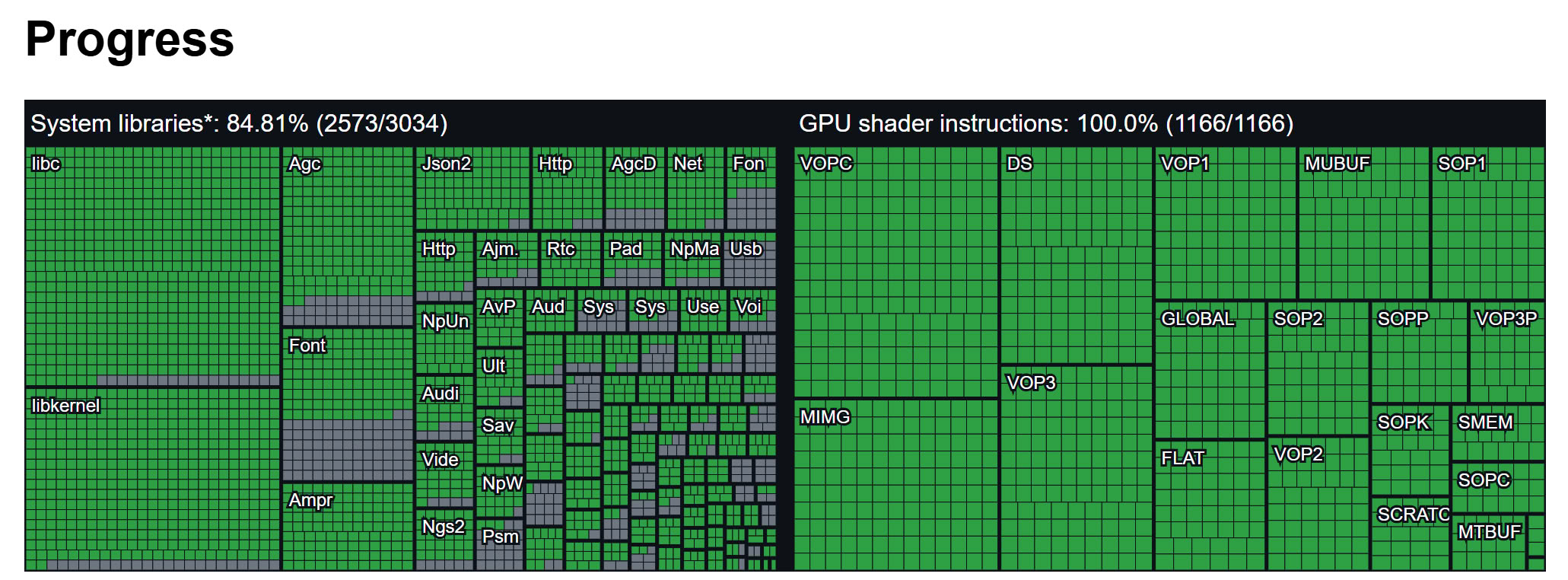
AnyPS5, an open source project designed to allow PlayStation 5 games to run directly on Windows and Linux computers, has made important progress recently. Project developers have implemented recognition and conversion support for all 1,166 currently tracked PS5 GPU shader instructions, with a coverage rate of 100%. This means that the technical obstacle for PS5 games to run on ordinary PCs has been reduced by one, but there are still many challenges before large-scale compatibility with commercial games.
The technical route of AnyPS5 is different from that of traditional game emulators. Traditional emulators usually need to simulate the hardware environment of a game console so that programs originally designed for the console can run on another hardware platform. The goal of AnyPS5 is to relink the executable files of PS5 games into programs suitable for Windows or Linux, and provide corresponding system library implementations so that the games can directly utilize the PC's processor and graphics hardware as much as possible.
PS5 uses AMD's customized processor, and the CPU is based on x86-64 architecture. This has high compatibility with the processor instruction set commonly used in modern Windows and Linux computers, providing convenience for the technical route of AnyPS5. Compared with solutions that require simulating the entire host hardware, this approach is expected to reduce some additional overhead.
However, the same CPU instruction set does not mean that PS5 games can be run directly on PC. The game also needs to call PlayStation-specific system libraries, graphics interfaces and other platform functions. AnyPS5 must provide compatible implementations for these dependencies, while handling issues such as system calls, resource management, and graphics rendering involved in game execution.
GPU shader instruction conversion is one of the key tasks. Shaders in games are responsible for handling a large number of graphics calculation tasks, including vertex processing, pixel shading, texture sampling, and other operations related to screen generation. PS5 uses AMD's custom GPU, and its instruction system is closely related to AMD's RDNA series architecture. However, the graphics program used by the game still needs to be appropriately converted before it can run in the target graphics environment of AnyPS5.
AnyPS5 uses the shader recompiler to convert relevant GPU programs into SPIR-V format in order to access its graphics processing flow. SPIR-V is an intermediate representation that is widely used in the compilation and transmission of graphics and computing programs. It can provide a certain compatibility basis for graphics processing on different hardware platforms.
The core of the progress of this project is that the developers have completed the recognition and support of all 1166 GPU shader instructions in the current tracking list. These instructions cover several categories, including data sharing, memory access, scalar operations, and vector operations. Completing the entire list means that the project no longer has unimplemented entries for recognizing and processing these known instructions.
But there is a very important difference here: 100% instruction coverage does not mean that all instructions have been completely and accurately executed in every game.
The way the project is counted, as long as the shader decoder can recognize the corresponding instruction, it can be counted as implemented. Therefore, this milestone mainly indicates that the project has the ability to recognize all traced instructions, but does not mean that all complex shader combinations, graphics effects and game scenes have been tested.
Actual games may use a variety of instruction combinations and rely on specific execution sequences, memory behavior, and graphics processing results. Even if the decoder can recognize every instruction, if the converted program produces different results when run, problems such as graphics errors, game crashes, or abnormal performance may still occur.
At the same time, AnyPS5 still has a lot of work to do in terms of system libraries. The implementation rate of system library functions currently tracked by the project is approximately 84.76%, corresponding to 2575 implemented functions and 3038 tracked functions.
This indicator also needs to be understood with caution. The 3038 functions do not represent all functions in the PS5 system, but the parts of the project that are currently included in the tracking scope. As developers discover and add new system functions, the statistical total may still increase, and therefore the implementation rate will change accordingly.
The reason why system libraries are important is that PS5 games not only rely on the GPU to complete screen rendering, but also require the operating system to provide file access, memory management, thread synchronization, input processing, and other basic services. If the game calls a function that has not yet been implemented or has incompatible behavior, the game may not start or run properly even if the GPU shader has been able to convert.
This also explains why reaching 100% coverage of GPU instructions does not mean that 100% of PS5 games can be run on PC. Shaders are just one of many components that a game depends on to run; system libraries, graphics behavior, synchronization mechanisms, and other features also affect compatibility.
Currently, AnyPS5 has demonstrated some actual operating results. For example, project information shows that the 2D platform game "Dreaming Sarah" can run at a stable 60 frames on a computer equipped with an NVIDIA GeForce GTX 1050 Ti graphics card and an Intel Core i5-7500 processor.
This case shows that the technical route of AnyPS5 is no longer in the theoretical stage, and at least some games can be run in the PC environment through relevant tools. However, "Dreaming Sarah" is a relatively simple 2D platform game, and it cannot be inferred that complex 3D masterpieces can also achieve the same compatibility and performance.
For PS5 games with complex graphics effects and a large number of system dependencies, such as "Gran Turismo 7", it is currently not possible to judge when they will run normally based on instruction coverage alone. Large-scale games usually involve more complex rendering processes, resource scheduling, and platform functions, which may require developers to solve problems on a case-by-case basis for specific games.
Compared with traditional emulators, the relinking and system library alternatives adopted by AnyPS5 are somewhat attractive. If we can make full use of the PC's own CPU and GPU capabilities while avoiding some of the overhead of simulating the entire host hardware, we may be able to provide a more efficient way to run some games in the future.
But this technical route also has its own limitations. Emulators usually try to establish a relatively universal host operating environment, while AnyPS5 needs to continuously supplement and improve the system library implementation and ensure that the converted program is compatible with the target platform. Different games have different reliance on system features, so even as the overall project progress continues to improve, actual compatibility may still show significant differences between games.
In addition, Windows and Linux are not exactly the same operating environments. AnyPS5 needs to generate corresponding executable files for different operating systems and handle their respective system interfaces and operating requirements. Just because a game works on one platform doesn't necessarily mean it will work on another.
Judging from the development progress, the GPU shader instruction coverage rate has reached 100%, which is an important phased achievement of the AnyPS5 project. It eliminates a glaring technology gap in the current tracklist, allowing developers to focus more on system library compatibility, graphics execution accuracy, and specific game execution issues.
However, the project still needs a longer period of development, testing and optimization before ordinary players can easily run a large number of PS5 games on PC. In addition to successfully launching the game, you must also ensure that the graphics are correct, the input is normal, the operation is stable, and that reasonable performance can be maintained during actual gameplay.
Therefore, what deserves most attention at this stage is not the 100% number itself, but whether AnyPS5 can gradually expand the list of verified games and allow more complex games to move from experimental operation to stable playability. As GPU instruction conversion and system library implementation continue to improve, the prospect of PS5 games running on PC is indeed more worth looking forward to. However, this progress cannot yet be understood as that the PS5 game library has achieved PC compatibility on a large scale.
Comments