
Abstract:
The National Aeronautics and Space Administration (NASA) and the European Space Agency (ESA) recently released a new photo taken by the Hubble Space Telescope, showing a seemingly calm spiral galaxy NGC 4698 that hides strange structures. Astronomers discovered that this galaxy about 55 million light-years away from the Earth has an extremely rare internal structure. The rotation direction of its central region is almost perpendicular to the entire galaxy disk.
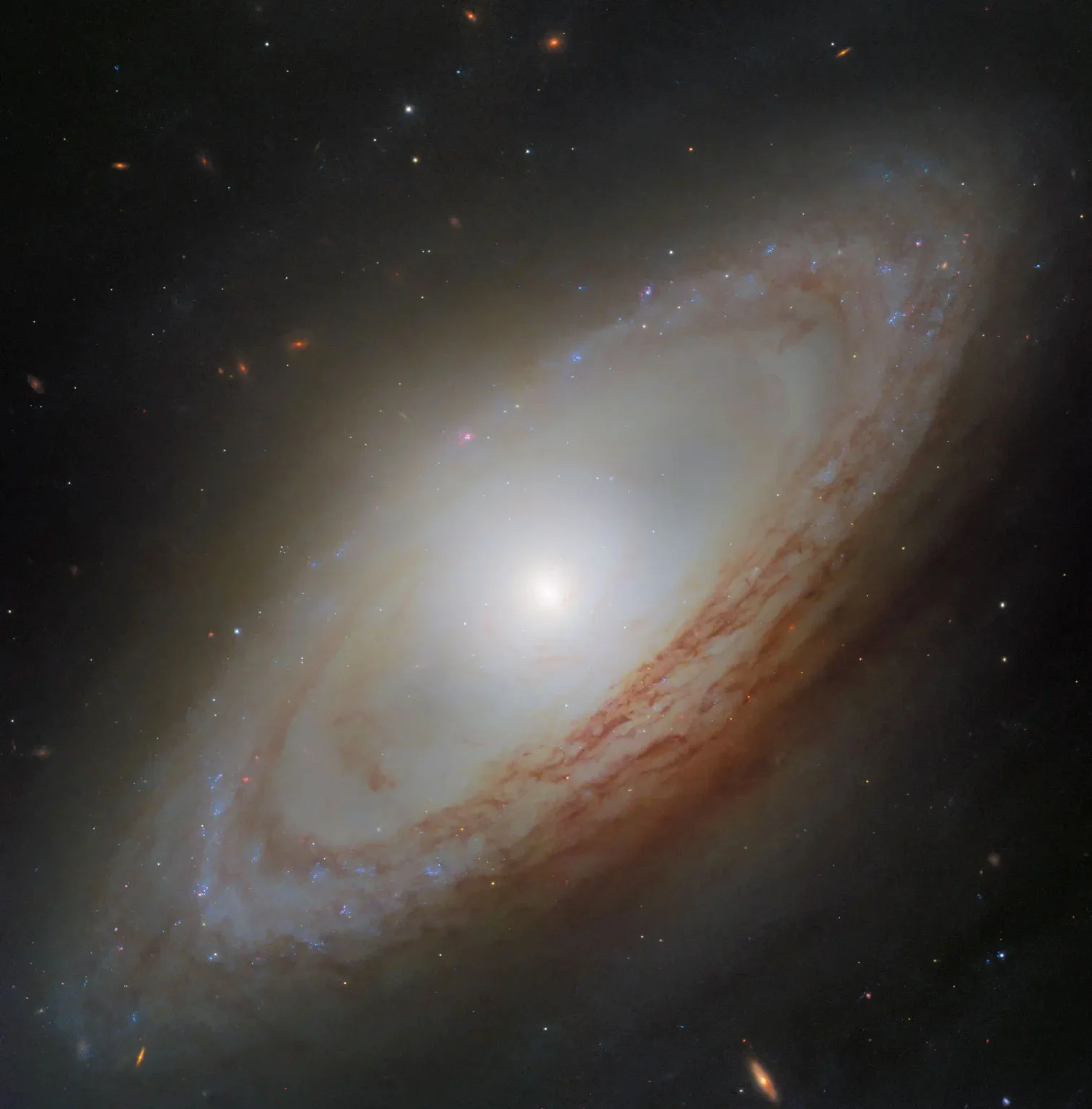
NGC 4698 is located in the direction of the constellation Virgo and belongs to the Virgo galaxy cluster. The cluster contains more than a thousand galaxies bound together by gravitation and is one of the closest large galaxy clusters to the Milky Way. From the overall appearance, NGC 4698 is quite similar to the Milky Way, with a flat disk composed of stars, gas and dust, and a spiral arm structure distributed along the disk.
Hubble's images show dark dust clouds and masses of young, hot, blue stars dotting these spiral arms. However, unlike most spiral galaxies, the spiral arms of NGC 4698 do not extend all the way to the central area, but are mainly concentrated on the periphery of the galaxy, forming a ring-like structure, as if they deliberately avoided the central area.
At the center of the galaxy is an elongated bulge composed of a large number of older, cooler stars that give it a soft, opalescent glow. These stars orbit a supermassive black hole that is millions of times the mass of the Sun. Observation results show that this black hole is still continuing to accretion surrounding gas and growing.
What really surprises scientists is that the central bulge is not oriented in the same direction as the main disk of the galaxy. The study found that NGC 4698 is one of the very few spiral galaxies known to have a central bulge that penetrates the disk at almost a right angle. In the Hubble image, one can even vaguely see the nuclear bulge extending outward from the upper and lower sides of the dust-filled disk.
Further observations show that the stars and gas located near the center of the galaxy are not only abnormal in position, but also move in a very special way. These celestial bodies do not move along the rotation direction of the entire galaxy disk, but rotate in a nearly perpendicular orbit to the main disk, forming a structure that is like "turning sideways", causing obvious desynchronization within the entire galaxy.
Astronomers believe that this abnormal structure was probably not born in the early stages of galaxy formation, but was caused by external factors during the subsequent evolution. One of the mainstream explanations is that NGC 4698 once accreted a large amount of gas from the outside. These newly acquired gases reassembled in the center of the galaxy and formed new stars and gas disks, but their directions were not consistent with the original disks, ultimately creating this special structure today.
In addition, the observation also discovered another important clue. The presence of a short hydrogen gas trail on one side of the galaxy is often seen as a sign that the galaxy has undergone a merger or gravitational interaction. Therefore, the researchers speculate that NGC 4698 may have engulfed a smaller neighboring galaxy or had a minor collision with other galaxies in the past, and this complex history ultimately changed the structure and movement of its central region.
The image data comes from an observation program dedicated to studying members of the Virgo galaxy cluster. The research team hopes to better understand the formation and evolution of galaxies by observing these galaxies relatively close to the Earth at close range and conducting in-depth analysis of the distribution of star clusters, nebulae and different star groups.
Scientists said that NGC 4698 shows that the structure of galaxies in the universe is far more complex than traditionally understood. Although it looks like an ordinary spiral galaxy from a distance, the almost vertical rotating structure of its center and periphery reveals an evolutionary history full of collisions, accretion and reshaping, and also provides valuable clues for studying how galaxies continue to change their shapes over billions of years.
Comments