
Abstract:
Hidden in the center of the Milky Way is a supermassive black hole with a mass of about 4 million times the sun - Sagittarius A*. Although it is about 26,000 light-years away from the Earth and its current overall activity is relatively quiet, it may have a surprising way of releasing energy: by sacrificing its own rotational energy, it accelerates surrounding particles to extremely high energies and provides power for some cosmic rays in the Milky Way.
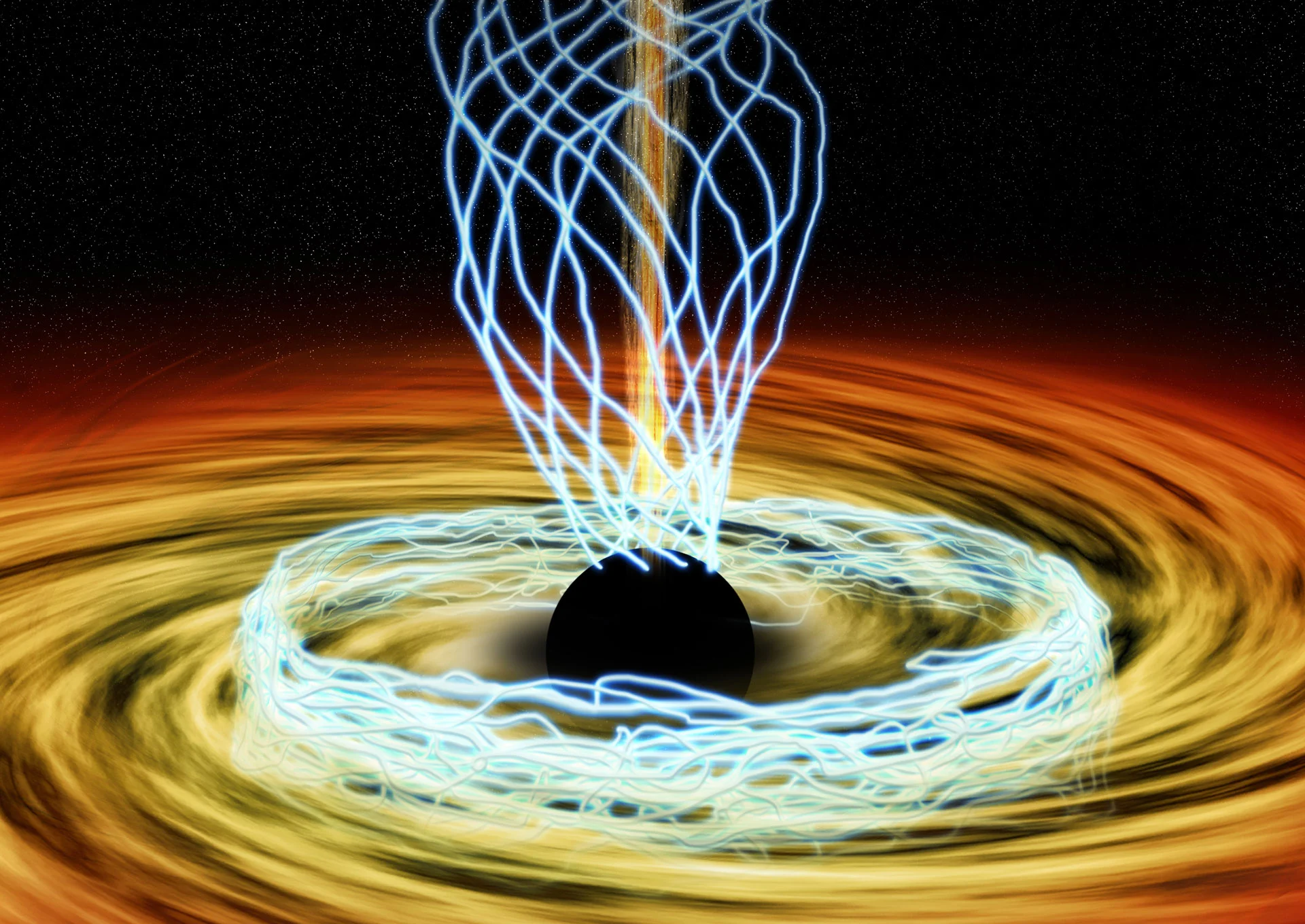
On October 17, 2026, SciTechDaily reported a latest theoretical study on this mechanism. Researchers propose that Sagittarius A* may transfer the black hole's rotational energy to protons through a mechanism called the "Magnetic Penrose Process," allowing these particles to reach energy levels of several petaelectronvolts (PeV). The research results further support the hypothesis that Sagittarius A* may be a natural ultra-high-energy particle accelerator in the Milky Way.
The study was released as a preprint on September 2, 2026, titled "Sagittarius A* as a Galactic Electron Voltaic Particle Accelerator: Multi-messenger Characteristics of the Magnetic Penrose Process." Through theoretical modeling, the research team analyzed how particles near the black hole acquire extremely high energy, and what signals this process may leave behind that can be identified by astronomical observations. At present, this is still a theoretical explanation that needs to be tested by observation, and it does not mean that scientists have confirmed that the black hole at the center of the Milky Way is accelerating cosmic rays in this way.
Cosmic rays are high-energy particles that travel through space at extremely high speeds, including protons, atomic nuclei, and a small number of electrons. Their energy range is extremely wide, and some cosmic rays carry energies far beyond what humans can achieve with existing particle accelerators. Scientists have long tried to figure out where these particles come from and what mechanism nature uses to accelerate them to such astonishing energies.
On Earth, humans use large particle accelerators to gradually increase the energy of charged particles through electric fields. But in the universe, supernova remnants, pulsar winds, and extreme environments around black holes may all become natural particle accelerators. The center of the Milky Way is of particular concern because it contains supermassive black holes, large amounts of gas, strong magnetic fields, and a complex high-energy radiation environment.
Researchers estimate that protons near Sagittarius A* may be accelerated to energies of several peta electron volts. One peta electron volt is equivalent to 1,000 trillion electron volts, or 10¹⁵ electron volts. This energy level far exceeds the energy of a single proton reached by proton collisions in the Large Hadron Collider. Therefore, if the relevant mechanism indeed exists, Sagittarius A* may become one of the important sources of high-energy particles in the Milky Way.
This type of celestial body that can accelerate protons to the energy level of electron volts is called "PeVatron", which is a particle accelerator of electron volt level. Astronomers have observed high-energy gamma rays at the center of the Milky Way, but whether these radiations come from particle acceleration near the black hole or from the interaction of other celestial bodies with larger-scale cosmic rays is still controversial.
Normally, the bright radiation around a black hole comes mainly from material that fell into the black hole before it fell. The gas gathers, compresses, and heats under the gravitational pull of the black hole, forming a high-temperature accretion flow or accretion disk, and the material releases a large amount of energy before finally crossing the event horizon.
But black holes themselves don’t just swallow energy. For rotating black holes, the energy carried by their rotation can also be extracted under certain conditions. It is this mechanism that directly uses the rotational energy of black holes that researchers are focusing on this time.
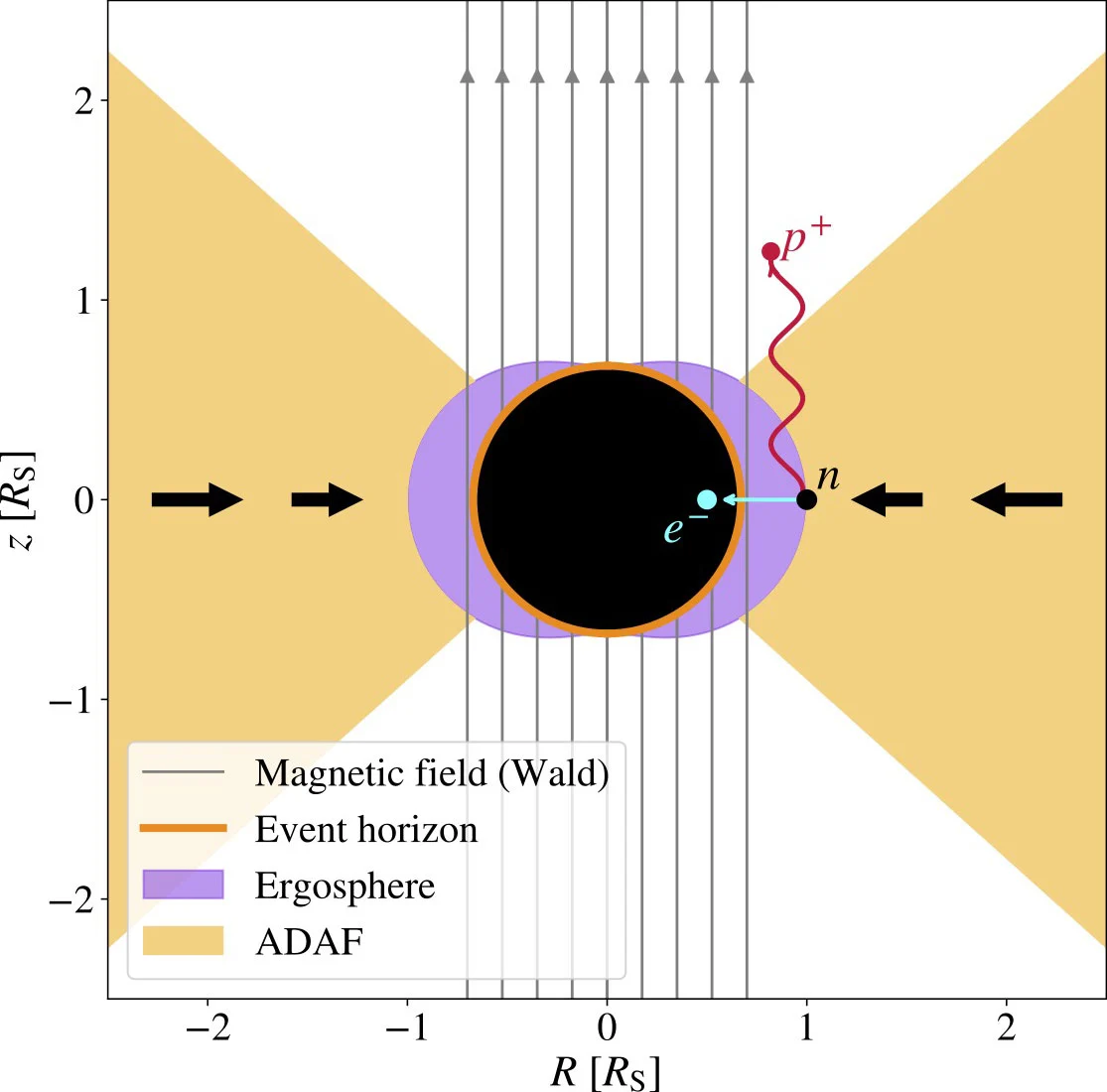
This theory can be traced back to the Penrose process proposed by physicist Roger Penrose in 1969. According to general relativity, there is a region called the "ergosphere" around a rotating black hole. Here, the black hole's rotation drags the surrounding space-time so strongly that objects cannot remain stationary relative to a distant observer, but must move in the direction of the black hole's rotation.
Under certain conditions, if particles enter the energy layer and undergo appropriate splitting processes, some of them can fall into the black hole carrying negative energy defined relative to infinity, while the other part can escape with more energy than the original particles. The extra energy gained by the escaping particles comes from the rotational energy of the black hole itself.
Think of it as extracting mechanical energy from a rapidly rotating machine: the escaping particles gain additional energy, while the black hole's rotational energy is reduced accordingly. The "consuming its own energy" mentioned here does not mean that the black hole burns like fuel, but that its rotational energy is transferred to external particles.
The researchers further considered the role of magnetic fields in this process. The magnetic Penrose process uses the magnetic field around the black hole to change the movement and energy distribution of charged particles, so that the rotational energy of the black hole can be more effectively transferred to charged particles such as protons.
In the model proposed in this study, the key link begins with nuclear reactions in the hot gas surrounding the black hole. Some nuclear reactions can produce neutrons. After these neutrons enter the energy layer of a black hole, they may undergo radioactive decay, producing protons, electrons and antineutrinos.
Neutrons themselves are uncharged and therefore are not directly affected by the Lorentz force of a magnetic field like protons. But the protons produced after the neutron decays have an electric charge and can interact with the surrounding magnetic field. Researchers believe that under the right conditions, these protons could gain energy from the black hole's rotation and subsequently escape into wider interstellar space.
This mechanism does not require the black hole to be extremely active. Sagittarius A*'s current accretion activity is relatively weak, but it still has a huge mass and potentially considerable rotational energy. As long as the surrounding environment has the right magnetic field, particle generation conditions and geometry, the energy extraction process is possible.
However, whether the model can be applied to the real center of the Milky Way still depends on a number of parameters that have not yet been fully determined, including the strength of the magnetic field around the black hole, the particle production rate, the black hole rotation state, and the various losses suffered by high-energy particles during their escape.
If high-energy protons do escape from the vicinity of a black hole, they may collide with the dense gas at the center of the Milky Way as they propagate outward, producing high-energy gamma rays and neutrinos. These secondary particles provide scientists with an important way to test theories.
Gamma rays are extremely high-energy electromagnetic radiation that is uncharged, so when passing through interstellar space, they are not drastically redirected by magnetic fields like charged particles in cosmic rays. Their direction of propagation often helps astronomers trace the radiation back to its source. In contrast, protons in cosmic rays are affected by interstellar magnetic fields and their trajectories can be significantly curved, making it difficult to determine where they initially accelerated directly from the direction in which they arrive at Earth.
The research team calculated the gamma ray energy spectrum that could be produced by the magnetic Penrose process and compared the model results with existing observations. The researchers believe that the radiation produced by this mechanism may contribute to some of the signals in high-energy gamma-ray observations, including those detected by the High-Energy Stereoscopic Telescope System H.E.S.S. and the High-Altitude Water Cherenkov Gamma-ray Observatory HAWC.
If the energy spectrum features predicted by different theoretical models can be measured more accurately, researchers will have the opportunity to determine whether the black hole rotation energy extraction mechanism is actually at work in the center of the Milky Way.
Future observing equipment may be key to testing this theory. The research team pointed out that the planned Southern Hemisphere Wide-field Gamma-ray Observatory (SWGO) is expected to detect the relevant signals predicted by its model, and the Cherenkov Telescope Array Observatory (CTAO) may also test some theoretical scenarios.
SWGO plans to use a large-area detection array to continuously monitor high-energy gamma rays, which is especially suitable for observing important sky areas such as the center of the Milky Way. Wide-field instruments can monitor changes in high-energy radiation in the sky for longer periods of time than telescopes that can only be pointed at a specific target for a limited time, helping researchers study ongoing particle acceleration processes.
However, the discovery of high-energy gamma rays alone is not enough to prove the existence of the magnetic Penrose process. The environment at the center of the Milky Way is extremely complex, with not only supermassive black holes, but also a large number of stars, dense gas clouds, other potential sources of high-energy particle acceleration, and a wide range of diffuse radiation. Different mechanisms may produce similar observed signals.
So scientists need to combine gamma rays with other types of observations, especially neutrino signals. When high-energy protons collide with gas, in addition to producing gamma rays, they may also produce neutrinos. Neutrinos interact extremely weakly with matter and can escape from dense celestial environments, providing researchers with another clue about particle acceleration processes.
But currently, neutrino observations at the center of the Milky Way have not given results sufficient to determine the relevant mechanism. In September 2026, an analysis published by the IceCube Neutrino Observatory in collaboration with HAWC found no significant neutrino signal at the center of the Milky Way and set new limits on the intensity of the associated radiation. The researchers pointed out that in the future, more sensitive neutrino observation facilities such as IceCube-Gen2, KM3NeT and P-ONE may help scientists further determine whether the high-energy gamma rays in the center of the Milky Way mainly come from the interaction between protons and gas.
This background also shows that although the black hole energy extraction mechanism has a clear theoretical basis, richer and more precise data are still needed to connect it with actual observations. Researchers must rule out other possible sources of high-energy radiation and verify whether the spectral features predicted by theory actually exist.
The significance of this study is that it provides an explanation for the source of high-energy cosmic rays at the center of the Milky Way that can be further tested. Traditionally, scientists usually focus on how supernova explosions, shock waves and magnetic fields accelerate cosmic rays; while the magnetic Penrose process turns their attention to the rotational energy of the black hole itself, indicating that even if the black hole is in a relatively calm state, it may transmit energy to external particles through special physical mechanisms.
If future observations confirm that this process indeed occurs, Sagittarius A* will not only be a massive gravitational source at the center of the Milky Way, but may also be an important source of power that affects the high-energy particle environment of the Milky Way. This will also help scientists further understand how supermassive black holes affect the surrounding gas, radiation environment, and the evolution of the entire galaxy's central region through energy release.
At present, what researchers have proposed is still a theoretical model, not a black hole energy extraction process that has been directly confirmed. Future observation results from SWGO, CTAO and new generation neutrino observation equipment will help determine whether these predictions are consistent with the performance of the real universe. For humans, the black hole at the center of the Milky Way still hides many mysteries, and cosmic rays may hold important clues about how its energy works.
Comments